For some carbon footprints, the shoe doesn't always fit










China needs to be careful in apportioning responsibility for emissions
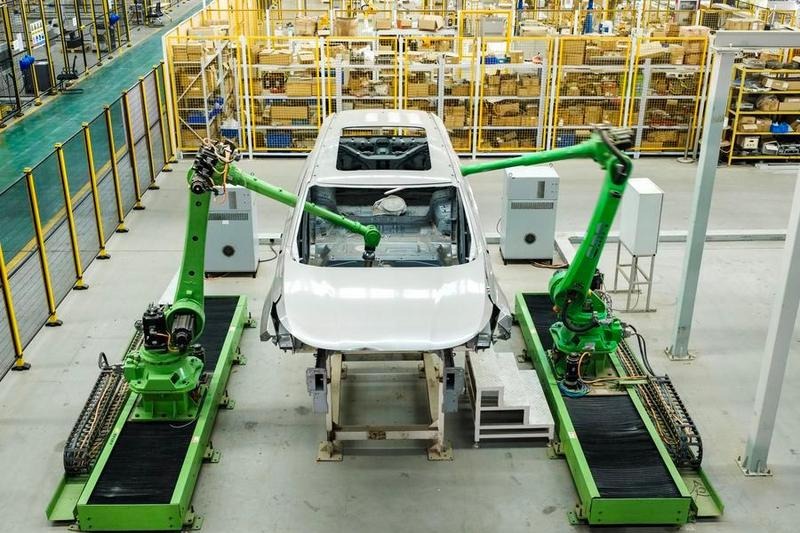
In the recent session of the National People's Congress, the head of a provincial environmental bureau told reporters that foreigners buy and use clean goods made in China but it is China that will have to put up with the pollution that comes with making those goods. Indeed, various studies show that goods that China exports contain huge quantities of carbon dioxide. They all come from the emissions that have helped make China the world's largest carbon emitter after the United States, and China is pulling further ahead in this race that no one wants to win.
This raises the question of who should be responsible for this pollution and who should bear the costs. It is a very sensitive and complex issue, but several years ago, at a news conference organized by the Information Office of the State Council, Ma Kai, the then chairman of the National Development and Reform Commission, China's top economic planning agency overseeing national economic planning and climate response issues, said China wanted importers to cover some, if not all, of the costs.
Under the accounting rules of the Intergovernmental Panel on Climate Change, all greenhouse gas emissions and their elimination are based on in-country production measurements. Commitments under the United Nations Framework Convention on Climate Change, the Kyoto Protocol, and its follow-up regimes are set and evaluated based on this territorial-based emissions accounting system.
China reckons that when a country's carbon dioxide emissions for production are higher than those for consumption, the country is in effect emitting carbon to meet the needs of other countries.
That is a perfectly reasonable argument, and putting it goes some way in providing a better understanding of China's emissions and their contributions, finding solutions to deal with the problem and allaying the concerns of developed countries.
However, if the argument is pushed to the limit, it will not lead to solutions but may in fact be detrimental to China's interests.
China's status as the workshop of the world came about largely because of a comparative advantage in the division of trade. Using fewer energy-efficient technologies to produce goods for domestic use and exports is also largely dictated by its current state of development.
It would be fair to say that rapidly rising carbon emissions and emissions embedded in exports are also the results of China's pro-trade policies. China has not only adopted common pro-trade policies, but has long used access to its unique giant customer base and its access to certain raw materials as a way of enticing foreign companies to open factories in China or relocate their production to the country.
If you concede China's argument that its emissions are in fact European and American ones generated by China's deliberate pro-trade policies, it can equally be argued that the jobs that generate those emissions must also be European and American. Given that job outsourcing in the current economic crisis is extremely sensitive in the US and the EU, such an argument does China few favors.
Combined with US concerns about the huge trade deficit and further deterioration of its trade balance with China, pushing the responsibility of the consumers in importing countries is definitely a tough sell to the US. Moreover, this is not just about China versus industrialized countries, but has a bearing on developing countries as well.
It could be argued that China ought to shoulder at least some of the blame. For example, it has been criticized for having a role in deforestation in Southeast Asia.
Existing studies on carbon emissions embodied in trade consider energy-related carbon emissions only, failing to take account of the role that land use changes and forests play in the emissions. If those factors are taken into account, what China is doing arguably reduces these countries' capacity to use forests as a sink to absorb global carbon and increases the carbon dioxide emissions contained in its imports.
Consumption-based accounting of carbon dioxide emissions further complicates the current debate on the legitimacy of carbon tariffs. The carbon tariffs that the US has proposed have drawn fierce criticism from China and India. However, if the consumption-based accounting of carbon emissions, either implicitly or explicitly, is to indicate that the responsibility for such emissions from the production of traded goods and services lies with the consumers in importing countries, it can then be argued that the final responsibility for regulating those emissions lies with the governments of importing countries.
This line of thinking ignores the dynamics of China's future development. Savvy Chinese leaders have recognized that China's capital-intensive, export-oriented growth over the past few decades is no longer sustainable. Accordingly, the current 12th five-year economic plan (2011-15) focuses on rebalancing an export-driven economy and on inclusive growth, aiming for less reliance on trade and for more on domestic consumption to drive growth. As would be expected, the share of China's carbon emissions embedded in exports is expected to fall over time.
Attributing emissions to consumers suggests that whoever consumes is responsible for pollution from consumed goods. If you put that user-pays principle in a broad context, it could be argued that it is rich people who are the highest emitters, so they are responsible for emissions in their countries.
A study published in the Proceedings of the National Academy of Sciences shows that if permitted national emission levels are based on the number of high emitters, the increasing number of high-living, carbon-guzzling rich Chinese would be unable to hide behind their poor and carbon-thrifty compatriots anymore and China would accordingly be asked to take on emissions caps even earlier, which would be more stringent, than it would wish.
However, assigning responsibility to China for the carbon emissions in its exports does not necessarily mean the issue can be dealt with at a domestic level alone. In fact, effectively controlling those emissions requires action internationally, too.
At the national level, China needs to focus on rebalancing its investment-driven, export-oriented economy, boosting the service sector and domestic consumption. It also needs to adjust its trade structure. The processing trade has played a significant role in promoting development and job creation, but that trade needs to be upgraded. This is essential not only if China is to press ahead with opening-up and maintaining its competitive edge, but also in improving the environment and reducing carbon dioxide emissions in the production of goods, whether they be for export or for domestic consumption.
Cutting carbon emissions in exports creates the impetus for upgrading the energy mix and improving energy efficiency. China has made great strides in this area and has committed itself to setting energy-conservation targets, the use of clean energy and carbon intensity. But it needs to be more ambitious, aiming to reduce emissions by 46-50 percent by 2020 and adopting absolute emissions caps around 2030 that will lead to the global convergence of per capita carbon emissions by 2050.
With rising domestic energy demand and increasing difficulty in further cutting energy and carbon use, putting a price on carbon is a crucial step if China is to successfully harness market forces to achieve that aim, and genuinely become a low-carbon economy.
At the moment, five provinces and eight cities in China are experimenting with low-carbon measures. In addition to that experiment, a carbon tax or a domestic carbon trading scheme would serve as a cost-effective measure to supplement costly administrative measures that the country relied on to meet its energy-saving goal in 2010.
Internationally, cutting China's carbon emissions in exports creates an impetus for strengthening coordination on climate change and establishing a global carbon price framework. It is the absence of a global carbon price that has failed to internalize carbon costs. China and the rest of the world need to work more closely together to internalize those costs, ensuring that the cost of emissions embodied in traded goods is reflected in the price to the consuming countries as well as those goods for domestic use. This is a feasible way of passing on carbon costs to consumers without consumption-based accounting of carbon emissions, which is more data-intensive and complex than production-based accounting of them.
To that end, China needs to increase its domestic carbon prices and support more stringent global greenhouse gas emissions reductions to bring about higher, more consistent carbon prices internationally.
The author is chairman and professor of School of Economics, Fudan University, Shanghai. The views do not necessarily reflect those of China Daily.
(China Daily 04/05/2013 page9)





Today's Top News
- UN envoy calls on Japan to retract Taiwan comments
- Innovation to give edge in frontier sectors
- Sanctions on Japan's former senior official announced
- Xi stresses importance of raising minors' moral standards
- Coordinated reform key to country's growth
- Shandong gives new life to traditions