On his majesty's service - and at his mercy









Missionaries in China from 16th century had royal reins placed on their work
"The moment they sought help from a Chinese emperor was the moment they placed themselves in the hands of these powerful - and often equally intelligent - men. But the manipulation, if that's what you want to call it, was mutual," says Zhang Xiping, whose book Following the Steps of Matteo Ricci to China offers tantalizing glimpses into a group of adventurer-missionaries who arrived between the 16th and 19th centuries. Most would never see the land of their birth again.
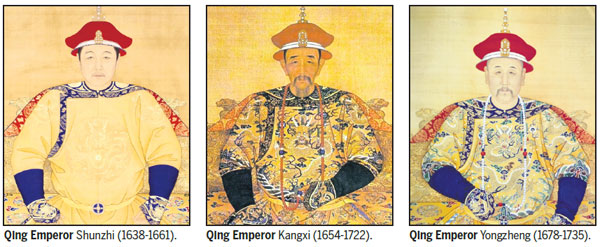
One example involves Emperor Shunzhi (1638-1661), the first emperor of the Qing Dynasty to enter Beijing, and Johann Adam Schall von Bell, a German Jesuit missionary who so impressed the young emperor that he regarded him as his mentor and confidant.
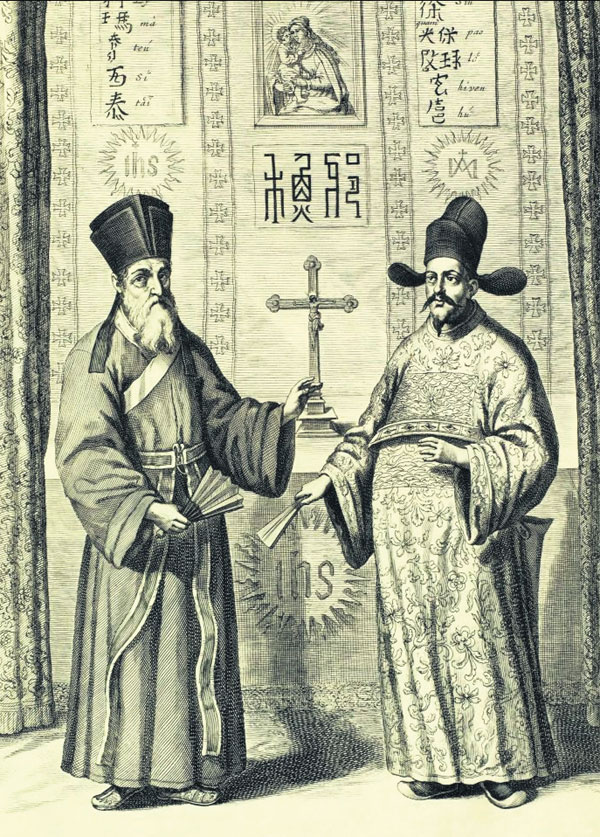
| Matteo Ricci and Xu Guangqi, a Ming Dynasty politician and scientist who Ricci befriended. Photos Provided to China Daily |
In 1652, the religious leader of Tibet, the Dalai Lama, planned to travel to Beijing and pay tribute to Shunzhi. As with the preparation of every major event of the time, a close reading of the stars was required. The task was traditionally reserved for the emperor's Astro-Calendric Bureau, an organization headed by Schall von Bell and later by his missionary successors, who also were astronomers.
Schall von Bell reported to Shunzhi that sunspots had appeared and that a "threatening meteor" was seen close to the Pole Star. The sunspots were interpreted as representing the Dalai Lama, who was about to obscure the radiance of "the sun" - the emperor himself. And the now "threatened" Pole Star, in the north, was a symbol of royal authority in feudal China.
Based on Schall von Bell's report, Shunzhi turned down a proposal for him to meet the religious leader in person on the outskirts of Beijing and then escort him to his royal palace, a proposal that Dorgon, the young man's powerful uncle and prince regent, had insisted on.
"The refusal (to meet the Dalai Lama on the outskirts of the capital) is very likely to have been seen as a snub, at least a signal that the emperor did not hold Tibetan Buddhism in particularly high esteem," Zhang says. "And this was exactly what Schall von Bell, a man dedicated to the promotion of Christianity, would have loved to see."
In fact, from the very beginning, the Jesuit missionaries tried to reach out to men at the top. Matteo Ricci (1552-1610), believed to be the first Jesuit missionary to enter Beijing, sought repeatedly but in vain an audience with the then Emperor Wanli of the Ming Dynasty (1368-1644).
There were many reasons for these failures, including a war the Ming emperor had with Toyotomi Hideyoshi of Japan between 1592 and 1598. However, Ricci did succeed on other fronts, befriending many members of the social elite who later paved the way for him and those who came after him.
Among them was Schall von Bell, who came to Beijing about 1623, 13 years after Ricci died. Soon establishing himself among a group of open-minded intellectuals, some of whom may have known Ricci, Schall von Bell was recommended to Emperor Chongzhen in 1630. It was under the last Ming emperor's auspices that he, with Chinese astronomers, completed the landmark Chongzhen Calendar.
"By the time Schall von Bell entered himself into the service of Chongzhen, the discrepancies between the existing calendar and the solar year had become so glaring for the topic to appear on the civil service exam," Zhang says. "All Chinese emperors believed that their right to rule was mandated by Heaven. It was likely that Chongzhen, facing the imminent demise of his empire, might have hoped for a reversal of things through a rereading of Heaven's messages."
That did not happen, of course: After 276 years, the Ming Dynasty ended tragically with the suicide of Chongzhen, who hanged himself from a tree in one of his royal gardens. Founders of Qing, China's last feudal dynasty, became the new rulers. Fear and turmoil reigned in the capital. However, for Schall von Bell, this initial chaos proved to be the beginning of a new era in which the missionary saw himself rise to a prominence previously unimaginable.
The Chongzhen Calendar, the product of his hard labor, was adopted by the Qing court. Moreover, he was able to cultivate a close relationship with Emperor Shunzhi, the ambitious and wide-eyed young master. For the next half-century, despite occasional twists and setbacks, Jesuit missionaries in China enjoyed a prolonged honeymoon, first with Shunzhi and then with his son and successor Emperor Kangxi.
Kangxi owed his very life to the French missionary Joachim Bouvet (1656-1730), who pulled the emperor from the abyss of death with a dose of quinine. Bouvet, together with his fellow Frenchman Jean Francois Gerbillon (1654-1707), also acted as the math teacher for Kangxi, who seemed to have inherited the curiosity of his short-lived father.
However, Kangxi, who became emperor when he was 8 and dealt a fatal blow to his political foes to secure his own role when he was 15, probably knew more about balancing power than any of his missionary teachers or aides.
He harnessed the powers of the missionaries with great skill. On one hand, the emperor employed their knowledge to the fullest, pushing them to work doubly hard.
He used cannons devised by the missionaries to wipe out powerful rebels (The Ming Emperor Chongzhen had also relied on the missionaries' cannons to halt the advance of Kangxi's ancestors.) and he engaged many of them in one of the biggest projects of his reign - mapping his vast empire.
For about a decade, between 1708 and 1718, groups of missionaries were sent from the capital to different parts of the country, where they carried out detailed surveys drawing on their astronomical and cartographical knowledge, before returning with maps crisscrossed with latitudinal and longitudinal lines. One French missionary is even said to have died of overwork on the southwestern Chinese border.
The emperor was ever conscious of ensuring that the Jesuit missionaries' presence did not drive a wedge between him and those who viewed Christianity as a menace to Confucianism, the dominant moral system of Qing China.
Li Xiumei, associate law professor at the Beijing Administration Institute, has spent the past decade looking into the lives of these Jesuit missionaries, many of whom were buried on what is now the campus of the institute.
"Missionary work during the early reign of Kangxi was in its heyday," she says. "There are estimated to have been 200,000 to 300,000 believers across the country. And the emperor approved the building of several churches within his own capital, but that does not mean he was behind the spreading of the Catholic faith."
In fact, by keeping the most talented and hardest-working missionaries within his own service, the emperor in effect kept them from going about their holy mission.
"For the missionaries, who would not have enjoyed such high-profile presence without the Chinese emperors' patronage, the royal favor was in fact a double-edged sword," Li says.
Later, in 1692, Emperor Kangxi, facing contentions rising from within the Catholic missionaries in China, issued the Edict of Tolerance Toward the Catholic Faith. It decreed that all missionaries wishing to stay and do missionary work in China must show respect to local culture and customs. The events leading to the issuance of the edict marked a turning point in the relationship between the missionaries and the Qing rulers.
When Emperor Yongzheng, the son of Kangxi and a devout Buddhist, succeeded his father in 1722, he further tightened the control over Western missionaries, banning their religious activities in almost every corner of his empire.
However, one place was exempt - the Forbidden City in Beijing, the royal palace and center of power for hundreds of years. There the missionaries continued to serve the emperor with their expertise in nonreligious matters.
"Sometimes they seemed more like decorations to the court than daring and passionate men who had traveled the globe guided by an urge to convert," Li says.
One of them was the Italian Giuseppe Castiglione (1688-1766), a missionary-turned-court painter whose half-century stay in China coincided with the reign of three Qing emperors. In one of his portrait busts, Emperor Yongzheng appears wearing voluminous brown curls - a wig style popular with the Western monarchs and aristocracy of his time.
Castiglione later became the de facto official portraitist for Emperor Qianlong, son and successor of Yongzheng. Qianlong also recruited the Polish missionary Florian Joseph Bahr and his Czech counterpart Johann Walter, among others, in forming his own chamber orchestra.
Combining the concept of perspective essential to Western paintings with a color palette and brush stokes that were unmistakably Chinese, Castiglione gave his own interpretation on canvas of Ricci's cultural adaptation and accommodation theories, which are believed to have accounted for the Jesuit missionaries' success in China.
"By providing a detailed pictorial account for the Qing Dynasty's longest-reigning emperor, Castiglione himself became part of the history he helped preserve," Li says.
"Qianlong appreciated Castiglione's service so much that he allotted a piece of land to him in the capital's suburb, something that was clearly against his law. But at the same time, the Italian, who also helped lay royal gardens and introduced the technique of enameling to China, never got a free day to preach before his death at the age of 78."
The death was deeply mourned by Emperor Qianlong, whose decree upon hearing the news was inscribed on the painter's tombstone steps away from those of Ricci and Schall von Bell.
In 1644, when the Qing soldiers stormed into Beijing, many missionaries fled, but not Schall von Bell. He chose to stay inside the little church that Ricci was allowed to build in Beijing about 1605. Beside him was the Chongzhen Calendar, which he planned to present to his new master in exchange for trust and support for continued missionary work.
"His willingness to take the risk is admirable," Li says. "But keeping in mind the favor and endorsement he had previously received from the Ming emperors and his official friends, it is clear his real faith lay with no one of this world, but with God alone."
(China Daily Africa Weekly 12/01/2017 page16)





Today's Top News
- China, Russia vow to defend WWII legacy
- Japan will pay a heavy economic price if it pursues Takaichi's militant agenda
- French President Emmanuel Macron arrives in Beijing
- Cold wave, strong winds grip many parts of country
- Russia's visa-free policy to promote tourism
- Yuan poised for stronger global role