Lasting legacy of men on mission









Li Xiumei loves snow. "It purifies and silences everything, especially in this part of the campus," says the associate law professor at the Beijing Administration Institute. "After one snowy night, I came here early in the morning to sink my footsteps into the spotless white spongecake - footsteps that took me to a group of men who have occupied my imagination and much of my time for the past decade."
To be precise, it is the repeated visits to the tombstones of these men that have kept Li in their thrall. The stones, standing quietly on a patch of land measuring about 200 square meters, are in tight formation. The intimacy is evocative because centuries ago, when those to whom the monuments are dedicated arrived in China after months, or even years, at sea, they were essentially alone, with almost no one to turn to but themselves and their God.
They were Jesuit missionaries who journeyed to China from countries including Portugal, Spain, Italy and France between the 16th and 19th centuries, and they had at least two things in common: undoubted talent - including personal and diplomatic skills - and an unwavering dedication to spreading the gospel message.
| Zhang Xiping, a professor at Beijing Foreign Studies University, who specializes in cultural exchanges between China and the West. |

| From top: Nantang, or the Southern Church built by Schall von Bell in 1680 is the first Catholic church in Beijing. Provided to China Daily; the gravestones for Western missionaries on the campus of the Beijing Administration Institute. Photos by Jiang Dong / China Daily |
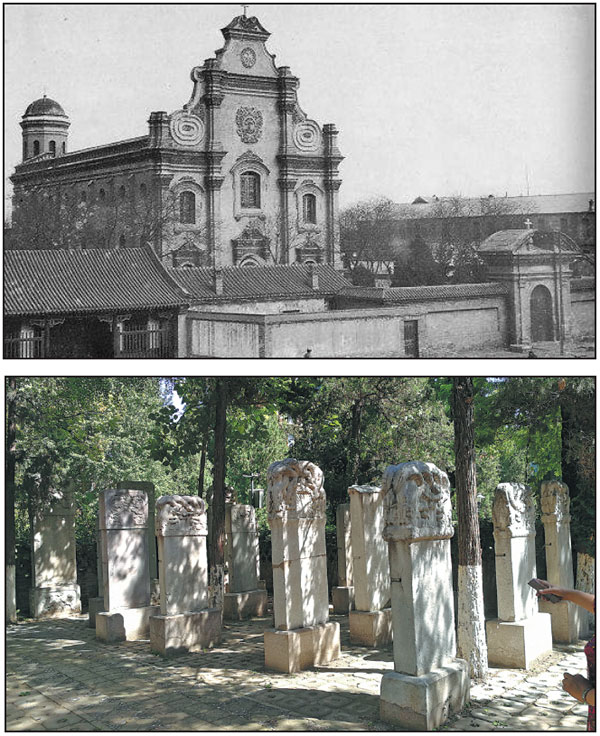
"The Society of Jesus, a religious order of the Catholic Church whose members are known as Jesuits, was founded by Ignatius of Loyola, a nobleman from northern Spain, in the mid-16th century," Li says. "Soon after, Francis Xavier, one of the society's core members, made the Jesuits' very first attempt to reach China."
Xavier never set foot on the mainland, dying only a year after arriving on the Chinese island of Shangchuan, off the country's southeastern coast. Missionary work would not resume until 30 years later and lasted until the mid-20th century.
"In that time, more than 1,000 Jesuits, not to mention other missionaries who had come under different banners within the Catholic Church, came to China," Li says. "But most of those buried here are either the forerunners of the Jesuit mission or its most active members."
Of all the 63 gravestones on the campus, three stand relatively apart, on a lot separated from the rest by a low wall. Their prominent position is indicated by symbolic earth mounds behind each monument.
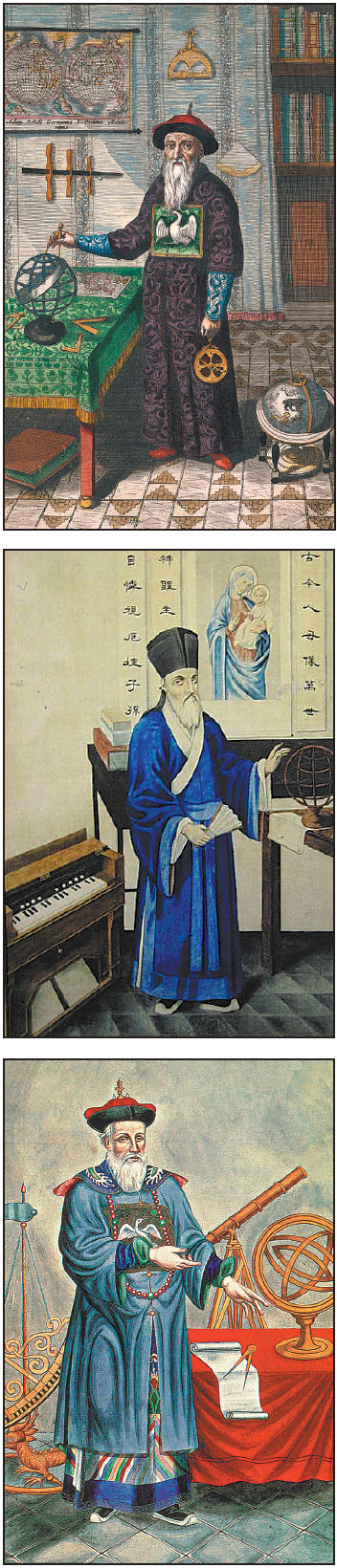
"The middle one belongs to Matteo Ricci, the Italian believed to have been the first Jesuit to enter Beijing," Li says. "To its left is that of Johann Adam Schall von Bell, a German whose eventful life mirrors the tumults of his time; and to its right is that of Ferdinand Verbiest, a Belgian who became a de facto mentor for Kangxi, one of Chinese history's greatest emperors and a contemporary of the 'Sun King' of France (Louis XIV, 1638-1715).
"Among them they shared not only legends, myths and anecdotes, but also triumphs and travails, and here, their final resting place."
Zhang Xiping, a professor at Beijing Foreign Studies University, has spent most of his academic life researching the cultural exchanges between China and the West and has published books on the Jesuit mission in the country's history.
"From the very beginning, they realized that in recruiting in the name of God they had to be very flexible, to 'become all things to all,' to use the words of Loyola himself," Zhang says.
Ricci, the Italian who, in the eyes of Emperor Kangxi, set an example for all missionaries who wished to stay in China, understood these words. Having learned Chinese in Macao, he went on to stay in Guangdong province, where Buddhism had a strong tradition, for more than a decade, before moving north to the cities of Nanchang and Nanjing, and ultimately to Beijing.
"Before reaching Nanchang, where he would acquaint himself with members of the local literati, Ricci slipped out of his monk's gown and into an official robe," Zhang says. "If nothing else, this provides a metaphor for his entire career in China, and for those who considered themselves his followers."
If a high level of adaptation is what the Western missionaries needed to disarm a people who Ricci believed deeply distrusted outsiders, then a demonstration that these men possessed the finest minds became necessary to break what the American historian Jonathan Spence has described as Chinese society's "serene indifference to foreigners".
"They needed to impress, and even to astonish," Zhang says. "Armed with knowledge gained from those 15th-century voyages that led to the discovery and colonization of the New World, and later from the invention of the telescope, they were ready to do exactly that."
| From top: Jesuit missionaries to China Schall von Bell (Germany), Matteo Ricci (Italy) and Ferdinand Verbiest (Belgium). Photos Provided to China Daily |
But before any serious business, there was often a display of intellectual curiosities, including trinkets to tickle the imagination.
On one occasion, Ricci is believed to have given to the decadent Ming Emperor Wanli (1563-1620) three things: a portrait of the Virgin Mary, a tin musical instrument and a chime clock. "Wanli was so infatuated with the clock that when his mother, the empress dowager, asked to have a look, the emperor, fearing that he might have to surrender his newly gained fetish, had the clock's inbuilt mechanics removed before presenting it to the old lady," Li says.
"Not surprisingly, the empress dowager was wholly unimpressed and returned the clock to her son. I've also read that Ricci had previously tried to present the emperor with other things, through one of his eunuchs, of course. However, as shrewd as Ricci was, he failed to take into account the eunuch's greed."
Getting nothing in return, the angry eunuch is said to have managed to have Ricci thrown into prison, if only briefly, before taking everything for himself.
"If this anecdote is true, then it seems that the Western missionaries had a lot more to adapt to than they had imagined," Li says.
These attempts at gaining attention were followed by significant and often prolonged efforts aimed at "bringing down the arrogance of the Chinese and bringing them into God's fold", Li says.
When Emperor Chongzhen (1611-1644), the last emperor of the Ming Dynasty (1368-1644), peered into the infinity of the universe through a telescope about 1641, with Schall von Bell at his side, the beleaguered man, whose vast empire was being eyed by powerful foes and who may have felt he needed heaven's help more than ever before, must have experienced moments of amazement and profound lamentation.
Seven decades later, when the French Jesuit missionaries, including Pierre Jartoux and Guillaume Bonjour-Favre, traveled all over what was then the Empire of Qing (1644-1911), working on the most comprehensive and accurate map ever produced of the Middle Kingdom, they may still have had their predecessors in mind.
"They were hard workers before they were 'shepherds', going about their job, be it making calendars or surveying land, with a passion and dedication just as impressive as the skills they harbored," Li says.
"And the way they worked - performing astronomical observations to verify and determine the latitudes and longitudes of various locations - ushered in a new era of cartography in China."
However, the iconoclastic nature of their work, especially in areas that directly challenged the conventional Chinese view of the cosmos, made them targets for attack, often by court officials who felt that their own hold on the emperor's imagination - and on power - was being undermined by these latecomers.
The suspicion and antagonism, once dipped in the gall of court politics, could be fatal. Late in his life, the Qing court sentenced Schall von Bell to death. This was after the death of Emperor Shunzi, father of Kangxi, who died at the young age of 23 and whose respect for Schall von Bell's counsel was such that he called the old man mafa, or grandpa.
The sentence was never carried out. An earthquake in Beijing sent an alarm to the powerful Empress Dowager Xiaozhuang, mother of Shunzi and grandmother of Kangxi, who intervened on Schall von Bell's behalf.
"The incident that ultimately led to Schall von Bell's death, soon after, in 1666, is believed to have had a lot to do with the intense power struggle triggered by the death of Emperor Shunzhi five years earlier," Li says. "A few years later, Schall von Bell saw a posthumous restoration of fame, partly thanks to his peer Ferdinand Verbiest, who came out triumphant in a showdown with the Chinese scholar and astrologist Yang Guangxian, and partly because of a change of the political climate at the court."
The contest, in which the two sides were required to predict the length of the sun's shadow at midday, went ahead at the order of Emperor Kangxi. Verbiest's win heralded a 200-year period during which Western missionaries, in effect, controlled what was known as the Qing Empire's Astro-Calendric Bureau.
It is worth noting that while the 74-year-old Schall von Bell was in prison, Verbiest was at his side. He still is today, since the tombstones of the pair are separated only by the one belonging to Ricci, in whose footsteps they all followed.
When I visited the tombstones, early on an autumn day, I was with Li. The plants were still lush and, viewed from a certain distance, the tiny walled graveyard resembled a little corner of Louis XIV's Versailles.
One type of tree at this spot is the little leaf box, a precious species believed to have been first planted here before appearing in other parts of Beijing. In about 2005, Li moved two ginkgo trees here, and when I was there a small patch of white flowers was in full bloom, half-hidden by broad leaves.
"Their color and shape resemble a jade hairpin, which of course is why they are called jade hairpin blossoms," Li says.
In that sense, they seem to be the perfect flowers for Giuseppe Castiglione, the Italian missionary buried here. In his five decades in China, he served mainly as a court painter for the Qing emperor Qianlong and his impeccably dressed and delicate-looking consorts and concubines.
Apart from the rustling of leaves, quietness reigned that morning. Occasionally a stray cat or two would come and curl up either on the low wall or beside the gravestones.
Castiglione left behind a sizable number of works but, for many buried here, the gravestones are the only physical reminder of their remarkable lives. On the day of my visit, blinding autumnal sun turned the stone monuments into gray canvasses for the interplay of light and shadow, which helped to accentuate the relief carving on the stones' surfaces.
While the centers of the tombstones are often inscribed - sometimes in both Chinese and Latin - with the name and major life events of the deceased, the heavily carved base often features traditional Chinese patterns of water and clouds, from which a winged horse like one from Western mythology might arise.
Almost without exception, the tops of the tombstones are occupied by two writhing dragons, the symbol of royal power. Just below, as if protected by the ferocious animals, is a cross.
zhaoxu@chinadaily.com.cn
(China Daily Africa Weekly 12/01/2017 page1)






Today's Top News
- Jimmy Lai found guilty of colluding with foreign forces
- Hong Kong court opens session to deliver verdict on Jimmy Lai's case
- China's economy posts steady growth in Nov
- Death toll rises to 16 in Sydney's Bondi Beach shooting
- Tariffs proving costly for US and partners
- Firm stance on opening-up wins praise