New Progress In Legal Protection Of Human Rights In China









III. Effectively Enhancing Judicial Protection of Human Rights
The judicial system plays a significant role in human rights protection. Since the 18th CPC National Congress, China has put people first in its judicial system, integrated criminal punishment with human rights protection, pressed ahead with judicial system reform, continuously developed and improved a socialist judicial system with Chinese characteristics, and endeavored to embody fairness and justice in each and every legal case.
Guaranteeing independent and impartial enforcement of judicial and procuratorial authorities as per the law. Thanks to comprehensive implementation of judicial accountability reform, improvement of the classified management system of judicial personnel, and full adoption of judge quota system reform, the number of judges has been streamlined from 198,800 to 120,000, and procurators from 158,000 to 86,000. Further progress has been made in standardization, specialization and professionalization. According to the principle that those who review a case pass judgment, and those who pass judgment are held accountable, judges and procurators are subject to life-long accountability for cases they handle during their service. Based on strict implementation of judicial accountability, a career security system in line with professional characteristics of judicial personnel has been established.
The mechanism that guarantees performance of duty of judicial personnel in accordance with the law has been improved, clearly stipulating that judges and procurators are to be free from interference by administrative organs, social groups and individuals when handling cases as per the law. Provincial-level courts and procuratorates have direct jurisdiction over the staffing, finance and property of their subordinate courts and procuratorates, and circuit courts under the Supreme People's Court and trans-regional courts and procuratorates have been set up to handle trans-regional cases in a concentrated way. The enforcement mechanism of judicial power, which explicitly differentiates power and responsibility, features effective supervision and regulation, and guarantees protection, continues to be improved. Pressing forward with reform of the criminal litigation system centering on trials. Basic evidence criteria at all stages of criminal litigation have to be made clear to ensure that factual evidence must withstand the test of the law, that innocent people are safeguarded from criminal punishment, and that the guilty ones are brought to justice. "The Opinions on Pushing Forward the Reform of the Criminal Litigation System Centering on Trials" and its implementing rules have been released to accelerate the reform of the criminal litigation system centering on trials, to strictly carry out the principle of assessing penalty by law, evidence-based adjudication and excluding illegally-obtained evidence, to guarantee legalization and justification of trial procedures, and to ensure that trial in court plays a decisive role in investigating facts, confirming evidence, protecting litigants' rights, and impartially adjudicating cases. A mechanism to separate complicated cases from simple ones has been applied to handle each in a distinct way. Since 2014, when the summary proceeding for criminal cases was adopted as trial in 18 cities including Beijing, pilot courts have concluded over 90 percent of cases within ten days of filing, with a rate of appeal of only 2 percent. Trial effectiveness and litigation efficiency have seen considerable improvement, and the rights of litigants have been effectively protected. In addition, the pilot reform of imposing lesser penalties on suspects who admit their guilt and accept punishment has been extended. To increase litigation efficiency, effectively reduce social conflict, and repair social relations as quickly as possible, lesser penalties will be imposed on criminal suspects and defendants who acknowledge their guilt, accept punishment, return ill-gotten gains, or make compensation as per the law.
Guaranteeing individual rights and interests in litigation. People's courts have changed the case filing review system into a case filing register system to put every case on file and review any litigation to completely protect the litigious rights of the parties concerned. Since the adoption of the case register system in May 2015, people's courts have registered and taken up on the spot 95 percent or more of the cases. By September 2017, over 39 million cases had been filed through registration. The Ministry of Public Security has released the "Opinions on Reforming and Improving the System of Accepting and Filing Cases", stipulating that public security organs must accept cases within their jurisdiction reported by people or handed over by superior organs and counterparts, and deal without any prevarication with accusation, seizure and delivery, and voluntary surrender. By June 2017, public security organs at provincial level had released opinions on carrying out reform on accepting and filing cases, and 18 provincial public security organs had set up case management departments to make case acceptance and filing more standardized, effective, convenient, and transparent.
Abiding by the rules concerning excluding illegally-obtained evidence. In order to regulate investigation and interrogation activities, we need to put in place strict rules concerning excluding illegally-obtained evidence stipulated by the Criminal Procedure Law, further clarify the scope and requirements of interrogation recording for cases subject to audio and video recording, and require that procuratorates and public security organs must have complete real-time audio and video recording when interrogating suspects concerning power abuse, those who might incur life imprisonment or the death penalty, and other suspects of major crimes. Provisions on Several Issues Concerning the Strict Exclusion of Illegally-obtained Evidence in Handling Criminal Cases has been released, further clarifying criteria and exclusion processes for illegally-obtained evidence at all stages of criminal procedure. Evidence collected by means of threat or illegal confinement should be subject to the rules of excluding illegally-obtained evidence. There are rules on exclusion of repeated illegally-obtained evidence, and the defense counsel now has more say in excluding illegally-obtained evidence. The Provisions clarify preliminary review functions of the pretrial conference on legitimacy of collected evidence, exclusion rules concerning illegally-obtained witness testimony, statements of victims and tangible evidence, and the principle of on-court verdict. Since 2013, procuratorates have withheld their approval in the case of 2,624 arrests, and declined to prosecute 870 accused through exclusion of illegally-obtained evidence.
Preventing and correcting wrongful convictions. The Ministry of Public Security issued the "Notice on Further Strengthening and Improving Law Enforcement to Prevent Miscarriages of Justice" and other documents to reinforce the mechanism and system preventing miscarriages of justice, improve the law enforcement system and case handling criteria, strengthen case scrutiny, and regulate the procedures of assessing, evaluating, rewarding and penalizing law enforcement personnel to prevent miscarriages of justice at source. The Ministry of Justice released the "Opinions on Maximizing the Functions of the Forensic Assessment System to Prevent Miscarriages of Justice" to strengthen all-round forensic assessment management and further regulate such activities. The Supreme People's Procuratorate released "Several Opinions on Effectively Performing Procuratorial Functions to Prevent and Correct Miscarriages of Justice", scrutinizing all activities concerning evidence, procedures and application of laws, improving the system of discovery, correction, and prevention of cases of misjudgment, and holding to account those responsible. The Supreme People's Court issued the "Opinions on Establishing and Improving the Working Mechanisms for the Prevention of Miscarriages of Justice in Criminal Cases", stipulating that the defendant should be acquitted in cases of lack of evidence, and no one should be punished without criminal evidence. People's courts at all levels conduct impartial trials in line with fact and law and make corrections when they find wrongful cases. From 2013 to 2017, they corrected 37 wrongful convictions involving 61 people, and acquitted 4,032 defendants as per the law.
Protecting lawyers' right to practice. The protection of lawyers' right to practice is essential to protecting the lawful rights and interests of their clients and ensuring proper enforcement of the laws. China has formulated or revised multiple laws, regulations and documents to better respect and guarantee lawyers' right to practice. "The Opinions on Deepening the Reform on the Lawyer System", the Regulations on Guaranteeing Lawyers' Right to Practice by Law, the "Notice on Formulating and Completing Fast Response Mechanism to Safeguard Lawyers' Right to Practice", the "Notice on Further Improving the Work to Guarantee Lawyers' Right to Practice", and the Measures on the Pilot Work to Apply Lawyer Defense to All Criminal Cases have been released, stipulating multiple-level measures to protect lawyers' right to practice, resolve prominent conflicts in the protection of lawyers' rights, and further clarify the duties of relevant departments to protect lawyers' right to practice and the right of persons. The Supreme People's Court has opened an online service platform for lawyers. Via this platform, lawyers will be able to file cases, access files, and contact judges. Since 2013, procuratorates at all levels have regulated and corrected 6,542 cases in which lawyers' right to practice were being impeded by state organs and case-handling personnel. By March 2017, rights protection centers had been established in 31 provincial-level lawyers' associations and in most cities with districts, basically covering the whole country. By August 2017, there were more than 330,000 lawyers and over 26,000 law firms across the country. Every year lawyers handle over 3.3 million lawsuits, more than one million non-litigation legal matters, take on over 500,000 cases of legal aid, offer public legal services in more than 2.3 million cases, and act as legal consultants for more than 500,000 entities. Guaranteeing the legitimate rights and interests of criminal suspects, defendants and prisoners. China has improved the procedures for granting exemptions from or altering of compulsory measures to suspects in custody and defendants, and reduced the application of compulsory measures of custody. Procuratorates at all levels, in accordance with the law, decide not to arrest or prosecute anyone for acts that they do not consider to be a crime or when there is insufficient evidence, and contest the criminal ruling when they believe that there is a real error in accordance with the law. From 2012 to 2016, procuratorial organs across the country recommended release or changes in the compulsory measures in case of 12,552 criminal suspects who did not require further detention. In 2016, procuratorial organs at all levels urged the withdrawal of 10,661 cases that they considered should not have been filed by investigation organs. They scrutinized and corrected 34,230 cases of investigation activities involving obtaining evidence in contravention of the law, and illegally applying compulsory measures. They rejected the arrest of 132,081 suspects and the prosecution of 26,670 accused for acts that did not constitute a crime or where there was insufficient evidence, and they filed 7,185 criminal counter appeals against wrong judgment.
The state has improved the conditions of detention and supervision, strengthened the construction and management of detention facilities and prisons, and guaranteed personal safety and other legitimate rights and interests of detainees and prisoners. By June 2017, psychological counseling rooms had been widely established in detention centers in China; 2,501 detention centers had two-way video calling services through the internet for detainees and prisoners, and more than 2,400 detention centers across the country had set up legal aid work stations to provide legal assistance to detainees. As of 2016, all detention centers in the country had set up complaint-handling mechanisms for detainees, and 2,489 detention centers had appointed special supervisors. China has improved the execution of penalties and the institutions of community correction. (Community correction refers to non-imprisonment correction penalty imposed on those whose crimes are relatively minor and who have been sentenced to public surveillance, probation, release on parole, and temporary execution outside prison.) By the end of June 2017, administrative organs of justice around the country had received a total of 3.4 million persons subject to community correction. Of these, 2.7 million had completed their correction, and 700,000 continued their community correction. A total of 2,075 county and district community correction centers have been set up nationwide. There are 25,278 community service bases, 9,373 education bases, 8,272 employment bases, and 687,000 community correction groups in China. The recidivism rate in the case of those assigned to community correction is 0.2 percent.
Improving the legal assistance system. China has reinforced criminal legal assistance. China has implemented provisions of the Criminal Procedure Law and other relevant laws and regulations on legal assistance. It has established a working mechanism of legal assistance contributing to the settlement of cases involving victim-offender reconciliation and the review of death penalty, and the legal assistance duty counsel system. China has improved the mechanisms for providing legal assistance to applicants, and for public security organs and procuratorates to notify the defendants about the legal assistance. China has improved the pilot mechanism for legal assistance playing a role in summary trial procedures for criminal cases; and provided legal assistance to more criminal litigants in accordance with the law. China has expanded the coverage of civil and administrative legal assistance and gradually included matters closely related to people's life into the scope of legal assistance. China has relaxed the criteria for economic difficulty applying to entitlement to legal assistance, further lowered the threshold for legal assistance, and helped more people in need. China has improved the mechanism of providing convenient legal assistance to the public, striven to achieve full coverage of legal assistance consultancy services, and promoted the standardization of legal assistance. From 2013 to 2016, a total of 7.3 billion yuan was used for handling more than 5 million legal assistance cases, helping more than 5.57 million people and providing legal consultancy services in more than 28 million cases.
Strengthening criminal judicial protection of juveniles. China has persevered with the principles of education, persuasion, and rehabilitation for juveniles who commit crimes, and implemented the system of sealing juvenile criminal records in cases below five years of fixed-term imprisonment.
The Supreme People's Procuratorate has set up a procuratorial work office for juveniles. As of November 2016, 24 provincial procuratorates, 192 municipal procuratorates and 1,024 grassroots procuratorates had set up special procuratorial agencies for minors. The state has promoted the development of juvenile courts, and as of June 2017, there were more than 2,200 juvenile courts and over 7,000 juvenile court judges throughout the country. In recent years, the recidivism rate of juvenile offenders has been held at 1-3 percent. The numbers of juvenile criminals and juvenile criminal cases have been declining as a whole.
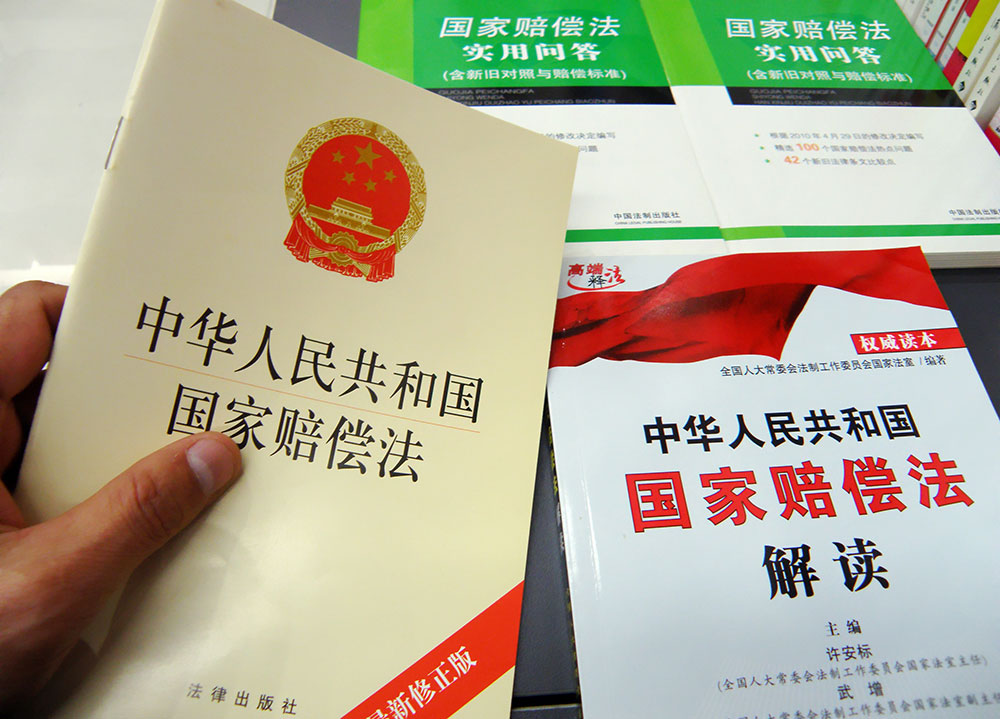
Improving the state compensation system and judicial aid system. China has promulgated the Interpretation on Several Issues Concerning the Application of Law in the Handling of Criminal Cases Regarding Compensation, issued guiding cases on state compensation, improved the procedure of cross-questioning evidence, and standardized compensation for mental suffering. From 2013 to June 2017, courts at all levels heard 20,027 cases involving state compensation.
China has strengthened and standardized the work of legal aid, unified the filing of cases, the scope, the procedures and the standards of legal aid, and the supply and the use of funds so as to institutionalize the legal aid system and handle cases qualified for legal aid in a judicial framework.
Courts at all levels including the Supreme People's Court have set up legal aid committees. The total amount of aid provided by the central and local governments was RMB2.47 billion in 2014, RMB2.94 billion in 2015 and RMB2.66 billion in 2016, benefiting more than 268,000 people.
Effectively resolving difficulties in the execution of court rulings. China has established a command system and an online check and control system about the execution of court rulings by all people's courts. It has improved an integrated punishment system on loss of credit, and issued judicial interpretations and normative documents on online judicial auctions and other issues related to the execution of court rulings, thus significantly improving the quality and efficiency of execution.
China has promulgated Opinions on Establishment of a Mechanism of Credit Supervision, Warning and Punishment over People Found to Have Lost Their Credit by the Court, which stipulated 37 measures to punish diehard debtors. It has improved the work mechanism for execution, including advance execution, and effectively alleviated difficulties of the parties involved.
The state has carried out special and concentrated actions concerning cases related to people's daily lives and focused on nine types of such cases, including the recovery of wages due, the wages of migrant workers, and alimony and support payments. In 2016, courts across the country heard a total of 6.1 million applications for execution, of which 5 million were concluded.
This was an increase of more than 30 percent over 2015. They involved sums amounting to RMB1.5 trillion, an increase of 50 percent over 2015.
Vigorously promoting judicial openness. The people's courts have built four major platforms for releasing information on judicial process, trials, written judgments, and the execution of judgments.
By October 16, 2017, Judicial Process Information Online had released 833,000 items of information about the cases and received 2.5 million visits.
As of November 3, 2017, courts at all levels had broadcast 404,000 live trials online through Chinacourt.org, attracting more than 3 billion visits. A total of 3,187 courts - 90.43 percent of all courts in China - have access to Chinacourt.org. China Judgments Online was launched in July 2013.
As of November 3, 2017, it had released 36 million copies of written judgments and received 11.4 billion visits from more than 210 countries and regions.
As of September 30, 2017, China Law Enforcement Information Online had revealed the identities of people who had been subjected to execution of court rulings in a total of 8.61 million civil cases, and more than 45 million pieces of information about these defendants.
The people's procuratorates have established a case information disclosure system and four major platforms for information services concerning trial procedures, the disclosure of legal documents, release of information on major cases, and the application for defense and legal representatives.
In addition, full information was made available to the public on criminal cases involving the offering of bribes. Public hearing was adopted in criminal litigation cases.
China has released the Opinions on Further Opening Prison Affairs, creating new open channels, expanding the scope of the release of information, and releasing decisions in accordance with the law on commutation of sentences, petitions for parole, and execution of sentences outside prison.
Improving the system of people's jurors and supervisors. The Pilot Program to Reform the People's Jurors System and the Program for Furthering Reform of the People's Supervisors System have been issued to reform measures on the selection and appointment of people's jurors and supervisors, expanding the scope of cases that involve people's jurors and supervisors so as to give full play to their role.
In 2016, people's jurors participated in the trial of more than 3 million cases. Pilot projects on reform of the people's supervisor system have continued.
As of June 2017, more than 21,000 people's supervisors had been appointed. Procuratorial organs at all levels have organized the supervision of cases, improved the procedures for supervision and appraisal, set up accounts for abuse-of-power cases, and established conference rooms to be exclusively used for hearing opinions of people's supervisors.
From September 2014 to July 2017, 7,491 cases handled by the procuratorates were supervised and appraised by the people's supervisors. Of the 247 cases in which people's supervisors gave opinions at variance with the preliminary decisions of procuratorial organs, 76 cases, or about 31 percent, were ruled in favor of the opinions of the people's supervisors.
Applying modern science and technology to the legal process. To adapt to the developing internet industry, China has established internet courts.
It is promoting the "smart court" in an all-around way, using information network technologies such as big data and cloud computing to standardize the management and statistical analysis of all types of trial information, to standardize criteria for judgment, especially concerning evidence in criminal cases, to promote consistent rulings in similar cases, to prevent and correct miscarriages of justice, and to ensure that all parties involved will obtain a fair trial.
China has promoted an "internet + litigation service" and launched convenient judicial services such as online filing, online mediation, remote court trial, electronic delivery, and online public disclosure. China has launched www.faxin.cn, a digital network service platform on the application of Chinese law, which aims to provide judges and lawyers with services such as legal document retrieval, professional solutions, and case analysis, to enhance the quality and efficiency of judgments, to make legal standards and judgment rules available to the general public, and to further meet the diverse legal needs of different subjects.






- Free shuttles provided for residents affected by Tai Po fire to vote
- Global influencers unlock scenic and cultural charms of Hechi
- PLA Navy urges Japan to stop 'smears', accusing Japanese military aircraft of repeatedly disrupting its training
- 'We can manage for now': HK rallies with fire recovery efforts on track
- Foreign media urged to report truthfully on HK matters
- Lee: Vote to drive reform and help HK fire victims