Rural rebirth









E-commerce alleviating poverty by helping 'Taobao village' farmers sell to, and buy from, cities
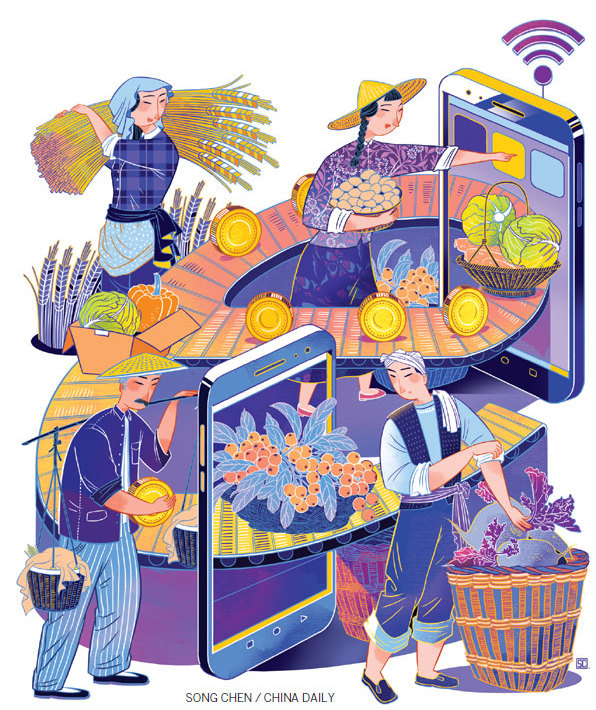
Village entrepreneurs are using China's burgeoning e-commerce markets to create new opportunities for themselves and their neighbors by selling specialized agricultural goods, cultural handiworks or light industrial products online.
By the end of 2017, more than 1.3 million new jobs had been created by rural e-commerce nationwide, and total transactions hit 120 billion yuan ($18.7 billion; 15.2 billion euros; £13.5 billion) in 2017, according to Alibaba research.
The number of "Taobao villages," in which at least 10 percent of the population sells goods on Alibaba's online platform with revenues of at least 10 million yuan, has soared from 20 in 2013 to more than 2,100 in 2017.
The nation's top leadership is strongly focused on improving the living conditions of rural residents. In his report to the 19th National Congress of the Communist Party of China in October, General Secretary Xi Jinping said, "What we now face is the contradiction between unbalanced and inadequate development and the people's ever-growing needs for a better life."
In a December speech at the Ministry of Transport, Xi urged transportation authorities nationwide to be dedicated to the construction and maintenance of rural roads to speed up rural modernization.
Also in December, the National Development and Reform Commission and the Asian Development Bank held a workshop in Beijing to present the conclusions of a two-year research project on "Rural Economic Transformation with Internet Plus."
The report said e-commerce has the potential to transform rural life, but also pointed out the need to overcome big obstacles. In many areas, the roads, broadband and cold-chain infrastructure needed to move products to market are not yet developed. Small farmers are also having problems in the food safety certification process. And many rural residents need further business and technical education to exploit opportunities fully.
Wu Xiao, director-general of rural economy for the NDRC, kicked off the Beijing workshop by noting that the nation is working on a targeted strategy for transforming rural areas through e-commerce and internet plus farming technologies. In order to let rural residents share the benefits of development, ways need to be found to coordinate industrial chains and marketing, to increase the scale of production, and to create brands and make agriculture more competitive, he said.
Before e-commerce, rural residents had to buy consumer goods and farming materials alike from local stores or middlemen. For many highly specialized products, there was no way for sellers to find buyers in cities.
Using e-commerce platforms, some villagers have built businesses selling traditional handiworks. For example, the people of Xinhua village in Yunnan province make silverware using techniques passed down since the Tang Dynasty (618-907). Selling on Taobao, JD.com and other platforms, they have increased their incomes while preserving the nation's intangible cultural heritage.
Other villages are able to sell specialized agricultural products directly to city buyers. Yonghe county in Shanxi province specializes in producing jujubes, also known as Chinese dates. In 2015, Yonghe harvested 20,000 metric tons of jujubes but was able to sell only about half. Many of the jujubes rotted on the ground because there was no way to connect buyers to producers.
According to the online journal chinadialogue.net, Liu Dongdong, a Yonghe native who had migrated for work to the provincial capital of Taiyuan after earning his university degree, returned to his native village to start an online store selling jujubes to buyers throughout China.
Other entrepreneurs have been able to turn their villages into light-industrial clusters specializing in one product. For example, starting in 2013, the village of Daiji in Shandong province, which was previously a highly impoverished area, has transformed itself into the national center for making acting and dance costumes.
In many villages, a single entrepreneur first developed an online business and then was followed by the growth of a cluster of similar businesses and suppliers in the area.
Goods don't just flow from the villages to the cities. More than half of China's rural residents now shop online. In the first eight months of 2017, rural online retail sales reached 729 billion yuan, an increase of 38.1 percent, according to chinainternetwatch.com.
Farmers' effective living standards soar when they get access to cheaper, better and more varied goods than are available at the local general store. In The Rise and Fall of American Growth, economist Robert Gordon details how 100 years ago, rural life in the United States was transformed by Sears catalog mail-order stores and other national retailers. A similar change is now happening in rural China.
The potential for internet technology to transform rural life is just now being tapped. The growth rate of Taobao villages, where much of the populations sells online, is very fast, but they still number only 2,100 out of the more than 600,000 administrative villages throughout the country.
Currently, 90 percent of Taobao villages are concentrated in eastern coastal provinces, and more than 70 percent are in southern China, especially in the highly commercial provinces of Guangdong and Zhejiang, according to Alibaba research.
A total of 1.28 million kilometers of rural roads have been built in the past five years, according to the Transport Ministry. But further improving rural infrastructure is a key goal of top national leaders and government agencies.
Yang Guangyun, general manager of the Rural E-commerce Operations Center in the Zhenyuan Yi, Hani and Lahu autonomous county in Yunnan province, says: "Without developing the rural areas, there is no speaking of developing the entire nation. It's a long way to go. We need the support of the government and universal training programs for the local people. We are still short of talent and have very weak infrastructure. It's easy for industrial products to reach the countryside, but it's not easy the other way around."
Another problem emphasized at the National Development and Reform Commission-Asian Development Bank workshop is that Alibaba's Taobao may have a near monopoly as a sales platform for many villages, and many fees are too high for small producers.
However, Zhang Ruidong, director of rural affairs for Alibaba Group, says the company is currently losing money on its Taobao village programs, since large investments are needed to build e-commerce centers throughout the country.
The company's Rural Taobao arm is training Taobao assistants in villages and building logistics branches in rural areas, says Li Tianyu, a project manager at Rural Taobao. It is also promoting agricultural products on the front pages of online shopping websites, providing unsecured loans for farmers and analyzing big data to provide feedback to help farmers to improve production efficiency, says Li.
As of March last year, the company had established a presence in 600 counties, covering 30,000 villages in 29 provinces or provincial-level regions.
According to the NDRC-ADB report, many farmers face difficulties in learning how to market their products online.
"They get used to interacting with the people they are familiar with in the transactions and sales of their products, but in e-commerce they are facing a kind of intangible customer," says Wang Libin, professor of rural development at China Agricultural University and team leader of the NDRC-ADB research. "They cannot actually see them or talk to them, so it is different from their old way of selling. They don't know how to attract customer visits to their online stores."
However, many farmers do have the skills to grab market opportunities. For example, Wu Yiming, a rice farmer from Xinzhuang, Jilin province, says he has been to Beijing once and was disappointed by the rice he ate in restaurants.
"I use the best type of rice seed, which comes from the country's northeast. The rice smells great when being boiled and tastes soft and good. People living in cities like Beijing and Shanghai can hardly get such good rice in supermarkets," Wu says.
"I saw that the price of rice from the northeast reached more than 30 yuan per kilogram. That is triple what I can offer." Wu says that's where the idea of opening a Taobao store began for him.
Although a new food safety law was enacted in October 2015, requiring that anyone selling food online, except for unprocessed agricultural products, must have a license, the need for such certification has been an obstacle for small farmers who want to sell online.
The NDRC-ADB report says the problem of licensing nonstandard food is "very prominent in Gansu and Yunnan provinces". It goes on to say that "the traditional workshop-style process will be replaced by factory production, which will have a huge impact on traditional locally processed specialty food. It is very difficult to maintain the original taste and flavor of the food."
Lan Haitao, co-author of the NDRCADB report and an agricultural economics expert and senior researcher at the Institute of Industrial Economy and Technical Economy, a research institute affiliated with the NDRC, says the government needs to at least double its current investment in rural infrastructure.
"Farmers are very clever. ... But they have many problems they cannot solve by themselves. They need the government to help them to solve public problems. This is a public policy problem, not a market problem," he says.
In 2014 and 2015, 256 counties were selected by the Ministry of Commerce for piloting of e-commerce in rural areas. Pilot counties received, on average, 18.75 million yuan from the central government for rural logistics, e-commerce service stations and primary processing facilities, as well as quality control systems and help with brand establishment.
The July 2016 National Informatization Development Strategy Outline said that "we should continue to vigorously develop rural e-commerce to drive the development of rural industries in poverty-stricken areas". In addition, a November 2016 guidance from the State Council, China's Cabinet, called for a quadrupling of rural e-commerce sales by 2020.