Reform paving the way to prosperity









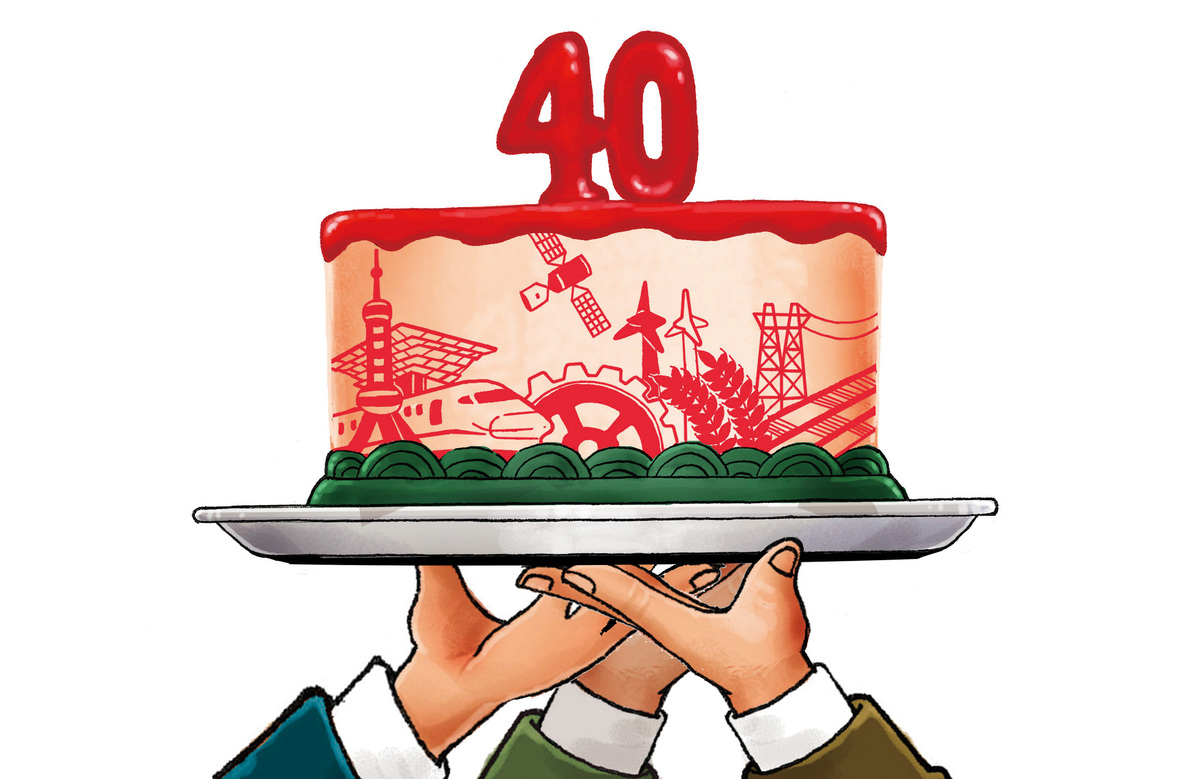
Reform and opening-up have helped China lift about 800 million people out of poverty in the past four decades and immensely improved the lives and livelihoods of the people
"The two most important days in your life are the day you are born and the day you find out why."-Mark Twain (1835-1910), American writer.
The quote sort of makes it clear why 1978 is important for me. It, however, took 40 years for me, and perhaps the world, to realize the importance of that landmark year, the year China launched reform and opening-up.
A small black-and-white family photograph has remained my favorite. It was taken in a studio in downtown Chengdu, Sichuan province, in the late 1970s. Taking a photograph in the late 1970s was no less than a big ceremony for an ordinary Chinese family.
Forty years on, almost every Chinese can be an amateur photographer thanks to the smartphone. The number of smartphone users in China is likely to reach 1.3 billion by the end of this year, making it the biggest market for electronic gadgets.
This tiny example reflects the tremendous changes brought about by the policies of Deng Xiaoping, the not-so-tall giant from Sichuan. He led China on a path that has remarkably improved Chinese people's lives and livelihoods.
At the Third Plenum of 11th Communist Party of China Central Committee in December 1978, Deng led the Party to put the country back on the track of economic development. Indeed, Deng is the architect of China's rapid economic development.
On a trip to Deng's hometown of Guang'an in 2007, I found that his family home, a typical Sichuan-style house built with wood and tiles and surrounded by bamboo groves, had been renovated and turned into a museum. Deng was born in a relatively well-off family on Aug 22, 1904. He left home at the age of 15 never to return, because he devoted the rest of his life to pursuit of China's prosperity. Today, millions of people flock to his family home in Guang'an to pay their respects.
Under the leadership of Chairman Mao Zedong, modern China came of age-it stood up. And in the era as mapped out by Deng, China has been gradually becoming prosperous thanks to reform and opening-up. In 1978, Deng visited Japan, saying, "now I understand what is modernization". The tremendous changes brought about by reform and opening-up show China has been "crossing the river by feeling stones" to explore its own path for modernization.
And 40 years after that landmark year, China is marching toward the "two centennial goals", of building a moderately well-off society by 2020, just before the 100th anniversary of the founding of the CPC in 2021, and a modern socialist country that is prosperous, strong, democratic, culturally advanced, harmonious and beautiful by 2050, a year after the 100th anniversary of the founding of the People's Republic of China in 2049.
More importantly, the history of the past four decades shows the Party has always accorded priority to the people, and ensured they benefit from reform and opening-up.
Milestones pave the way for economic take-off
In 1978, China's GDP was about 367.87 billion yuan ($57.38 billion). Many families relied on just one member's salary of a few dozen yuan. Even during my early childhood, I saw my parents buying daily necessities, from food to cloth, with a few yuan and quota coupons. The shortage of daily necessities, a consequence of the "cultural revolution" (1966-76) which turned China away from the path of economic development, didn't ease till the quota bills were scrapped.
The first improvement can be attributed to the "household contract responsibility system". Started in Xiaogang village in Anhui province in the late 1970s, the system enables farmers to use rural collective land for farming through long-term contracts and keep the produce after paying taxes. It raised productivity and increased agricultural output, paving the way for industrialization and urbanization. No wonder it is widely acknowledged as a milestone in economic reform.
To cite another example, in the late 1970s Chengdu was much different from the present modern metropolis. It was a city full of two-story houses made of wood with tiles for roof and without much transportation. It gradually became a vibrant kingdom of bikes. Slowly, radios, sewing machines and black-and-white TVs began appearing in ordinary Chinese homes. TV dramas and films, in particular, were eyeopeners for the Chinese people, and the foreign TV dramas such as La Grande Vadrouille and Hunt enabled ordinary Chinese to peep into the outside world.
Accompanying these phenomena was the establishment of the Shenzhen "special economic zone", the pilot program for reform and opening-up in South China's Guangdong province.
Talking of reform, two families occupy a special place in the grandiose chapter of reform. After the end of the "cultural revolution", about 14 million urban youths working in rural areas gradually returned to cities, imposing huge pressure on employment. In April 1979, the State Council, China's Cabinet, proposed that self-employment be encouraged.
Liu Guixian, China's first self-employed in the reform and opening-up era, started her restaurant to ease her family's monetary burden in 1980 amid controversy. The official document describing "self-employers as socialist workers" in October 1981 cleared people's doubts, and restaurants began mushrooming in Beijing and other major cities.
I interviewed Liu in 2002 at her small and simple restaurant in Cuihua Hutong, a narrow alley in Dongcheng district of Beijing. She was the same humble person despite her "historical stature". Liu passed away in 2015, leaving the restaurant to her grandson.
Yin Shengxi was the founder of Laoshe Teahouse, named after Teahouse by Beijing-based author Lao She, as a pioneering collective enterprise. In 2007, I interviewed his daughter Yin Zhijun, who succeeded her father after he passed away in 2003. When her father led a dozen unemployed youths in 1979 to open a simple tea kiosk at Qianmen in Beijing, few would have imagined the outlet that offered tea at 2 cents a bowl would develop into a cultural icon and entertain many foreign dignitaries, including former US secretary of state Henry Kissinger.
Many other famous entrepreneurs rode the tide of reform and opening-up to success, but Liu Guixian and Yin Shengxi remain special.
Market economy deepens its roots
No reform can be accomplished at one stroke. Because of the drastically changing international situation, there was a fierce debate in the late 1980s and early 1990s that China would return to planned economy. But the successful hosting of the 11th Asian Games in 1990, the first sports gala in China, sent a strong signal that China would never shut its economy to the outside world. Such was the public enthusiasm in the run-up to the Asian Games that people donated money to build the sports facilities. China's GDP that year reached 1.89 trillion yuan.
In early 1992, Deng's southern tour on the frontier of reform and opening-up gave a shot in the arm of reform. And a popular song, A story in spring, spread across China in the days that followed, reflecting Chinese people's support for continuous reform and opening-up. The historic tour cleared the dark clouds over reform. And it became fashionable again to do business.
In October 1992, the Pudong New Area was established, and in less than three decades, Shanghai has become a key financial hub in Asia. Although I had seen photographs of Shanghai and heard a lot about the city, I was still amazed to see the colorful lights and grand buildings on both sides of the Huangpu River at night early this year. The Europeanstyle buildings in Puxi, part of the "foreign concessions" till the mid-1940s were magnificent but also revealed the ugly scars of foreign invasion to force China to open up its economy in the 19th and early 20th century. In contrast, the three breathtaking skyscrapers in Pudong, which are among China's tallest buildings, reflect contemporary China's embracing of globalization.
When China's rapid economic growth needed a solid legal framework, the Party answered the call. People often ask how the Party has led China to achieve such a miracle. The answer lies in the Party's capability of self-introspection and self-revolution to adapt to the changing times.
The 14th National Congress of the CPC in October 1992 set the target of building a socialist market economy; it was written into the Constitution the next year. Between 1993 and 1998, a total of 118 laws and regulations related to market economy were passed, and the term "market economy" became an integral part of socialism with Chinese characteristics.
One year that stands out in the past four decades, also for a tragic reason, though, is 1997. Deng passed away on Feb 19 that year, just months before Hong Kong's return to the motherland on July 1. It was because of his political acumen and wisdom that the principle of "one country, two systems" came into being and paved the way for the historic moment.
On July 1, the United Kingdom's flag came down and China's flag went up in the Hong Kong Special Administrative Region. And when Jiang Zemin, then president, delivered his speech at the handover ceremony, patriotism touched the hearts of every Chinese.
Deng impressed people with his firm stance to ensure the return of Hong Kong to the motherland during the many rounds of talks with the UK, saying China was no longer under the weak Qing Dynasty (1644-1911) government. Two years later, in 1999, Macao returned to the motherland from the control of Portugal. All these would not have been possible without China's rapid economic rise that was made possible through reform and opening-up.
Under Jiang Zemin and then Hu Jintao, the Party continued China's rapid economic development. In 1997, China became the world's seventh-largest economy. In 2000, it surpassed Italy as the world's sixth-largest economy. Five years later, it surpassed France as the fifth-largest and in 2006 the UK as the fourth-largest economy. It overtook Germany to become the third-largest economy in 2007 and Japan to become the No 2 economy in 2010.
Further deepening reform to build xiaokang society
Thanks to its rapid ascent on the global economic ladder, China has made huge contributions to the world economy. At home, people have been enjoying the fruits of economic development. In the past four decades, China has lifted about 800 million people out of poverty. Eliminating extreme poverty can never be an easy job, but it is widely believed that China's dream of building a xiaokang (moderately prosperous) society will come true under the leadership of President Xi Jinping.
When I visited a village in Baoding city, Hebei province, in 2004, I was shocked to see the condition of the poor family of a man surnamed Yin. Just about 170 kilometers south of the booming capital city of Beijing, Yin's dilapidated house had only one electric appliance, a dim light bulb. His wife's cancer had swallowed every penny Yin had saved and pushed the family into heavy debt. Unfortunately, she died a few years before a nationwide rural healthcare system was introduced.
During my visit to northern Sichuan in 2007, 62-year-old Tan Tinggui, who had been the chief of Sixing village in Guang'an for 21 years, told me that his dream to see improvements in farmers' life has partly come true. Earlier, Tan had told a senior official during the latter's inspection tour about the farmers' wish to have their tax burden reduced and receive proper medical care. In 2005, Tan witnessed the launch of a new rural cooperative medical program (actually launched in 2002) in Sixing. And in late 2005, the central government announced the abolition of the ancient agricultural tax and introduction of new subsidies for farmers from 2006. This was followed by the establishment of a nationwide rural cooperative medical program as the basic rural healthcare system in 2009.
In 2012, after the 18th Party Congress, newly-elected General Secretary Xi Jinping vowed to work to improve people's lives and livelihoods. Since then, more than 13 million people have been lifted out of poverty every year. And the Party with Xi at its core has decided to deepen comprehensive reforms to achieve quality economic development and further improve people's livelihoods.
At the Third Plenary Session of the 18th CPC Central Committee, the Party said it is committed to further promoting comprehensive reforms. The announcement made clear the Party and government will take measures to allow the market to play a decisive role in resource distribution. The central leadership has also vowed to strengthen property rights protection. And it has eased the family planning policy to allow all couples to have two children.
Economic miracle to eradicate extreme poverty
In 2017, China's GDP surpassed 82 trillion yuan (nearly $13 trillion). At the 19th Party Congress last year, Xi said socialism with Chinese characteristics has entered a new era, and Xi Jinping Thought on Socialism with Chinese Characteristics for a New Era was enshrined in the Party Constitution. Also, Xi emphasized that China's principal contradiction has changed to one between the unbalanced and inadequate development and people's ever-growing needs for a better life.
Xi has vowed to realize the two centennial goals of building a moderately well-off society and eliminating extreme poverty by 2020, with the fight against poverty being made one of the three priorities for the Party and the government.
Hopefully, when the target is achieved, no more farmers will be forced to live a miserable life like Yin whom I met in Hebei in 2004. And the gap between Beijing and its neighboring rural areas in Hebei will be narrowed after the implementation of "integration development plan for Beijing-Tianjin-Hebei" and the ambitious Xiongan New Area plan in Hebei.
The two other priority tasks from 2018 to 2020 are the fight against environmental pollution and the battle to minimize financial risks. The rapid economic development has brought huge gains for China and its people, but it also has produced side effects of widening wealth gap, severe environmental pollution and accumulating financial risks, especially because of the overheated housing sector. The only way to win the three battles is through deepening reform and opening-up.
At the "two sessions" this year, China announced some bold measures, including State and Party institutional reform to improve modern governance. This was followed by Xi announcing a series of policies for further opening-up at the Boao Forum for Asia in April.
It's widely believed the Chinese Dream of national rejuvenation will be achieved as mapped out in the 19th Party Congress report, and China will become stronger in the Xi era. And the people will continue to share the dividends of the reform and opening-up in the new era.
The author is a senior editor with China Daily.