Back under control









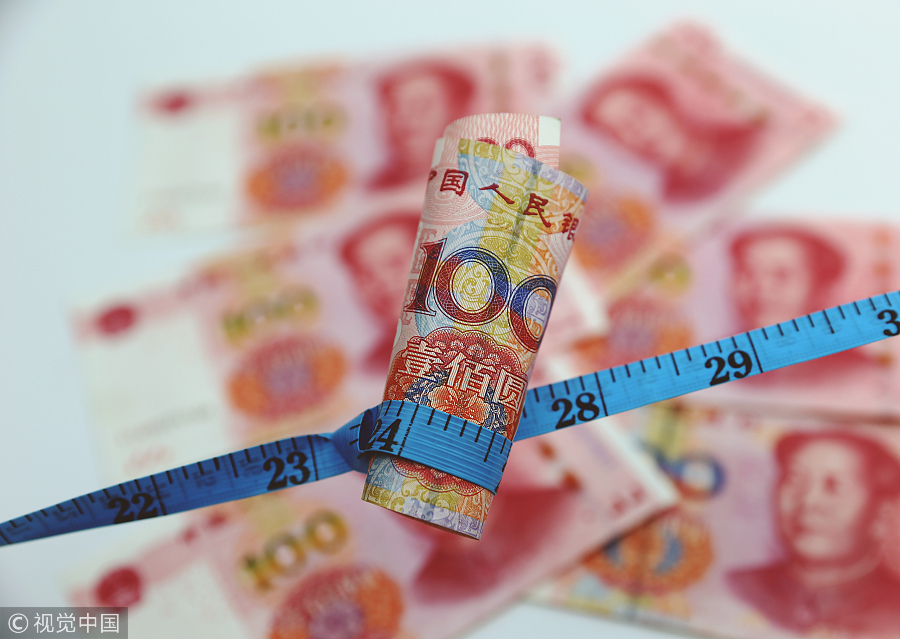
Prudent monetary policy, market discipline help rein in runaway corporate debt
These days, creditors to Chinese companies are optimistic.
Analysts attributed the optimism to the light of monetary policy at the end of the dark, seemingly endless tunnel of corporate debt, as the total outstanding debt financing instruments reached 9.19 trillion yuan ($1.39 trillion)
Fears of corporate debt defaults that bedevilled market sentiment for long, are receding. What's more, economic fundamentals appear rock solid - Chinese GDP, which expanded 6.9 percent in 2017 to 82.71 trillion yuan, is forecast to grow by 6.6 percent to 6.8 percent this year - despite trade tariff tensions and currency and stock-market fluctuations.
Effective implementation of a prudent and neutral monetary policy, marked by regulatory tightening and steady progress in deleveraging, is helping minimize default risk related to ballooning corporate debt. And big fat corporate profits are raising hopes of some debt repayments, which would not only reassure creditors but brighten investor mood, analysts said.
The National Association of Financial Market Institutional Investors, an organization that helps the interbank bond market to regulate itself, said in a note earlier this month that there were no new defaults among non-financial enterprises in June, indicating that credit risk of debt financing instruments is "generally under control".
Central bank data indicated that by the end of May, outstanding repayments related to corporate credit bonds that had already defaulted stood at 66.3 billion yuan, accounting for just 0.39 percent of the total value of outstanding bonds.
Pan Gongsheng, deputy governor of the People's Bank of China, the central bank, said, "The overall risk in the bond market is under control. Though some default cases have occurred, the new defaults are sporadically distributed instead of demonstrating a risk concentration, reflecting the effects of stronger market discipline and orderly unwinding of implicit repayment guarantees. The bond default rate remains low in general."
Agreed Brian Coulton, chief economist at Fitch Ratings, the global ratings agency. "There has doubtless been some good progress made of late towards stabilizing corporate debt."
In its annual economic report for 2017 published on June 24, the Bank for International Settlements or BIS stated that China's overall credit-to-GDP ratio index, after a very rapid increase, peaked at the beginning of last year.
"In particular, credit to the corporate sector fell sharply as the authorities intensified measures to encourage deleveraging and reduce financial stability risks," said the BIS annual report. "(And it signaled) that the financial cycle appears to have already turned."
To control corporate debt expansion, the central bank had guided financial institutions to cut loans to industries suffering from overcapacity. As a result, banks cut back on loans to industries like iron, steel and coal.
China's credit risk, however, is still concentrated in the corporate sector, compared with government debt and the household sector.
In 2017, the leverage ratio of the corporate sector in China was 159 percent, down 0.7 percentage point year-on-year. Leverage ratio is an indicator of how much capital comes in the form of debt or loans, and reflects the ability of a company, a sector or a government to meet its financial obligations.
It was the first drop in the corporate sector's leverage ratio since 2011. The number had been increasing an average 8.3 percentage points annually between 2012 and 2016, according to PBOC data.
In contrast, by the end of last year, the leverage ratio of government debt was 36.2 percent, down 0.5 percentage point year-on-year, and that of the household sector was 55.1 percent, up 4 percentage points year-on-year, PBOC data showed.
After a flourishing credit cycle in the last decade, Chinese companies found themselves with over-expanded balance sheets. But this was in line with their radical expansion strategies.
However, the uncompetitive ones among them, given their structural defects, may struggle with refinancing when a large pile of their existing debt becomes due for repayment later this year.
In the third quarter - the July-September period - corporate debt valued at 1.37 trillion yuan will be due for repayment, according to Bloomberg data.
According to data from Wind Info, a market information provider, corporate bonds worth 98.82 billion yuan will expire in the third quarter, followed by a larger tranche worth 103.98 billion yuan in the fourth quarter.
If the companies concerned struggle to find refinancing in time, defaults may well occur, potentially besmirching corporate China's reputation and raising fears about macroeconomic implications.
Refinancing could prove to be tricky as a recent regulatory crackdown to contain rising financial risks associated with increasing leverage, had a restraining effect on some interbank financing channels, especially the so-called shadow banking activities. So, companies will need to look for alternative sources of refinancing to roll over their debt.
There are other concerns too. The clampdown on some types of bank credit and slower growth of broad money supply since last year have pushed up corporates' funding costs in the onshore bond market, analysts said.
A rising interest burden suggests that corporate savings as a share of GDP are likely to continue falling over the next few years, warned the Fitch economist Coulton. "This means that investment needs to slow sharply in order to reduce corporate borrowing."
Fitch's scenario analysis suggests that business investment growth would have to fall by 5 percentage points in order to stabilize corporate debt-to-GDP ratio by 2022.
According to Fitch data, 12 onshore listed corporate bond issuers defaulted on 21 bonds whose collective principal amounts totaled 20 billion yuan this year so far. In 2017, 18 issuers defaulted on 46 bonds whose collective principal amounts totaled 39.3 billion yuan.
The trend, which started earlier, had even affected bond issuance. For instance, Chinese corporates' onshore bond issuance slumped by 32 percent to 5.7 trillion yuan in 2017, the first annual decline since 2010.
The total new issuance in the first half this year was only 89.62 billion yuan, less than the expired 317.1 billion yuan, according to data from China Central Depository and Clearing Co Ltd.
"Investor reassessments of default risks could lead to an increase in risk premiums this year, as wider application of cross-default provisions and greater acceptance of defaults by the authorities lead to an increase in default events," said Zhang Shuncheng, a Fitch analyst.
Although creditors to corporates are breathing easy now, the recent wave of corporate debt default cases shows that the country's financing environment has changed in the wake of deleveraging and regulatory tightening, said Gao Shanwen, chief economist at Essence Securities Co.
When the corporate sector reels from tight credit supply, companies usually choose to deploy their less liquid financial assets to liquid money, to mitigate the effects; but this support may diminish if corporate confidence falls, such as under the expectation that growth may continue to slow, said M.K. Tang, an analyst with Goldman Sachs (Asia).
"Given the relevance of confidence, policy measures to preempt adverse market and public sentiment from taking hold would be important," he said.
Aware of the potential liquidity stress in the country's indebted corporate sector, especially for the small and micro-sized enterprises that are still facing difficulties and high financing costs, the PBOC determined to cut the amount of reserves financial institutions are required to keep with it.
The reserve requirement ratio or RRR cut, which took effect on July 5, will free up 700 billion yuan, which will be used in two ways: 500 billion yuan will support the "debt-to-equity" swaps program of larger banks; and 200 billion yuan will be used to encourage small banks to lend to small and micro enterprises that are facing financing difficulties, according to the central bank.
The "debt-to-equity" swaps program is for banks to write off debt to companies in return for equity stakes, mainly targeting to ease debt burden for heavily indebted State-owned industrial companies.
Compared with State-owned enterprises, which are usually backed by local governments' "implicit guarantees" when borrowing money from commercial banks, the nation's small and medium-sized enterprises have long struggled to secure credit as the risk-averse banks offer tough qualifying conditions with higher costs.
When monetary conditions tighten, the small and micro enterprises, the so-called weak links in the real economy, are the first group to feel the financing stress. As the central bank said, this round of RRR cut will be carefully launched as a "targeted" measure, which should "facilitate steady progress in structural deleveraging", instead of a broad easing that may erase the previous achievement of deleveraging, if the debt-to-GDP ratio rebounds fast.
The central bank's RRR cut, to some extent, is to strengthen the market sentiment when volatility is rising. "In that regard, while the mechanical impact on growth of some policy actions, such as the recent RRR cut, may not be straightforward, they may still well be beneficial," said Tang of Goldman Sachs.
Liu Shijin, vice-president of the China Development Research Foundation, a government think tank, said China will be able to continue stabilizing its macro leverage and gradually lower the leverage ratio.
A member of the monetary policy committee of the PBOC, he attributed his positive outlook to supportive factors such as a quality-oriented economic shift and strengthened financial supervision.
"The economic transition from high-speed expansion to high-quality development requires focus on corporate profitability, employment, development stability and sustainability, which will help lower the leverage ratio in the future," Liu said.