Astonishing growth has been foretold









When Deng Xiaoping embarked on the reform path 40 years ago, did he, never mind anyone else, have the slightest inkling it would lead to the China we know today? I was just about to start a one year's master's degree in economics and finance at Sheffield University in the United Kingdom, having just completed my first degree in economics.
Indeed, I am returning to a 40-year alumni event as a guest of the university to give an after-dinner speech, and I might ask the audience: Did anyone think about China in those days? I know I didn't, and I suspect, not many outside a small elite of international thinkers focused on China.
Few thought much about China four decades ago
In 1978, all the attention was on the inflationary decade that had preceded us, and the new role of rising oil prices, which were about to surge again and present a new challenge to the then dominant Western economies. There was a huge focus on the Middle East in this regard, and when I finished my masters, I somehow obtained a grant to undertake a PhD studying in detail for three years what was going on with oil prices, and the massive cash surpluses that many Middle Eastern oil producing countries suddenly accrued. Outside of this, I recall most intellectual attention on the heightening cold war with the Soviet Union, the apparent unstoppable rise of Japan.
It was the oil price crises and their consequence that dragged me into the world of international finance with my first professional job in the early 1980s when the world economy seemed to roll from one major crisis to another. But I don't recall virtually any attention to the rise of China nor the reform path China had embarked upon.
It was toward the end of the 1980s when my eyes opened up a bit more globally. Having lived in New York from 1985 through mid-1988, I returned to the UK to work for a Swiss bank, in an arm that was very active in the then important euro bond business. Within 18 months, specifically, I made my first visit to China in 1990. I have three abiding memories of that first trip to Beijing.
First, it seemed as though the car I was traveling in from the airport was the only car on the road, and was surrounded by seemingly millions of old fashioned pedal bikes. Second, I have memories of visiting Badaling, the nearest part of the Great Wall, and the last few miles were essentially a dirt track. But third, I was surprised from just limited wandering around central Beijing streets about the evidence of street market trading, and I remember concluding that this wasn't what I had expected from a communist economy. That all must have been part of my first fascination with China.
Vital role in resolving Asian financial crisis
Fast forward to the second half of the decade, and in particular the 1997-98 Asian financial crisis, and by then, having been to China at least 10 times, and now a partner at Goldman Sachs, I was highly impressed with the role China played in helping, especially indirectly, in halting the crisis. A key moment in global financial markets occurred during this period when then US treasury secretary Bob Rubin reversed his stance on not intervening in the foreign exchange market, and undertook a timely, albeit modest-size, intervention to stop further dollar strengthening against the yen.
Indeed, the yen subsequently reversed direction and rose sharply, and it seemed to coincide with the end of the Asian financial crisis. This justified the views of many, mine included, that the decline of the yen against the dollar had undermined the fixed exchange rate regime of many Asian countries, and contributed centrally to the massive debt crisis that then unfolded.
It subsequently emerged that, in the background, a huge influence on Rubin was the threat that if the yen continued declining, China would have no choice but to devalue the yuan. This was a massive mental awakening to me about China's indirect influence on global financial markets.
It played its own role in my thinking in what, in many ways, shaped my own international reputation, when three years later in 2001, I dreamt up the BRIC acronym to describe the potential rise of Brazil, Russia, China and India. It was already clearly evident at the turn of the millennium that each of China and India had entered the international economy in a meaningful way, in particular allowing each of their 1 billion plus people to participate in the forces of the global economy.
It was also seemingly apparent that, post-crisis Russia, now adopting Western economic liberalization and then a member of the G8, was embarking on a path of rising economic relevance. Brazil had not, and indeed, many including my own specialist Brazilian economist at Goldman Sachs, were doubtful about its likely relevance. And in this context, its own spectacular decade that followed positively surprised the world, perhaps as much as the ongoing rise of China and the others.
Most important factor in the BRIC group
But of course, the reality was, even back then, that within the BRIC group, nothing quite mattered as much as the role of China, and within a couple of years, China's emergence as a major economic force started to influence more and more global markets, ranging from commodities to luxury goods. All of this helped my own fame as I was courted by many global companies of the day, whether the likes of BHP, the Australian based commodity conglomerate, big German car companies such as BMW, or global fashion leaders such as Louis Vuitton.
I remember after a visit to Louis Vuitton's Paris headquarters, being told of a story I had already heard in the mid-2000s. It became so fashionable for Chinese tourists to try and buy as many luxury bags from their flagship Champ-Elysees store that the owners introduced a "one bag, one person" limit, which resulted in an even stronger desire for purchases. It led to a well-known trading opportunity for Parisian students wandering up and down the street being offered up to 50 euros each to make the purchase on their Chinese client's behalf.
Evidence of other colorful stories of China's rise are endless. Another of my personal favorites was on a trip to China in 2008. I took a photo of an advertisement on the wall of a dilapidated building in a village saying "success in English equals success in life". I was mesmerized by this, and it added to the strength of feeling I have had ever since about the huge opportunity China's rise was for my own country, the UK, as well as the rest of the world.
Let me put China's rise to date in more conventional economic terms. In the second paper that we published at Goldman Sachs in 2003 where we set out what the world might look like by 2050, we included a colorful chart of countries with racing cars on a chart. The charts were to depict in which year each of the BRIC countries would overtake their bigger developed country counterparts. The chart suggested China would overtake Japan, then the second-largest economy in the world by 2015. In fact, by 2015, China's economy had become twice as large as Japan's.
China surpassed all expectations
Throughout the 2000s, all the BRIC economies grew faster than I had considered possible in any scenario back in 2001, but only one of the four has surpassed expectations continuously since, and of course, it is China.
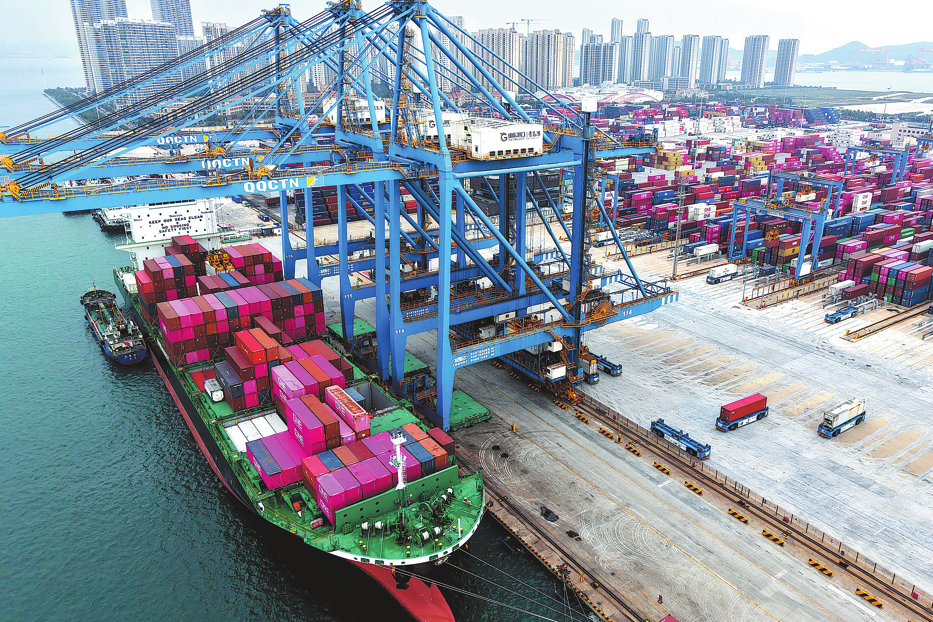
By the end of 2017, China had become an economy as large as $12.7 trillion in nominal US dollar terms. It is not far off from being three times bigger than Japan. It is bigger than the eurozone and nearly 70 percent as large as the US. It is more than twice the combined size of the other three BRIC economies, close to six times bigger than the only other billion-population BRIC country, India. During 2017 alone, its additional $1.5 trillion increase was equivalent to creating an entire new Australian economy in one year, or two Switzerland economies. I could go on and on.
Because of all of this, China's contribution to the world has been getting bigger and bigger, and despite many disturbing aspects in Western economies and some others, the global economy since the turn of the millennium has grown faster than in the 1980s and 1990s. In those two decades, the world economy grew around 3.3 percent. In the 1990s, the world grew by 3.9 percent, and so far this decade, despite the challenges in many places, the decade to date growth rate is close to 3.5 percent. China has been the most dominant force behind this stronger growth.
Future challenges and priorities
So what about the future, and China's challenges and priorities, especially now that we have an apparent stronger challenge to China from the Unites States?
In our initial BRIC 2050 projections, we highlighted that sometime between 2025 and 2030 China might match the size of the US in current nominal dollar terms. (It is already bigger than the US in purchasing power parity, or PPP, terms). China is very much on that path, but it is not a given that it will happen, either by then or at any time.
I am writing this at a time when China's financial markets including its equity and currency are losing value, and if the yuan were to maintain its recent decline, it would make it a lot harder for China to reach the status of the world's largest economy before 2030.
More importantly, it will make it a lot harder for China to achieve more important goals, such as doubling the wealth of its citizens, and especially further rebalancing its own economy more toward the consumer. A weakening yuan means more expensive imports, which means less disposable income for yuan-income earners, and therefore less money to spend.
Things to do to build a much better future
So here's what China needs to do in my view, most of which isn't that difficult.
First, China has to remain determined to grow in the 5-6 percent vicinity in the next decade, and within it, pursue policies that support the growth of domestic incomes, which will allow for increases in personal consumption.
Second, to foster this direction, China needs to pursue monetary and fiscal policies consistent with this goal, and to try to achieve more evenly shared income growth.
Both of these goals are central to the government, and among those I don't believe to be too difficult to achieve.
Some others might be more challenging although attainable if pursued with determination.
I believe that the Chinese authorities will need to consider completely abandoning the hukou (household registration) system where migrant workers are not allowed the same privileges as urban dwellers. I think the authorities will not be able to sustain their goals, including social harmony, unless they do so, nor will they be able to truly rebalance the economy toward increased sustainable consumption and more shared growth. I know the government has already pursued this policy in tier-three cities, but at some stage, I think it will have to be done in the big cities.
I also think China has to be successful with its clearly articulated policy of improving the environment and boosting the air quality in its major urban areas. The case is so well articulated, and steps to achieve this goal embraced, but I think it is crucial for China's long-term economic and social health to achieve this.
Belt and Road must offer more shared ownership
A final suggestion relates to President Xi Jinping's important Belt and Road Initiative and its exciting symbolism of China's soft global power. Some countries are wary of the initiative, and I believe China has to consider offering more shared ownership of its development. Perhaps one idea would be to openly encourage other countries to positively influence the direction of the Belt and Road Initiative as it develops along its journey, not least as it would be a subtle sign of China's often stated intent of being a peaceful friendly nation as it becomes more and more influential globally.
China's next 40 years will be as fascinating as the last 40 years, and while I am sure there will be inevitable unexpected twists, I, for one, expect that within this period, perhaps even within the first decade, China might become the world's largest economy. I look forward to watching the journey.
The author is chair of Chatham House. The article is an excerpt from the upcoming book The Sleeping Giant Awakes, edited by China Watch, a think tank powered by China Daily.