Frailty drives US tech cold war agenda









In the early 2010s, an aspiring Chinese internet entrepreneur Zhang Yiming launched ByteDance while developing a video sharing platform. And after Douyin's success in China, he began to internationalize the app.
To avoid conflict in national jurisdictions, Zhang had TikTok and its Chinese version Douyin run on separate servers. TikTok's data collection is similar to that of major US social media platforms and apps, and certainly less intrusive than Facebook's.
By the end of July, Douyin had more than 500 million active users, while the number of TikTok users had surpassed 1 billion worldwide-in barely four years. To manage the global concern, Zhang hired a Disney executive Kevin Mayer, to head TikTok and oversee its parent company ByteDance's operations. Backed by the largest US and Japanese financial giants, ByteDance was valued at $75 billion-the most valuable startup worldwide.
Desperation to develop China-free internet
The US president has signed two executive orders banning US "transactions" with ByteDance and Tencent, owner of WeChat, a highly popular social media and trend-setting mobile payment app that has more than 1.5 billion active users. In turn, TikTok is moving ahead to sue the United States administration.
Afterwards, US Secretary of State Mike Pompeo offered his new vision for a "clean" internet, presumably in the name of "national security". As US-based critics quickly warned, Pompeo's vision is not a plan to "clean" but to techno-ethnically "cleanse"-to create a China-free internet. Similarly, his Indo-Pacific strategy aims at a China-free Asia.
In Kafka's Trial, the key character is arrested "without having done anything wrong". Among Chinese corporates, a similar series of nightmares began two years ago with the arrest of Meng Wanzhou, chief financial officer of Huawei, in Vancouver, Canada, on a provisional US extradition request.
The US administration has escalated Sino-US tensions to an unprecedented level, undermining four decades of strategic trust in barely four years. But the US' tech war against China and pioneer innovators in Europe and Japan is of older origin.
Japan forced into secular stagnation
After the end of World War II, the US dominated advanced technology worldwide. But after postwar recovery, Western Europe became competitive. By the 1980s, Japan dominated consumer technology until it was compelled to sign the Plaza Accord that paved the way to its secular stagnation.
In conventional economics, developing economies are seen to trade primary commodities in exchange for developed countries' manufactured technology. Such trading has not been characteristic of the US' trade with China. Rather, the US trades primary commodities for Chinese technology. Even today, the "phase two" trade talks hinge on Beijing's purchases of US soybeans.
In the name of "national security", the US has a highly restrictive control system that restricts "dual-use technology" exports to China and many other countries. Behind the fa?ade, non-US CEOs see it as a non-economic instrument to prolong strategic advantages the US no longer enjoys in commercial competition.
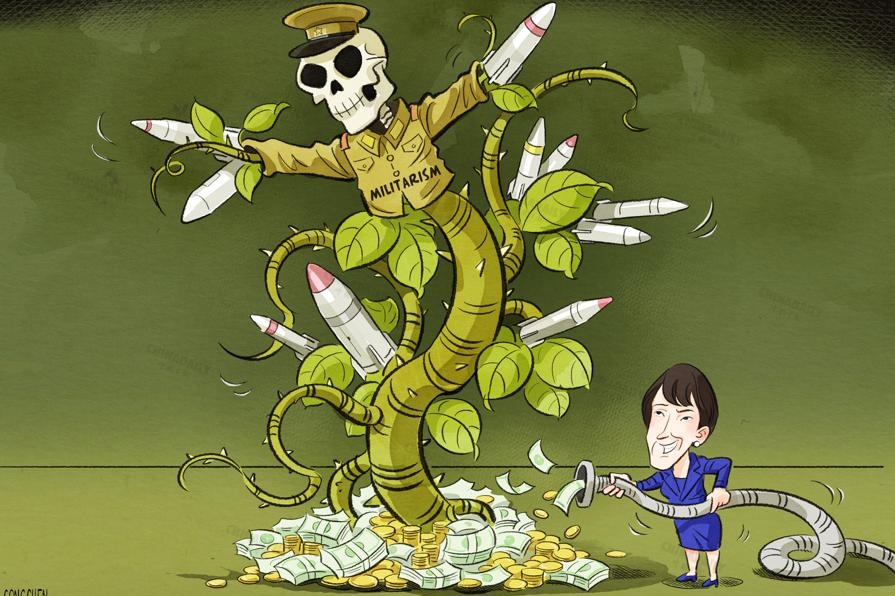
In the 21st century, no single country can control entire technology ecosystems. Yet that's the US administration's goal, due to Pentagon's quest for "full-spectrum dominance". In that view, the world, particularly the field of new technologies, is seen as a "battlespace", which must be subject to US dominance alone.
Desperate bid to regain advantage in 5G era
Until recently, US enterprises lagged behind international competition in 5G mobile technology. Historically, the US dominated the analogue 1G through the 1980s. With deregulation and liberalization, it lost its edge. When globalization intensified in the digital 2G era by the early 1990s, the European Union introduced the GSM standard, which fueled the rise of Swedish Ericsson and Finnish Nokia. Along with Republic of Korea challengers, the European leadership prevailed through the 3G digital broadband in the 2000s.
For years, Microsoft had tried to bully and buy the hugely successful Nokia. In 2010, to the Finns' surprise, a former Microsoft executive Stephen Elop, touted by Nokia chairman Jorma Ollila (who also chaired the Anglo-Dutch Shell), was made Nokia's first non-Finnish director. Elop had a controversial record of restructuring stints. In four years, the "Trojan Horse" (as the Finns named him) bankrupted the 150-year old company, which was then sold cheaply to Microsoft.
In the 2010s, the still faster 4G saw the rise of Chinese innovators (Huawei, Alibaba, Tencent, Xiaomi) and Indian IT service giants (Tata, Infosys, Winpro). As rivalry began for the internet-pervasive 5G era, US companies no longer dominated the new platform, except for Apple's iPhone (which was too costly for mass use).Accordingly, concerns grew in the White House and Pentagon.
The TikTok story in the US is the latest variant of an older story.
Cloned innovations, imposed dominance
In the past, Chinese multinationals, like their European and Japanese precursors, imitated technology leaders in the West. Today, they excel in innovation. Some projected the trend already in the 2000s.
US companies remain competitive internationally, but are no longer the only innovators. Half of the US' research and development involves eroding defense contractors relying on cozy supplier networks. As a result, US companies increasingly imitate their foreign counterparts in commercial competition. That's not a sign of American weakness, it's a sign of the rise of new global competitors.
That's why Microsoft would like to buy TikTok today just like it bought Nokia yesterday. Assets are cheaper when their value is down.
Imitation is the new rule of the game. Take, for instance, Facebook, which has been accused of, even charged for, anticompetitive behavior worldwide. As it has lost its innovation edge, it has cloned US rivals, such as SnapShot (Facebook's Slingshot); Timehop (On This Day); Snapchat's feature (Instagram Stories); Craigslist (Marketplace); Amazon's Twitch (Facebook Gaming); Zoom and Houseparty (Messenger Rooms).
Now that Chinese companies and apps have joined global innovation leaders, the old rules of the game are changing, while Facebook's strategy isn't. That's why it just launched Instagram Reels-a TikTok clone.
Washington's quest for economic nationalism
Clones are seldom as attractive as the original. Imitation is not the real thing. That's why the White House needs a "national security" argument for technologies that are no longer competitive globally-to provide legitimacy for full-spectrum dominance.
In that quest, the US administration is likely to target one major Chinese technology giant after another. At first, the effort is to restrict, marginalize and cleanse these companies away from the US. Next, the administration may focus on these companies' executives and international suppliers. What may start with courting may end with threats and sanctions. The ultimate goal is full dominance.
Effectively, the administration is thus fostering the rise of US-based "national champions"; that is, corporations that are ostensibly private but sustain the dominant position on the back of government policies.
Such policies promote economic nationalism at home and forced global eminence, which will further reinforce protectionism. They do not protect the US' national security but will undermine it. They are non-economic instruments in a doomed effort to cleanse the world of Chinese technology innovators.
The author is the founder of Difference Group and has served at the India, China and America Institute (USA) and the Shanghai Institutes for International Studies (China) and the EU Centre (Singapore). The views don't necessarily represent those of China Daily.