Opening Up New Frontiers for Marxist Political Economy in Contemporary China









Opening Up New Frontiers for Marxist Political Economy in Contemporary China
Xi Jinping
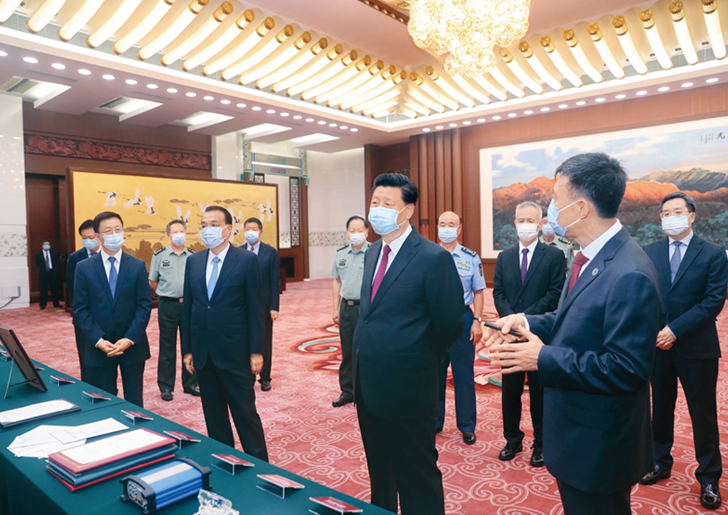
Today, we are holding the 28th group study session of the Political Bureau and our focus is on the basic principles and methodology of Marxist political economy. The aim of this study session is to strengthen our understanding of the basic principles of Marxism. We have previously held sessions on subjects related to historical materialism and dialectical materialism. On this occasion, we will deepen our understanding and grasp of the laws underlying economic development by reviewing Marxist political economy so that we can become more competent and proficient at leading the nation's economic development.
I would now like to discuss some of my thoughts.
Marxist political economy is an important component of Marxism, and required learning for our efforts to uphold and develop Marxism. Marx and Engels carried forward historical achievements made in the field of economics, especially British classical political economy, through a process of critical examination based on the worldview and methodology of dialectical materialism and historical materialism. After intensive study of human economic activities, they founded Marxist political economy, which drew back the curtain on the laws underlying the economic workings of human society and capitalist society in particular. Engels said that the whole theory of a proletarian party was derived from the study of political economy, while Lenin regarded political economy as the most profound, most comprehensive, and most detailed proof and application of Marxist theory. Though there is now a rich diversity of economic theories, our study of political economy must be based on Marxist political economy and not any other economic theory.
There are people who believe Marxist political economy and Das Kapital are obsolete, but this is an arbitrary and erroneous judgment. Setting aside more distant events and looking at just the period since the global financial crisis, we can see that many capitalist countries have remained in an economic slump, with serious unemployment problems, intensifying polarization, and deepening social divides. The facts tell us that the contradictions between the socialization of production and the private possession of the means of production still exist, but they are manifested in ways and show characteristics that are somewhat different. After the global financial crisis, many Western scholars began studying Marxist political economy and Das Kapital again for the purpose of reflecting on the deficiencies of capitalism. Last year, the book Capital in the Twenty-First Century by French scholar Thomas Piketty aroused broad discussion in international academic circles. Using accurate and abundant data, Piketty shows that levels of inequality are as high or higher than they have ever been in the US and other Western countries. He argues that unconstrained capitalism has aggravated phenomena such as wealth inequality, and that the situation will continue to get worse. His analysis is mainly conducted from the perspective of distribution and does not touch significantly upon more fundamental questions of ownership, but the conclusions he reaches are nonetheless well worth our consideration.
Our Party has always attached great importance to the study, analysis, and application of Marxist political economy. Mao Zedong arranged special reviews of Das Kapital on four occasions, and led multiple discussions on the Soviet Textbook on Political Economy, stressing that the analysis of questions on political economy was of great theoretical and practical significance. During the period of New Democracy (1911-1949), Mao Zedong created the new democratic economic program, and introduced a number of original ideas on developing China's economy in the process of exploring the path to socialism. For example, he introduced the theory of basic contradictions in socialist societies, and put forward important concepts such as pursing comprehensive planning and overall balance, regarding agriculture as the foundation and industry as the leading force, and coordinating the development of agriculture, light industry, and heavy industry. These are all examples of how our Party has driven forward evolution of Marxist political economy.
Since the Third Plenary Session of the 11th CPC Central Committee in 1978, our Party has integrated the basic principles of Marxist political economy with the practice of reform and opening up, and made constant efforts to enrich and develop Marxist political economy. After the "Decision of the CPC Central Committee on Reform of the Economic Structure" was passed in October 1984, Deng Xiaoping commented that this represented a"first draft" of political economy that fused the basic principles of Marxism with the practice of socialism with Chinese characteristics. As reform and opening up has constantly pushed deeper in the more than three decades that have passed since then, we have brought about many important theoretical achievements in the Marxist political economy of contemporary China. Some examples are the theory on the essence of socialism, the theory on the basic economic system for the primary stage of socialism, the theory on establishing and implementing the philosophy of innovative, coordinated, green, open, and shared development, the theory on developing the socialist market economy and making the market play the decisive role in resource allocation while ensuring that the government better plays its role, the theory on China's entrance into a new normal of economic development, the theory on coordinating the processes of new industrialization, digitalization, urbanization, and agricultural modernization, the theory on the nature of ownership rights, contract rights, and usage rights for contracted farmland, the theory on making effective use of domestic and international markets and resources, and the theory on promoting social equity and justice and bringing about common prosperity for everyone. These theoretical achievements were never discussed by the authors of the Marxist classics, and before reform and opening up we had no experience or understanding of the issues with which they are concerned. Instead, they form a body of knowledge about political economy that has been molded by the conditions of contemporary China and the nature of the times. This has not only provided firm guidance for China's endeavors in economic development, but also opened up new frontiers for Marxist political economy.
In the volatile and unpredictable tide of the world economy today, a major test of our Party is whether or not we can effectively steer the great ship of China's economy. With an extremely complex economic landscape both at home and abroad and an overwhelming profusion of economic phenomena to contend with, studying the basic principles and methodology of Marxist political economy can help us master sound means of economic analysis, understand the processes through which the economy runs, build a grasp of the laws underlying social and economic development, and become more competent at keeping the socialist market economy on course. This will enable us to address theoretical and practical challenges in our nation's economic development more effectively.
The purpose of studying Marxist political economy is to better lead China's economic development. While we must ensure that we uphold its basic principles and methodology, it is even more important that we integrate Marxist political economy with the realities of our nation's economic development, and constantly strive toward new theoretical achievements in the process.
First, we must uphold a people-centered approach to development. Development is for the people; this is the fundamental position of Marxist political economy. Marx and Engels stated that, "The proletarian movement is the self-conscious, independent movement of the immense majority, in the interests of the immense majority," and that in future societies, production would be "calculated for the wealth of all." Deng Xiaoping said that emancipating and developing productive forces and eliminating exploitation and polarization in order to ultimately bring about common prosperity represents the essence of socialism. The Fifth Plenary Session of the 18th CPC Central Committee in October 2015 clearly emphasized the need to uphold a people-centered approach to development, and to make improving the people's wellbeing, promoting their all-round development, and pursuing steady progress toward common prosperity the immutable aims of economic development. This is something that we must never lose sight of. When planning economic work, formulating economic policies, and promoting economic development, we must always adhere firmly to this fundamental position.
Second, we must uphold the new development philosophy. Responding to new changes in the environment, conditions, tasks, and requirements for our nation's development, the Fifth Plenary Session of the 18th CPC Central Committee set forward the need to establish and uphold a new philosophy of innovative, coordinated, green, open, and shared development. The five components of this philosophy were introduced on the basis of a deep review of lessons and experience in development from at home and further afield, as well as a thorough analysis of major domestic and international development trends. They represent a concentrated reflection of our Party's new understanding of the underlying laws governing China's development, and correspond with many of the perspectives of Marxist political economy. For example, Marx and Engels imagined future societies in which there would be "participation by all in enjoyments produced by all," in which "man is directly a natural being," and in which "the history of nature and the history of men are dependent on each other." Meanwhile, the five components of the new development philosophy also represent a distillation of the perceptual knowledge we have acquired in the process of driving forward economic development and a theoretical summary of our experience in this regard. We must persist in using the new development philosophy to guide and advance our nation's economic development, and to consistently resolve challenges and break new ground in the process.
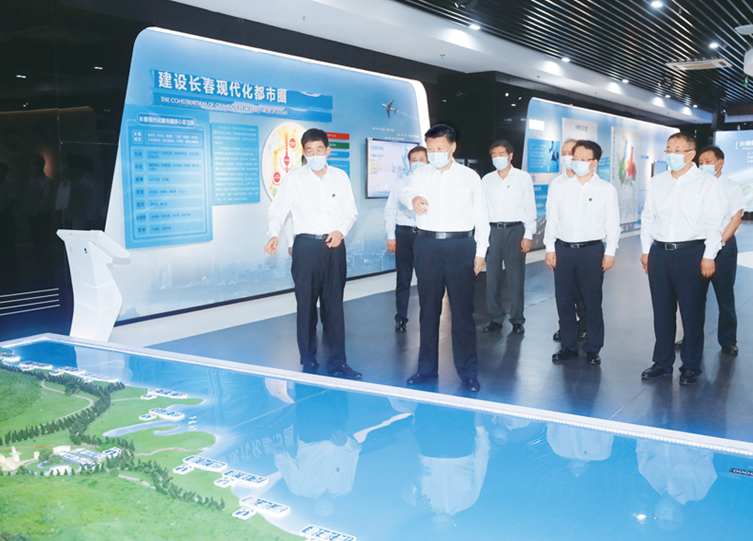
Third, we must uphold and improve our basic socialist economic system. According to Marxist political economy, ownership of the means of production is the core of the relations of production, and this determines a society's fundamental nature and the orientation of its development. Since reform and opening up, our Party has reflected on both positive and negative experiences, and established a basic economic system for the primary stage of socialism. Under this system, we have stressed the importance of continuing to make public ownership the mainstay while allowing ownership of other forms to develop side by side, and made it clear that both the public and non-public sectors are important components of the socialist market economy as well as crucial foundations for our nation's economic and social development. We must consolidate and develop the public sector with firm commitment, and devote equal commitment to encouraging, supporting, and guiding the development of the non-public sector, ensuring that ownership of all forms can reinforce each other and develop together. At the same time, we must be extremely clear that our nation's basic economic system is an important pillar of the Chinese socialist system and the basis of the socialist market economy, and therefore the dominant role of public ownership and the leading role of the state sector must not change. This represents an institutional guarantee for ensuring that people of all ethnic groups across China are able to share in the fruits of development, as well as an important means of consolidating the CPC's governing position and upholding our nation's socialist system.
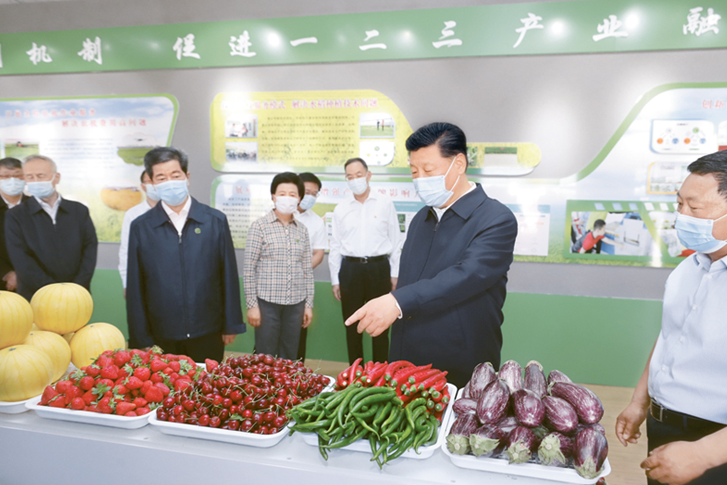
Fourth, we must uphold and improve our basic socialist distribution system. Marxist political economy posits that distribution is both determined by and reactive to production, and that "production is most encouraged by a mode of distribution which allows all members of society to develop, maintain, and exert their capacities with maximum universality." Through consideration of our actual conditions, we established a system of distribution centered on labor-based distribution while allowing other forms of distribution to coexist. This institutional arrangement has been proven through practice to be conducive to mobilizing the initiative of all sectors and achieving an organic balance between efficiency and equity. Due to a multitude of factors, however, a number of prominent problems still exist in China's income distribution. The main problems are that the income gap has grown wider, the proportion of primary distribution accounted for by wages is relatively low, and the share of personal income in the distribution of national income is also on the low side. We have taken these problems very seriously, working hard to ensure that personal income grows in step with the economy, and that wages increase in step with labor productivity. We will adjust the national income distribution stricture, bring about consistent increases in the incomes of urban and rural residents, and continue to shrink the income gap, through constant improvement of systems and mechanisms as well as specific measures.
Fifth, we must uphold reforms to develop the socialist market economy. Developing a market economy under conditions of socialism represents a great pioneering effort undertaken by our Party. One of the key factors behind China's tremendous success in economic development is that we have simultaneously leveraged the strengths of both the market economy and the socialist system. Our market economy has developed under the essential conditions of socialist system and the leadership of the CPC. The term "socialist" is the key descriptor, and this is something that we must never lose sight of. We call our economy a socialist market economy because we are committed to maintaining the strengths of our system while effectively avoiding the deficiencies of a capitalist market economy. Recognizing the two-sided nature of things under a dialectical approach, we must keep working to integrate the basic socialist system with the market economy, ensuring that the strengths of each are brought to bear, and devote practical efforts to solving the universal economic challenge of how to have both an efficient market and an effective government.
Sixth, we must uphold the fundamental national policy of opening up. According to Marxist political economy, human society will ultimately witness the transcendence of history from the level of individual nations to the global scale. Today, the degree of our country's connection with the world is unprecedented, as is our economy's impact on the world economy and vice versa. With globalization advancing deeper, we could not possibly pursue development by closing ourselves off. Instead, we must be adept at keeping an eye on the landscape both at home and abroad, and making good use of domestic and international markets and resources. Conforming to the trend of our economy's deep integration into the world economy, we must develop a more open economy, actively participate in global economic governance, and push the global economic order in a more just, equitable, cooperative, and mutually beneficial direction. At the same time, we must firmly safeguard our nation's development interests, forestall risks of all kinds, and ensure our economic security. In carrying out these tasks, there are many theoretical and practical questions that we must explore further.
To conclude, our commitment to upholding the basic principles and methodology of Marxist political economy does not imply rejection of the rational components of the economic theories of other countries. Western economic knowledge on topics such as finance, prices, currency, markets, competition, trade, exchange rates, industries, enterprises, growth, and management do reflect one side of the general laws underpinning socialized production and market economics, and should therefore be used as reference. At the same time, however, we must cast a discerning eye on the economic theories of other countries, particularly those of the West, making sure that we separate the wheat from the chaff. Putting our own interests first while using the strengths of others to our advantage, we must ensure that we do not mechanically copy the aspects of these theories that reflect the nature and values of the capitalist system or that are colored by Western ideology. Although the discipline of economics is devoted to the study of economic issues, it does not exist in a vacuum, and therefore cannot be separated from social and political issues. Therefore, when our educators teach economics, they must not advocate the indiscriminate absorption of foreign concepts. They must discuss Marxist political economy and the socialist political economy of contemporary China thoroughly and at length so to prevent their marginalization.
For Marxist political economy to remain vital, it must evolve with the times. Practice is the source of theory. In the space of mere decades, we have completed a process of development that took centuries for developed countries. Behind all our incredible progress and achievements in economic development have been the tremendous momentum, vigor, and potential of theoretical innovation. Today, our economy and the world economy are facing many major new challenges, and these need to be addressed by sound theories. Grounded in China's national conditions and our experiences in development, we must thoroughly look into new issues and circumstances faced by the domestic and global economies, bringing new patterns and characteristics to light. We must review and refine the achievements we have made in recognizing underlying laws through the process of economic development, and elevate our practical experience to the level of systematized economic theories. By doing so, we will constantly open up new frontiers for Marxist political economy in contemporary China, and contribute Chinese wisdom to the discipline's innovation and development.
Speech at the 28th group study session of the Political Bureau of the 18th CPC Central Committee on November 23, 2015
Originally appeared in Qiushi Journal, Chinese edition, No 16, 2020



- CPC issues revised regulations on its working bodies
- Melodic harmony under gingko tree
- Media tour explores Xiamen's tech surge and smart manufacturing
- Discover Xiamen with beauty of ecological governance
- Conference aimed at strengthening global organ donations opens in Guangzhou
- In China's 'ice city,' ice harvest sets stage for winter tourism season