Cleaner city leader









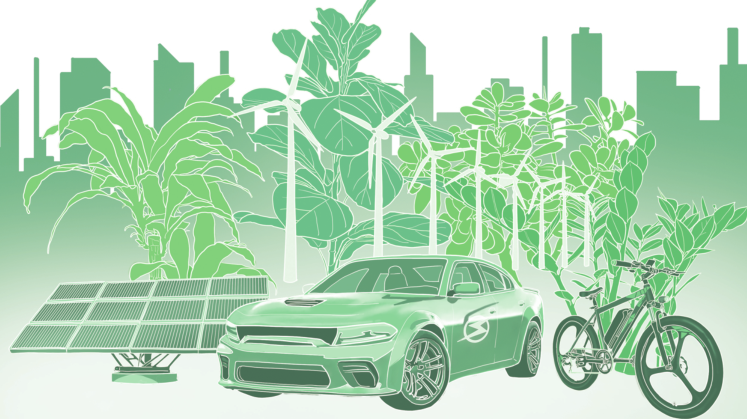
China could demonstrate international leadership in the collective fight against global threats by focusing on sustainable urban development
Having done a good job in controlling the novel coronavirus and restarting its economy last year, China is leading the world's economic recovery, and it now has a critical opportunity to demonstrate to the rest of the world how to make the transition to sustainable and resilient growth, particularly in its cities.
New figures show that China's economy grew by 2.3 percent in 2020. Although this was sharply down on the growth rates over the past few years, it is a better performance than the contractions recorded by many other countries, including the advanced economies. In particular, China's GDP increased by 6.5 percent in the last quarter of 2020, higher than the annual growth rate in 2019.
The flip side of China's rapid economic recovery in 2020 was the continued rise in its carbon dioxide emissions, as its consumption of coal increased by 0.6 percent last year, oil by 3.3 percent and natural gas by 7.2 percent.
It is a reminder of the challenge that China still faces to realize President Xi Jinping's vision of an ecological civilization.
China's growth in recent decades has helped to lift hundreds of millions of people out of poverty and improved living standards across the country. This economic miracle has mainly been powered by the growth of its cities, with many workers migrating from rural to urban areas.
But much of this urban development has created pollution, waste and inefficiency. The 14th Five-Year Plan (2021-25), which has been adopted at the just-concluded session of the National People's Congress, offers a chance for China and its cities to move toward higher-quality growth, with sustainable urban development at its center.
Many of China's cities, particularly those along its coastline, have become sprawling metropolises, as local authorities have attempted to generate revenues, including from land sales, by encouraging rapid outward development.
But this has been at the expense of the destruction of arable land, natural ecosystems and biodiversity in the surrounding rural areas. It has also locked in inefficiencies and pollution with longer commuting times for many workers, and higher consumption of energy and fossil fuels.
As recent studies by the Coalition for Urban Transitions have outlined, China has much to gain if its future growth is focused on clean, compact and connected cities where it is easier to move, breathe and work productively.
Such a new paradigm of urban development is urgently needed in China as it moves away from massive investment in high-carbon sectors. Stronger spatial planning policies and improvements in the energy, buildings, materials and transport sectors would support this.
Some of China's cities are already embracing a more sustainable model for development, driven by cleaner energy, more efficient use of resources, and innovation in technology, finance and policy.
Shenzhen, for instance, has embraced low-carbon development, focusing on the greening of its industries. It has been continuously improving its economic quality, with innovation and industrial modernization at the core, rather than narrowly focusing on the pace of growth. For almost 10 years, it has been operating a trading system for greenhouse gas emissions, and it plans to peak emissions by 2022.
Sustainable urban development has boosted Shenzhen's competitiveness domestically and internationally. It provides important lessons for other cities in China.
China's huge and growing urban population, as well as its leading role in promoting green finance, means that it will likely play a particularly important role in pushing forward sustainable urban development across the world, including in the countries participating in the Belt and Road Initiative.
Sustainable urban development will be crucial to the achievement of President Xi's historic pledge, announced at the United Nations last September, that China will strive to achieve carbon neutrality before 2060.
Given the aim of peaking national emissions of carbon dioxide before 2030, China will be attempting a transition over 30 years that other countries are planning to achieve over a significantly longer period.
For instance, the United Kingdom's territorial emissions of carbon dioxide peaked in 1972, and it plans to reduce its output of all greenhouse gases to net zero by 2050.
If China were to accelerate sustainable urban development across the country during the 14th Five-Year Plan, it would reinvigorate growth and put itself more firmly on the path to an ecological civilization.
It would mean, for instance, that many of its cities could peak their emissions before 2025, allowing the country as a whole to reach the milestone of peaking by 2025, and putting the 2060 target for carbon neutrality more firmly in reach.
If China's updated nationally determined contributions to the Paris Agreement includes a commitment to peak emissions by 2025, it would place pressure on the Biden administration to respond with a significantly more ambitious pledge by the United States.
Joint leadership by the world's two largest emitters of greenhouse gases is needed now more than ever. An analysis recently published by the UN revealed that the updated emissions plans of countries that have already been submitted ahead of the global climate change summit scheduled to be held in November in Glasgow, Scotland, are still not consistent with the goal of limiting global warming to well below 2 C.
And we have seen the growing cost of climate change impacts, which includes wildfires, flooding and storms, over the past 12 months, with 2020 ranking as the warmest year on record in both Europe and Asia.
Most of all, sustainable urban development would demonstrate how the world could benefit from China's international leadership in the collective fight against global threats including infectious diseases, biodiversity loss and climate change.
Nicholas Stern is chair of the Grantham Research Institute on Climate Change and the Environment at the London School of Economics. Qi Ye is the professor of environmental policy at Tsinghua University and director of the Institute for Public Policy at the Hong Kong University of Science and Technology.