Waste management booming
Industry now worth billions of dollars as country tackles mounting problem









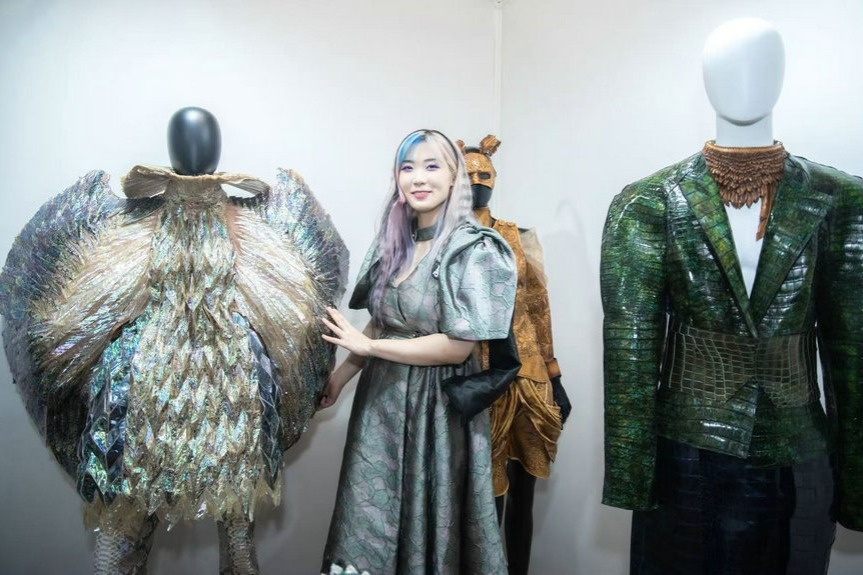
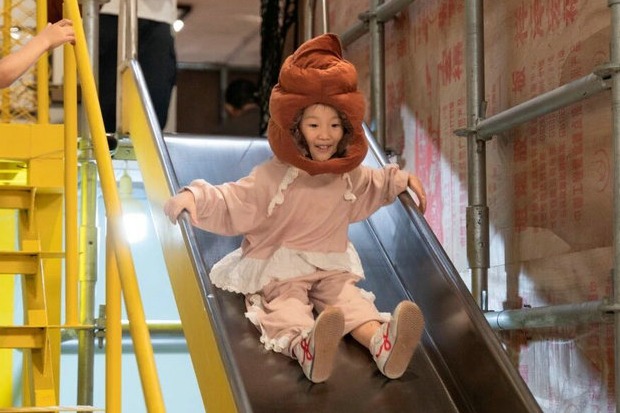
In Shanghai's Pujin subdistrict, sculptures made from beverage cans, bicycle tires and plastic bottles are displayed around a recyclable transfer center. This is where 17 trucks transport recyclables every week from 71 districts and nine villages near the center.
"We came up with the idea of making sculptures with trash to let people know that trash can be useful when sorted properly," said Ma Jun, deputy manager of the center.
Residents can use a WeChat mini program to request that their recyclables are picked up, or they can deposit the recyclables at a designated station in their neighborhood. After the recyclables are compressed, they are sold to big recycling plants to be turned into raw materials again.
The Pujin facility, built in 2019, is one of the 200 recyclable transfer centers operating in Shanghai. They collect about 6,800 metric tons of discarded glass, textiles, plastics, paper and metals every day. It is also part of the growing waste management business that China has been building in recent years.
Solid waste management has become big business in China as the country resolves to tackle the mounting urban trash problem in the next five years. This has in turn created multibillion-dollar market opportunities in the industry.
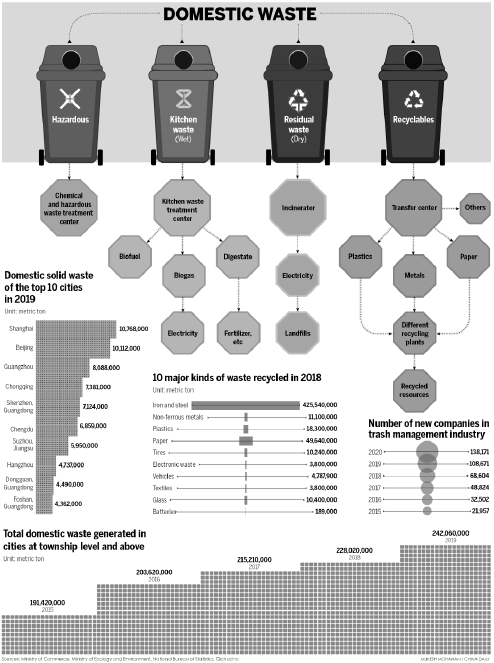
China is among the world's largest producers of municipal solid waste, which is generated from companies, institutions, individuals and households. According to the National Bureau of Statistics, the country's urban population produced 240 million tons of waste in 2019.
The solid waste management chain includes trash collection, transportation, treatment and recycling. Currently, more than 99 percent of urban waste is collected and around half of it will go to incinerators, while the rest ends up in landfills, which has created problems of soil and underground water contamination and land shortages.
Experts said the way out of the urban trash problem is to increase the percentage of trash incineration and recycling, and that sorting trash at the disposal stage is key to recycling.
"Trash sorting can drive the upgrade of the whole waste management chain," said Liu Jianguo, a professor at Tsinghua University's School of Environment. "When domestic trash is separated, kitchen waste can be processed with compost technology, and much of the resources can be recycled without being mixed with wet waste."
The country launched pilot trash classification programs in the early 2000s, only to receive a lukewarm response from the public. It was only in 2018, when President Xi Jinping emphasized the importance of trash classification, that the initiative started to get on the fast track.
In the proposal for the 14th Five-Year Plan (2021-25) and the long-range objectives through the year 2035, now ratified, the Communist Party of China Central Committee said the country should implement trash classification, reduction and resource recovery, and accelerate the building of waste recycling systems.
The question "What kind of trash are you (carrying)?" became a popular joke among people in Shanghai when the city implemented a law in 2019 that required the sorting of household waste into four categories-recyclables, kitchen, hazardous and residual waste (nonhazardous waste material that cannot be re-used or recycled)-or face fines.
Community volunteers and grassroots officials stationed at the trash bins would ask people who came to dump trash that question and helped them gain knowledge of trash classification.
Despite initial skepticism, the trash sorting program has been successfully implemented. According to last year's figures from the Shanghai municipal government, the amount of collected recyclables had grown 57.5 percent and kitchen waste 27.5 percent, while residual waste decreased 20 percent.
Similar laws and regulations were then adopted across the country, as the central government ordered 46 major cities to finish implementing a trash classification and treatment system by the end of last year. About 300 cities at the prefecture level and above should have similar systems to classify and dispose of trash by 2025.
Huang Wei, the president of electronic waste recycling company TES-AMM China, said the waste the company collects has increased in recent years. "The country is getting more serious and is supportive of the recycling industry. … The e-waste we received grew around 10 to 20 percent every year," he said.
The company has been providing services since 2005 to manufacturers to recycle old computers, mobile phones and other home appliances. It now processes about 10,000 tons of e-waste a year, recycling 98 percent of the waste back into raw materials such as gold, copper and iron.
"As the trash sorting program is gradually implemented, we hope to expand our services to recycle more e-waste from domestic waste in the next five years," Huang said.
Around 200 billion yuan ($30.7 billion) in investment will be needed if the trash sorting program in Shanghai is to be implemented across China, according to a report by Orient Securities. Another report from market tracker Mordor Intelligence said China's overall waste management market is expected to grow at a compound annual growth rate of more than 7 percent from 2019 to 2024.
Data from Qichacha, a company that tracks business registrations, showed that around 500,000 companies operate in the waste management industry in China, and more than 300,000 companies were founded in the past three years.
Many companies are entering the trash separation and recycling market. Huazhan Environment in Jiangsu province launched a new brand, Maoxiansheng, or Mr Cat in English, selling intelligent trash stations and bins to local governments and residential communities.
Equipped with cameras, sensors and screens, the smart trash stations are interactive and help people to correctly dispose of different kinds of refuse. They can also alert waste transportation companies when bins are full.
Xue Tao, executive director of environmental think tank E20 Institute, said the hottest market segments in the waste management industry will be kitchen and food waste treatment.
"Since 2019, the growth of the trash incineration market has started to slow down after several years of rapidly constructing new incineration plants, which have basically met the needs of trash incineration in large cities, and future development will be in smaller cities," he said.
Statistics from the Ministry of Ecology and Environment show that the number of trash incineration plants in China has tripled to more than 400 in the past decade.
"The implementation of trash sorting programs across the country will separate a lot of wet waste, which demands more treatment facilities, and we estimate there will be a market of 213 billion yuan during the country's 14th Five-Year Plan (2021-25) period," Xue said.
Every day, about 15,000 tons of trash-or half of the domestic trash generated in Shanghai-is processed at the Laogang Ecological and Environmental Protection Base, the largest comprehensive trash treatment facility in Asia. There are also landfills, incineration and biomass energy plants at the base.
Since beginning operations in 1985, the base has evolved from a huge landfill into a modern waste treatment center. In 2019, the second phase of its incineration plant and a new biomass plant began operations. The incineration plant can burn 6,000 tons of dry trash a day, while the biomass plant can process 1,000 tons of wet trash.
"In the past, we dumped 3 million tons of trash into the landfill a year. But now, we have changed from dumping to incineration, and only the ashes and slag are sent to landfills," said Zhu Siliu, general manager of the Laogang Renewable Resource Recycling Center.
"By burning trash, we generate up to 1.2 billion kilowatt-hours of electricity a year," Zhu said.
The recycling and resource recovery sector, which deals with waste metal, paper, textiles, plastics glass and electronics, has also been expanding. According to a report by the Ministry of Commerce and the China National Resources Recycling Association, the total amount of recycled waste was 320 million tons in 2018, up 13.4 percent from the previous year.
As for the recyclable transfer center in Pujin, the expansion of China's recycling industry is only good news.
"When the transfer center opened in 2019, we could only collect 3 tons of recyclables per day. But by the end of 2020, the daily average rose to more than 15 tons, which makes our revenue break even," said Ma, deputy manager of the center. "Public awareness and government emphasis have contributed to the change. I cannot wait to see more breakthroughs in this field in 2021."