Current features and trends in the South China Sea










Remarks at the 34th Asia-Pacific Roundtable
The situation in the South China Sea is evolving from stability to chaos this year due to a combination of factors in the region—a new round of policy changes in the United States since President Biden took office, the potential rise of anti-Duterte and pro-US forces in the Philippines because of the narrowing window for the consultations on the Code of Conduct in the South China Sea (COC) and changes in its domestic politics in the near future, and China's growing and diverse capacity to safeguard its rights to the South China Sea. We can see the following new features and trends.
First, the US-led security multilateralism is taking shape in the South China Sea.
Since taking office, the Biden administration keeps saying to the world that it will abandon the unilateralist approach of its predecessor and return to multilateralism as the principle in dealing with global affairs. In the Interim National Security Strategic Guidance released in March 2021, the White House identified "lead and sustain a stable and open international system, underwritten by strong democratic alliances, partnerships, multilateral institutions, and rules" as one of the three priorities of the US national security strategy in the new era. The guidance was blunt when it said "We can do none of this work alone. For that reason, we will reinvigorate and modernize our alliances and partnerships around the world." It is worth noting that the US "multilateralism", essentially based on an exclusive club composed of its allies and partner nations, is driven by its own interests such as containing China.
The Biden administration's multilateralism on the security front is perfectly presented in the South China Sea. In February shortly after it took office, the Biden administration chaired a Quad foreign ministers' meeting among the United States, Japan, India and Australia; in March, pushed by the United States, the Quad held its first-ever leaders' summit, with the South China Sea issue as a must on its agenda. Signs indicate that the United States intends to extend and expand the Quad relaunched in 2017 to the South China Sea, bringing Britain, France and Germany as well as some countries in the region to put together a NATO in the Indo-Pacific. With their own interests and aspirations, these countries inside and outside the region have followed the US steps to contain China in the South China Sea.
Second, the US "New Deal" for the South China Sea is emerging.
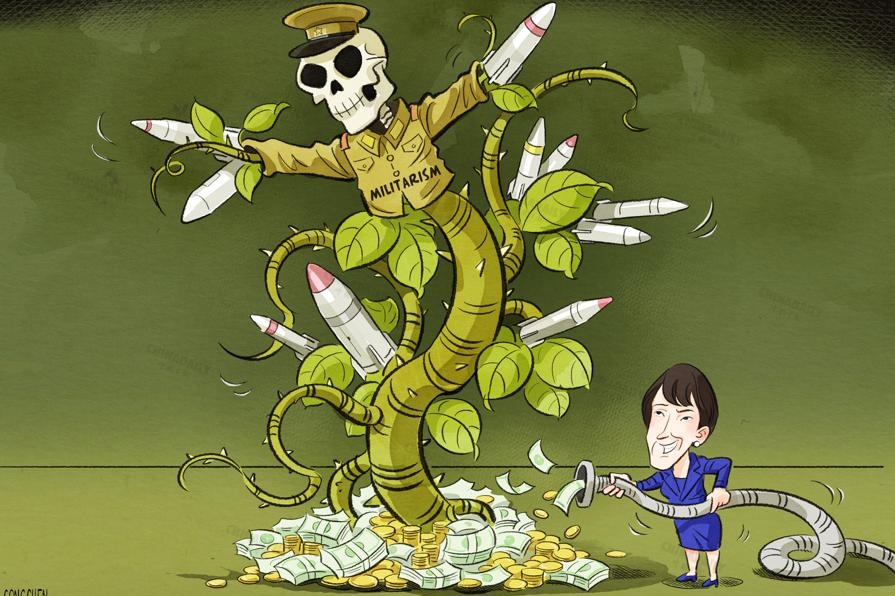
Just as the US "one-China policy" on Taiwan exists in name only, its "New Deal" in the South China Sea will also abandon the "neutrality" policy. In addition to reconfiguring and strengthening relations with allies and partners such as the Philippines and Vietnam, the US "New Deal" in the South China Sea focuses on regional military deployment adjustments. On June 9, after four months, the China Task Force, a group of 15 civilian officials and military advisors, submitted a report to Defense Secretary Austin with specific and practical recommendations for dealing with China. The report is a classified document, but from what some senior US officials have revealed, the central theme of the report is to focus on its number one challenge—China, to be specific, by revitalizing the network of allies and partners, enhancing deterrence, and moving faster in building new, modernized war-fighting capabilities.
Defense Secretary Austin asserted that the US needs to redeploy its military globally in response to the Chinese threat, stressing that China would not be allowed to gain military advantage. This plan means that the US will start another round of military deployment adjustment after deploying 60 percent of its naval forces to the Asia-Pacific region in 2012 under the Asia-Pacific rebalancing strategy. Judging from the current tensions in the US-China military competition, the Pentagon will continue to deploy superior forces to the Indo-Pacific region, including new combat capabilities such as unmanned and intelligent systems. The South China Sea region is expected to be a focus of this military deployment adjustment.
Third, it will be difficult to stop unilateral actions of claimant countries, mainly oil and gas development activities in disputed areas.
Offshore oil and gas development in the South China Sea has been a major driver for economic and social development in claimant countries such as Vietnam, Malaysia and Brunei since the 1980s, , and will underpin their post-Covid economic recovery. Among them, Vietnam and Malaysia have made preparations for the next round of unilateral oil and gas activities in the disputed area of Block 117/118 in the Xisha Islands and Nankang Ansha in the Nansha Islands respectively. In addition, with the approach of presidential election in the Philippines (only ten months away), China-Philippines relations may suffer some setback after President Duterte leaves office. The Philippines may take some unilateral actions, such as raising the arbitral ruling again, suspending its ongoing negotiations with China on oil and gas cooperation, and creating new disputes, for example, in the waters of Ren'ai Reef, the Huangyan Island and Tiexian Reef.
Fourth, maritime cooperation and joint development advocated by China will face unprecedented difficulties.
To maximize their resource development interests and maritime claims, some claimant countries have put forward unilateral claims based on the arbitral ruling, made lukewarm reaction to the Chinese proposals on multilateral maritime cooperation and joint development activities, and showed little political will in joint cooperation. At the same time, from the perspective of some claimants, as the window is closing for COC consultations, unilateral actions to consolidate and expand vested interests far outweigh the need for cooperation in terms of importance and urgency. In addition, the new US policy on the South China Sea and the pursuit of geopolitical and geoeconomic interests by extra-regional countries in the South China Sea through military and diplomatic means have increased, to some extent, the cost of cooperation between other coastal states with China.
Fifth, under the shadow of the arbitral ruling, legal struggle is revived once again.
In the eyes of the United States, the Philippines, Vietnam and many other countries inside and outside the region, the arbitral award is by no means a "scrap of paper". Since last year, a number of countries in and out of the region have invoked the arbitral award time and again under the name of "upholding and respecting international law" in an attempt to deny China's claims. In the battle of diplomatic notes triggered by Malaysia's submission on the outer limits of the continental shelf beyond 200 nautical miles from the baselines in the South China Sea on December 2019, Vietnam, Malaysia, the Philippines, Brunei and Indonesia have submitted notes to the UN Secretary-General or issued statements for 11 times, all of which based their main arguments on the arbitral ruling. Philippine President Rodrigo Duterte claimed in the general debate of the 75th session of the UN General Assembly in September 22, 2020 that "the award is now part of international law". On June 23 this year, Philippine Foreign Secretary Teodoro Lotsin Jr. said in a public statement that the arbitral award "became and continues to be a milestone in the corpus of international law"; on June 28, a Philippine senator filed a resolution declaring July 12 as "National West Philippine Sea Victory Day", in honor of the late "father of our 2016 victory at The Hague"—President Aquino III. This year, as the fifth anniversary of the arbitral award, the United States, the Philippines and some other countries with ulterior motives may seize the opportunity and take new initiatives to hype up the award, or revive it in some other ways.
Sixth, the possibility of COC consultations "stillborn" could not be underestimated.
Having reached agreement on the framework in 2017 and the single text for consultations in 2018, the parties to the COC consultations have begun the second reading of the text. Having moved on the "fast track" for a while, the COC consultations are facing three new and more serious challenges. First, the premise, objectives and expectations for claimants such as Vietnam, the Philippines and Malaysia to participate in the consultations have changed. They have notably less political will to push for progress in the talks, making it difficult for the parties to build effective consensus. Second, the United States has been moving faster in changing its strategy and tactics to prevent China from dominating the South China Sea issue through the COC consultations. It is pushing for faster militarization of the South China Sea to hedge the efforts advocated by China to manage crisis by rules. Third, the rise in China's hard power in the South China Sea has not been accompanied by a rise in its soft power. Anxiety and hostility toward China's rise has not been mitigated among other coastal states to the South China Sea. Concerns remain on China's perceived efforts to dominate the making of regional rules through the COC consultations. These three factors combined make it increasingly difficult for China and ASEAN countries to reach final agreement on the COC text. The possibility could not be excluded for stagnated or "stillborn" COC consultations.
WU Shicun is Founding President of China's National Institute for South China Sea Studies and Chairman of China-Southeast Asia Research Center on the South China Sea