Time to reflect on 'week that changed world'









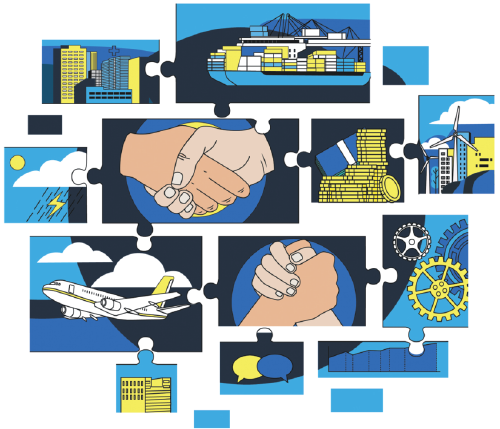
The week starting Feb 21 half a century ago is remembered as one of the most momentous in modern history. It was, as then US President Richard Nixon aptly described, "the week that changed the world".
Nixon, a once-rabid, life-long anti-communist arrived in Beijing on Feb 21, 1972, to turn a previously hostile relationship into what would soon become one of warm peace in the depths of the Cold War. The architect of Nixon's visit was then national security adviser and later secretary of state Henry Kissinger, master practitioner of the realpolitik school of international relations.
Need to take in-depth look at communique
At the conclusion of Nixon's visit, the two countries signed the Shanghai Communique. The communique along with the other two in 1979 and 1982, are the foundational architecture on which Sino-US relations prospered for nearly half a century.
Relations reached their peak in 2013 when President Xi Jinping and then US President Barack Obama agreed in their Sunnylands Summit on a new model of major country relations. Together, the two leaders also provided the leadership needed to clinch the Paris Agreement at the UN Climate Change Conference in 2015.
Sadly, this relationship frayed soon, especially after the US presidential election a year later. Donald Trump was elected US president by a minority of the voters under the outmoded 18th century governance model that promotes white supremacy. The governance model has become malignant thanks to the dysfunctional US body politic that has metastasized to such lethal proportions that it could lead to Trump's re-election in 2024.
While I reject some Republicans' allegations that incumbent President Joe Biden has "lost" his memory, when it comes to China, not only the Trump administration but also Biden and his officials seem to have lost their institutional memories about what was solemnly agreed on in the Shanghai Communique.
It behooves us to take an in-depth look at the communique, how much of it has been and continues to be eroded, and how we can begin anew to honor the letter and spirit of the terms agreed upon.
The Chinese side stated in the communique that "all nations, big or small, should be equal: big nations should not bully the small and strong nations should not bully the weak. China will never be a superpower and it opposes hegemony and power politics of any kind."
The US side said that "the effort to reduce tensions is served by improving communication between countries that have different ideologies so as to lessen the risks of confrontation through accident, miscalculation or misunderstanding. Countries should treat each other with mutual respect and be willing to compete peacefully, letting performance be the ultimate judge. No country should claim infallibility and each country should be prepared to reexamine its own attitudes for the common good."
The communique affirms that both sides "agreed that countries, regardless of their social systems, should conduct their relations on the principles of respect for the sovereignty and territorial integrity of all states, non-aggression against other states, non-interference in the internal affairs of other states, equality and mutual benefit, and peaceful coexistence. International disputes should be settled on this basis, without resorting to the use or threat of force".
The two sides also agreed that "neither should seek hegemony in the Asia-Pacific region and each is opposed to efforts by any other country or group of countries to establish such hegemony".
Importantly, the US "acknowledges that all Chinese on either side of the Taiwan Strait maintain there is but one China and that Taiwan is a part of China. The United States Government does not challenge that position."
US shouldn't seek hegemony in Indo-Pacific
But that was then. Today, it seems like we're living in another universe with Biden's Indo-Pacific adviser, Kurt Campbell, the author of the US pivot to Asia during Obama's presidency, having declared last May that the "dominant paradigm" between China and the United States would be one of competition, as the period of US engagement with China had "come to an end".
And a few days ago, Biden's National Security Council in its "Indo-Pacific Strategy" document declared in its opening paragraph that "the United States is an Indo-Pacific power … More members of the U.S. military are based in the region than in any other outside the United States." It goes on to say that "this intensifying American focus is due in part to the fact that the Indo-Pacific faces mounting challenges, particularly from the PRC. The PRC is combining its economic, diplomatic, military, and technological might as it pursues a sphere of influence in the Indo-Pacific and seeks to become the world's most influential power."
Hegemony is defined as the dominance of one group over another. Since the disintegration of the Soviet Union, the US has been the sole global hegemon and continues to act as such. It's clear that the US, as the most capitalist of countries, where competition is the ne plus ultra, is afraid of competition from China or any other country and, in violation of its affirmations in the Shanghai Communique, wants to encircle China and contain China's peaceful rise.
The US' special focus on China also explains the revival of the Quadrilateral Security Dialogue among the US, Australia, India and Japan. It's also the raison d'être of AUKUS, a trilateral security pact among Australia, the United Kingdom and the US to assist Australia to acquire nuclear-powered submarines with China in its crosshair. And it's the reason the Cold War-era Anglosphere intelligence alliance known as Five Eyes, comprising Australia, Canada, New Zealand, the UK and the US, has focused on China and its technology giants such as Huawei.
The most difficult topic addressed by the Shanghai Communique was the status of Taiwan. It remains one of the most intractable and dangerous issues of our time. Under the Taiwan Relations Act of 1979, despite the US abolishing formal diplomatic ties with Taiwan, it followed a policy of strategic ambiguity and maintained special offices with each other.
This model was followed until Trump appeared on the scene as president-elect and had a talk with Taiwan leader Tsai Ingwen over the phone, the first official contact since 1979. The strategically ambiguous relations maintained for more than four decades began to unravel with a single phone call.
Under Trump, the US' relations with Taiwan were significantly upgraded in 2018 with the passage of the Taiwan Travel Act, which opened two-way travel by US and Taiwan high-level officials. In 2020, US relations with the island were further upgraded with the passing of the Taiwan Allies International Protection and Enhancement Initiative Act. The two acts increased the scope of US relations with Taiwan and encouraged other countries and international organizations to strengthen their official and unofficial ties with Taiwan.
And in January 2021, Biden invited Taiwan's delegate to the US to his inauguration, the first time since 1979. Worse, in December, the only non-country invited to Biden's so-called "Summit for Democracy" was Taiwan.
With so many problems in the world, and with many of the existential challenges shared by the US and China such as global health, the environment and arms control, isn't it time to resume some degree of bilateral cooperation in the spirit of Sunnylands and the Shanghai Communique?
Unfortunately, it's unlikely to happen any time soon. Bringing the story full circle, the secretary of state in the Trump administration, Mike Pompeo, a likely 2024 presidential candidate, visited the Nixon Library in California where Nixon grew up and is now buried, in July 2020. Pompeo basically trashed the Nixon-Kissinger initiative that has yielded so much fruit over most of the past five decades.
While Pompeo has shed more than 40 kilograms, he still retains his rusted armor as an unrepentant Cold War warrior. Poor Nixon must have been turning in his grave.
The views don't necessarily reflect those of China Daily.
The author is a senior fellow at the Center for China and Globalization.
If you have a specific expertise, or would like to share your thought about our stories, then send us your writings at opinion@chinadaily.com.cn, and comment@chinadaily.com.cn.