


Philippines has gone off course in South China Sea









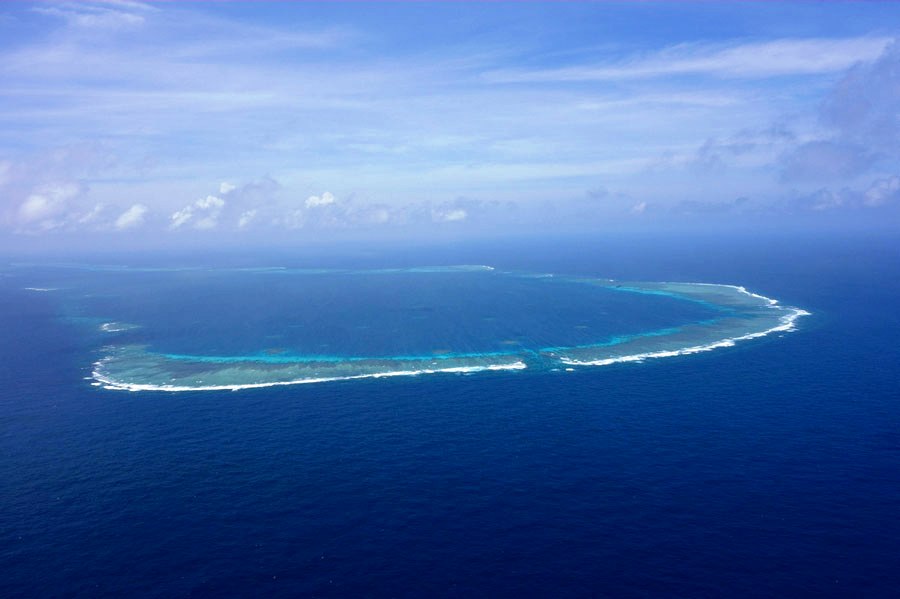
Recently, the maritime situation at Ren'ai Jiao has attracted attention from the international community. Ren'ai Jiao is an integral part of China's Nansha Islands, and China's territorial sovereignty over Ren'ai Jiao is based on China's overall claim to Nansha Islands as a mid-ocean archipelago. Under the pretext of "technical malfunction of warships", the Philippines has been illegally staying on Ren'ai Jiao for a long time and has also tried to illegally occupy Ren'ai Jiao by building permanent facilities, thus violating China's territorial sovereignty.
China's response to the Philippines' illegal transportation of construction materials at Second Thomas Shoal is based on the need to safeguard territorial sovereignty, not out of geopolitical considerations, nor is it a countermeasure to the Philippines-US alliance to enhance synergy, nor is it taking advantage of the "opportunity" of the Russia-Ukraine conflict and the Middle East conflict to "expand" in the South China Sea, as some commentators have wrongly speculated.
While firmly safeguarding its territorial sovereignty and maritime rights, China insists that the parties resolve disputes through direct negotiation and consultation, properly manage maritime differences and avoid escalation of crises and is committed to promoting the implementation of temporary arrangements such as joint development of resources. At the same time, China does not accept or recognize the South China Sea arbitration award, nor does it accept any claims or actions based on it.
This stability and continuity of China's South China Sea policy is rooted in its own interests in the South China Sea and a clear understanding of the nature of the South China Sea issue, and will not deviate from a right way despite the US and the West intentionally or unintentionally promoting the "de-disputed", "quasi-adjudicated" and "pan-securitization" of the South China Sea narrative, nor will it fall into self-denial due to erroneous accusations in the international arena of public opinion and the escalation of maritime affairs between China and the Philippines.
It is clear from the recent statements made by the Ministry of Foreign Affairs, the Ministry of National Defense, and the China Coast Guard that China is objectively and rationally describing the facts and restoring the truth when it comes to the maritime situation at Ren'ai Jiao, and admonishing the Philippines, which hardly contains any harsh words or emotional language.
On the other hand, the Philippines has indulged in maritime provocations in a hyped manner, with high-level officials from different departments, including the Philippine Coast Guard, the Ministry of Foreign Affairs, the Security Council, and the Department of National Defense, making emotional and inflammatory statements from time to time, and even threatening to prosecute China again before international judicial and arbitration bodies, expel the Chinese ambassador to the Philippines, unite more countries to carry out maritime patrols, or conduct security reviews of Chinese investments.
This kind of political and diplomatic rhetoric will not help ease differences and cool down the situation but may further deteriorate political mutual trust between the two sides and make people even more confused about the direction of the Philippines' China policy and South China Sea policy.
In response to the situation at Ren'ai Jiao, some political forces in the Philippines have either hyped up for personal gain or have been instigated by the United States and other countries outside the region to create chaos. This political ecology has further led to the regression of the Marcos Jr. administration's policy in the South China Sea. If there are sectors in the Philippines that could benefit from maritime tensions, the Philippine Coast Guard can be said to be strongly driven by specific interests. By continuously emphasizing maritime conflicts, the Philippine Coast Guard can secure more financial support, gain greater influence, voice and visibility in the Philippine political ecology and domestic public opinion, and even give coast guard officials more room for promotion. Senior Philippine coast guard officials have threatened on various occasions that they will "more frequently adopt means that can force China to respond more often than diplomacy." There are certainly high-sounding "reasons" behind this kind of statement, but there are obviously many actual "benefits" that cannot be put on the table, but everyone in the Philippines knows about it.
Since January, the Philippines and the United States have been discussing their alliance obligations to each other and their role in maritime emergencies. The Biden administration has asked the Marcos Jr. administration to gradually translate the Philippines' obligations to the United States under the US-Philippines Mutual Defense Treaty into a list of matters. In return, Marcos Jr. also wants the United States to be clearer about the specifics and conditions under which the treaty could be triggered in the South China Sea, as well as what kind of military and intelligence support the United States could provide to the Philippines. Clearly, the Philippines is also trying to test the extent to which the United States will meet its security commitments to the Philippines by transporting construction materials to beached warships.
The US-Philippines Mutual Defense Treaty is a product of the Cold War, and the Ren'ai Jiao issue is a bilateral issue between China and the Philippines and has nothing to do with the United States. The United States has repeatedly threatened China with the implementation of the US-Philippines Mutual Defense Treaty and endorsed the Philippines' illegal claims, which has encouraged Philippine opportunism at Second Thomas Shoal and has also had a bad affect. The Philippine-US military and security cooperation has a long history and profound impact, and at present, nationalism is rising in the Philippines, and the "China threat theory" still has a large market in the Philippines, and even the China-Philippines economic and trade cooperation, which brings tangible benefits to the Philippines, is accompanied by so-called "economic coercion" and "security threats" in the Philippines. Under such circumstances, it is difficult for the objective and rational voice of the Philippines to be heard, and some people of insight have even been labeled as betraying the national interests of the Philippines and have been attacked in the domestic public opinion arena.
The Philippines believes that the South China Sea arbitration award provides a so-called international legal basis for its Ren'ai Jiao claim. The South China Sea arbitration case is an erroneous attempt by the Philippines, instigated and supported by the United States, to reduce the space for China's sovereignty and maritime rights and interests on the premise of "legalizing" the Philippines' illegal occupation of Nansha islands and reefs. In this case, the arbitral tribunal violated many basic principles that should be followed by international judicial and arbitration institutions, exceeded its authority in exercising its jurisdiction, and rendered an award that was full of loopholes. Far from resolving disputes, the ruling has squeezed the political space for both sides to manage their differences. If the Philippines clings to the illusion that "award is international law and a guidepost" and falls into the illusion that China will accept a solution that is not fair and just, the logical result may be that the South China Sea dispute will enter an unsolvable dead loop.
At present, China-Philippines relations are facing serious difficulties, and the root cause is that the Philippines has changed its previous policy on China and the South China Sea and has reneged on its commitments. At a time when China-Philippines relations are at a crossroads, the Philippines needs to learn from history and learn valuable historical experience from the ups and downs of the situation in the South China Sea over the past decade.
Ding Duo is deputy director and associate research fellow, the Research Center for Ocean Law and Policy at the National Institute for South China Sea Studies.
The opinions expressed here are those of the writer and do not necessarily represent the views of China Daily and China Daily website.
If you have a specific expertise, or would like to share your thought about our stories, then send us your writings at opinion@chinadaily.com.cn, and comment@chinadaily.com.cn.
















