Cause for concern









MA XUEJING/CHINA DAILY
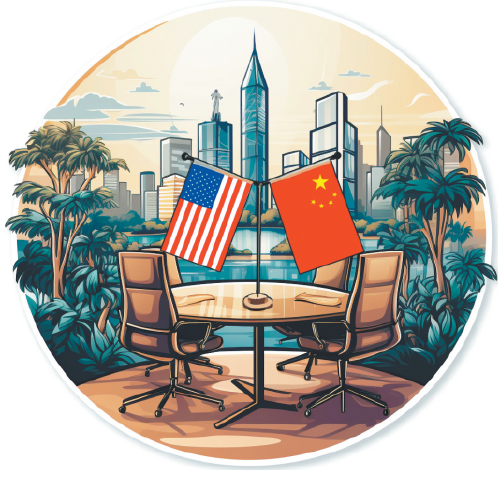
Countries in the Asia-Pacific are wary of being led into the trap of bloc politics by the US
The Joe Biden administration is intent on restoring US leadership in the "Indo-Pacific" by reinvigorating the United States' network of alliances and partnerships in the region.
The Biden administration is thus encouraging the US' allies and partners to comprehensively strengthen relations with the US and courting its allies outside the region to engage in "Indo-Pacific "affairs. By deeply intertwining security, political, economic and ideological issues, the US has been striving to create an all-round bloc and ecology to isolate and suppress China.
However, the situation in the Asia-Pacific region is completely different from what it was during the Cold War rivalry between the US and the Soviet Union. There is no way the Asia-Pacific region will tread the old path of the Cold War.
To start with, currently in the Asia-Pacific region, there do not exist two confrontational military alliance systems. On the one hand, there will be no China-led military alliance system in the Asia-Pacific region as the country maintains a non-alliance stance. On the other hand, the US can hardly rally its allies to jointly contain China through multilateral measures. The US' alliance system in the Asia-Pacific region is based on the country's bilateral relations with its allies, but the cohesiveness of US-led multilateral mechanisms is relatively low. Due to the historical disputes and great differences in geopolitics and culture between the US and its Asia-Pacific allies, the US' alliance system in the region can hardly accomplish the transformation toward a networked system. Thus, a US-led, China-focused multilateral military alliance system that resembles the North Atlantic Treaty Organization can hardly take shape in the Asia-Pacific region.
Second, different from the US-Soviet Union Cold War rivalry, the competition between China and the US is focused on economic and technological competition.
China has deeply participated in the regional division of labor amid economic globalization, and its economic growth to a great extent benefits from economic globalization. Despite a possible "decoupling" in certain sectors, a full-scale "decoupling" of the world's top two economies is unlikely. In a world where the Chinese and US economies are highly interdependent and economic globalization is deeply advanced, there can hardly be two parallel economic systems completely decoupled from each other in the Asia-Pacific region, like the one during the Cold War period.
Last, the differences in ideologies and political systems between China and the US are in no way like the two ideological camps dominated respectively by the US and the Soviet Union. Differences in values between China and the US are not based on ideological confrontation between capitalism and socialism, but rather, are based on the two nations' vastly different development models and governance models.
The so-called value-based alliance stressed by the Biden administration, which attempts to bundle economic and political exchanges between countries with ideology, is not warmly received by the US' allies.
In sharp contrast to the US' narrow-minded egoism, China has always been upholding the principle of pursuing the greater good and shared interests in its foreign diplomacy, which receives wide acclaim from the vast majority of countries.
The US is attempting to create a politics-based bloc ecology in the "Indo-Pacific", by turning regional priorities from open, inclusive development and regional governance to security issues and ideology. In military and political areas, the US has been isolating and suppressing China and coercing other countries to take sides. In the economic field, the US is building anti-China club-style multilateral mechanisms under the pretext of "security concerns". Regarding ideology, the US is seeking to build a so-called value alliance to contain China, trying to curb China's development.
Under the US' "carrot and stick "strategy, its allies in the "Indo-Pacific "and major regional countries that have strategic competition with China are showing a tendency of taking sides. But most Asia-Pacific countries are striving to maintain strategic independence, which is the foundation for China to build a surrounding environment beneficial for its development and for the Asia-Pacific region to maintain a regional order based on peace and stability.
To start with, most Asia-Pacific countries have chosen to stay nonaligned amid the China-US competition, rather than taking sides.
Despite pressure from the US, most of the members of the Association of Southeast Asian Nations have chosen not to follow the US lead in containing China. Most ASEAN members are indifferent toward the US' "Indo-Pacific" strategy, fearing that the quadrilateral security dialogue among the US, Japan, India and Australia (the Quad) will evolve into an anti-China multilateral alliance that poses a big underlying security risk to the region. In the meantime, they think the US courting Japan, India and Australia will undermine ASEAN's international status. ASEAN's stance on this matter is a result of the sound neighborhood environment created by China's neighborhood diplomacy in recent years and provides ample room for further development of China's neighborhood policy.
Second, the US has gradually lost the willingness and ability to be the economic growth engine and provider of public goods for the Asia-Pacific region, whereas China's contribution to and status in the regional economic order have been ascending amid the industrial chain and value chain restructuring.
In the post-Pandemic era, all developed economies are seeking to bring back industries domestically or to their surrounding areas. China's neighboring countries pin high hopes on China's critical role in the restructuring of regional industry chains and value chains in the years to come. Thus, regional economic cooperation and China's influence on its neighboring countries will rise accordingly. China will gradually replace the US as the center of the Asia-Pacific economic order.
Last, despite the US' relentless efforts to create an ideology-based bloc to counter China, most countries in the Asia-Pacific region and in the world are unwilling to join such a confrontational camp. Instead, they are more focused on how to establish a more fair and reasonable international order and how much major countries can contribute to equitable global governance.
Although the Western society is concerned that China's rise will break the current international order, many people have good intentions toward and high hopes of China, wishing to have a more diverse and balanced world. Most of China's neighboring countries focus on China's role in the regional supply chains in the post-pandemic era, resulting in their great willingness to advance economic collaboration in the Asia-Pacific region.
In the face of the COVID-19 pandemic, China has demonstrated its major-country responsibility in global health governance, whereas the US-led West has demonstrated weakness and fatigue amid humanity's common disaster due to their governance model based on self-centeredness and capitalism.
The demonstration effect of Western development models for non-Western countries has been declining. The US' lack of leadership in global governance and the EU's malfunctioning in the face of collective dilemmas have made more and more countries skeptical of Western countries' so-called universal values, development path and the international order dominated by them.
If China and these countries have more common ground in development models and China provides more public goods for regional and global governance, particularly for its neighborhood area, non-Western countries will have more confidence in prosperity and stability brought by Chinese solutions to global governance.
The author is a professor with the Institute of World Economics and Politics at University of Chinese Academy of Social Sciences and a research fellow and deputy director of the Institute of Latin American Studies. The author contributed this article to China Watch, a think tank powered by China Daily.
Contact the editor at editor@chinawatch.cn.