A tale of China's economic resilience should be retold









We live in a world where the growth momentum has weakened, and countries have taken on divergent recovery paths. Uncertainties in global trade, geopolitical tensions and monetary policies further complicate the picture. But despite the ups and downs of the global economy, China benefits from an integrated world as much as the world benefits from a prosperous China.
China remains a major global economic player as the world's second-largest economy. Yet an important but often overlooked question is: "What does China really mean to the global economy?"
The answer becomes apparent through the lens of concrete historical data.
During the 1997 Asian financial crisis, the stability of the renminbi was critical to preventing risk escalation, while the 2008 global financial crisis saw China's economic stimulus package helping other economies emerge out of recession. And during the 2011 European Union debt crisis, China increased exports to Europe to help ease the pressure the crisis had caused.
Besides, amid the US-China trade tensions in 2018, China acted as a responsible global player through active negotiations and concrete actions. During the three-year COVID-19 pandemic through delivering a swift rebound and a robust prop-up in manufacturing, China further demonstrated its pivotal role in the global supply chains. By 2023, China had consistently contributed more than 30 percent to the global GDP growth for a decade.
China a great contributor
to global economy
At each critical moment of global or regional economic crises, instead of being the "next domino to fall" as many estimated, China positioned itself as a cornerstone and stabilizer of the global economy. The reasons for that are fourfold.
First, China has the most comprehensive industrial system in the world. It is the only country with all the industrial categories defined by the UN International Standard Industrial Classification of All Economic Activities. China became the world's leading manufacturer in 2010 and has maintained that status till date. In 2023, China accounted for about 35 percent of the global manufacturing output and 30 percent of the added value, according to the Organisation for Economic Co-operation and Development. China's economy of scale and interwoven industrial chain boost efficiency and reduce costs for itself as well as the rest of the world.
The world's access to affordable, high-quality, made-in-China products plays a crucial role in tempering global inflation. Since 2020, geopolitical tensions and the West's efforts to "decouple" from the Chinese economy have disrupted global supply chains. While the US and the EU were busy sounding alarm bells of inflation, China kept its consumer price index at a reasonable level. As such, China's critical contribution to stimulating global economic growth while managing inflation merits greater recognition.
Second, China pledges to adhere to the rulebook in global trade and beyond. Allegations that China is a rule-breaker are groundless given the hard evidence that prove otherwise. Since joining the World Trade Organization, China has amended thousands of laws and regulations — 2,300 at the central level and 190,000 at the local level — to ensure conformity with the WTO rules and its commitments.
As of 2021, China has successfully reduced its import tariff to 7.4 percent, well below its initial commitment of 9.8 percent, down to the levels seen in developed countries. And it has withdrawn non-tariff restrictive measures significantly, including such as import quota, as promised.
As a matter of fact, China's adherence to rule-based engagement in international trade has been richly rewarded, as it now stands at the very heart of global commerce. It ranks No 1 in the world in terms of trade in goods and second in terms of services. China has also forged strong partnerships with more than 140 countries. Having gained and done so much in the global commercial ecosystem, China would be the last one to break it.
So even in the face of the complexity of modern trade, China will continue to be a dedicated player, working with other countries to perfect the rules. With development programs such as Belt and Road Initiative, the WTO reform proposal and membership of the Regional Comprehensive Economic Partnership, China has contributed to refinement of the global trading system. Giving a voice to all participants, big or small, South or North, developed or underdeveloped, is the key to devising fairer and more nuanced global economic norms.
Third, the significance of the opening-up of China's economy is a tale that can never be told enough. Four decades of experience shows that an advanced manufacturing system emerges from deeper global integration. The inflow of capital in the form of foreign direct investment, and advanced technologies and talents to China has facilitated the country's industrial upgrading, with the Yangtze and Pearl river delta manufacturing hubs witnessing thousands of producers ascending to the medium-high end of global industrial chains by leveraging foreign know-how.
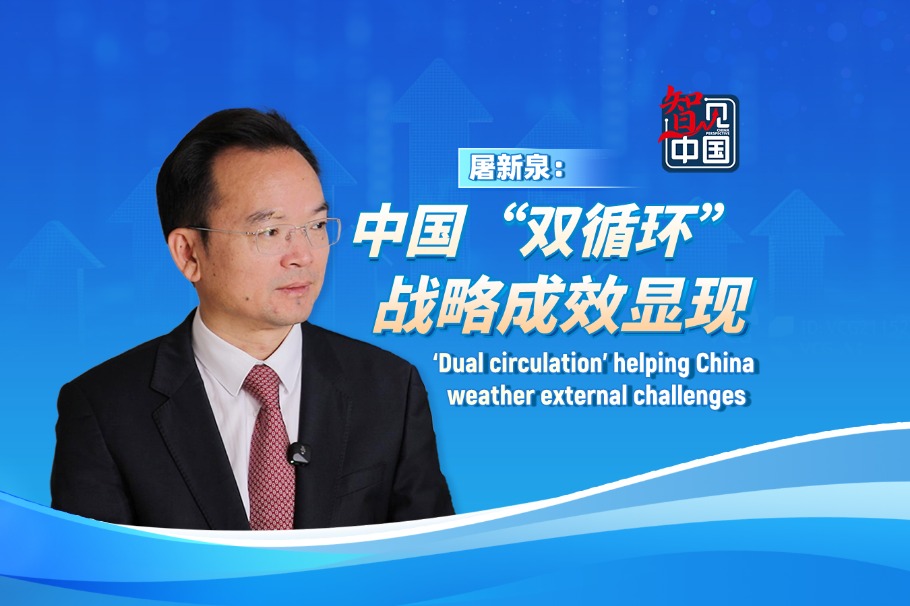
China's recent push for a dual-circulation development paradigm might, at first glance, seem like a step toward more self-reliance. Yet on closer look, it indicates China will further open up its economy to the outside world. Perhaps China knows that enhanced synergy with the global economy is required for expanding and elevating domestic circulation more than any other country. Since the 1990s, at least some manufacturing in all countries has gone global. For more than three decades, companies have been strategically distributing operations worldwide. To make iPhone, for example, Apple assembles more than 1,000 parts from the United States, the Republic of Korea, Japan, China and other countries, which shows how intertwined the production process has become.
The story is the same on the consumption side. Countries rely on both local products and global trade, much beyond leveraging comparative advantages. Especially for innovative products, reaching scale means entering into markets at home and abroad. This strategy not only makes better use of resources and capital but also strengthens the global cooperation.
China is rolling out the carpet. By promoting high-level opening-up, reducing restrictions on foreign investment and improving the business environment, it aims to swing its doors even wider to the outside world.
And fourth, China's high-quality development benefits the globe. China is pursuing high-quality development. It is a pursuit marked by a commitment to modernizing industrial systems and nurturing new quality productive forces. Central to these initiatives are advanced productivity, technological breakthroughs, and deep industrial transformation and upgrading. New industries, models and growth momentum that emerge in this process empower a paradigm shift in both scale and quality.
However, China is not considering excessive stimulus. While short-term outcomes can be similar, transitioning the economy to a more efficient and resilient state requires a tech-driven and human-capital-centered approach.
The benefits of China's high-quality development extend far beyond its borders. China's upgraded domestic demand creates a huge market for foreign high-tech equipment and components. In 2023, China imported integrated circuits worth more than $300 billion, 1.6 times of that in 2013. Shenzhen, called "China's Silicon Valley", alone aims to increase its import of integrated circuits to $110 billion by 2025 to bolster local high-end industries.
In turn, China's advanced exports enrich the global market, and its satellites support international scientific endeavors in space. Chinese robots, from coffee-makers to plane-welders, are revolutionizing services and high-end manufacturing. And drawing on its extensive rail network experience, China is exporting high-speed train technology to countries in Southeast Asia and Central and Eastern Europe, in order to improve local interconnectivity.
Fresh data on China's growth in 2023, issued recently, show the country's GDP was more than 126 trillion yuan (more than $17 trillion), meaning it grew by 6 trillion yuan, which is equal to the GDP of a medium-sized country.
A stable China can
better weather storm
But despite such impressive achievements, external skepticism vis-à-vis China persists. This leads to me to my points on the current state of China's economic development.
The trajectory of China's economic development should be interpreted over an extended time frame and from a global perspective. We can roughly divide China's economic ascent after the launch of reform and opening-up into three phases. The period from 1978 to 2010 was marked by market-oriented reforms, demographic dividends, growth of foreign trade and real estate development. During this period, low base figures amplified high potential growth rates.
From 2011 to 2018, China became a powerful workshop plus booming e-commerce while global economic prospects were dimming. All the while its focus was on adjusting and strengthening the economy in response to changing circumstances. And since 2019, China has been transitioning from a conventional to an innovation-driven economy. Like other big economies, China, too, has seen normalization of the growth rate and regression to the mean.
As China has become a pivotal force in the global production network and global value chain, developing economies need the quality, affordable and steady supply of goods from Chinese manufacturers, while developed countries will continue to benefit from the resilience and efficiency of China's supply chain.
China's economy has grown in a wave-like fashion amid twists and turns. Therefore, other countries would do better to coordinate and weather the storm in the global sea along with the giant vessel that is China. A more stable China can better anchor the global economy, and a world of high fences will only increase vulnerability for all.
China's industrial restructuring will give rise to new industries while transforming conventional ones. A vivid illustration of this would be the real estate sector. The housing reform from 2003 to 2020 ushered in an era of real estate prosperity. It was the pillar of China's economy, driving its rapid growth in recent decades. Now, with changing dynamics, the industry's role in the economy is being re-examined and re-positioned. Its contribution to GDP will be steadily shared by strategically new industries. That being said, the real estate sector still has great potential given China's further progress in urbanization and the renovation of existing buildings.
At the same time, the industry is also finding new edges. The country's top leaders stressed the importance of the use of new technologies for the transformation and upgrading of traditional industries, and promoting high-end, intelligent, and green industries. In this regard, the real estate sector has to go smart and go green.
To go smart means leveraging digital technologies such as big data, artificial intelligence, and the internet of things and improving "building lifetime management" and intra- and inter-connectedness to a broader extent. As smart buildings evolve into smart communities and further expand into smart cities, the real estate sector will definitely propel the digitalization of cities.
To go green means constructing buildings that can save, store and even produce clean energy. Developers can tap an entirely new industrial chain based on sustainable technology, renewable energy, new materials, innovative design and other factors. In fact, the development of green cities and sustainable economies will open up new horizons for the industry.
Looking into the broader stage, the global economy finds itself again at a critical juncture. Tensions arise. So do sentiments. Unilateralism, protectionism and populism are rearing their heads in some economies. All in the name of fixing what seems unfair in global competition.
Yet the level playing field for instance is not a static ideal, but an inherently relative concept. Picture a giant vessel sailing into a confined lake, the water level rises because the vessel displaces huge volumes of water. As the world's manufacturing powerhouse, China has led global production for 14 straight years, contributing to one-third of global manufacturing output. China's entry into any field increases competition, as it provides the world with cost-efficient and high-quality goods. This illustrates the evolving nature of the international economic interactions. With China's participation, the playing field may change at the absolute level, but the leveling can be redefined by better products, fairer pricing and more fine-tuned rules.
China's participation has certainly caught the attention of competitors. But to hastily label the competitive pricing as unfair play overlooks the complexities involved. Prices reflect strategic decisions made by suppliers based on their resources and capabilities; however, the yardstick to measure competition should not be the absolute price level, but equity, transparency and consistency of rules of the game.
Tesla Shanghai Gigafactory best testifies to this. More than 50 percent of the electric vehicles Tesla delivered globally came from this plant. The manufacturing cost for Model 3 in Shanghai is 65 percent lower than any production base in the US. Such efficiency in manufacturing enables Tesla to reduce prices while leading the premium EV segment.
Big names in auto industry, including Volkswagen, BMW and Toyota, are heading to China to build their EV platforms. Attracted by China's comprehensive industrial chains, cost-effective labor and logistics, and relaxed foreign investment regulations, they view the country as a prime destination to enhance their EV prowess. The playing field is level, even though it's poised for further elevation by global competitors.
Going forward, advancing the global economy implies embracing digitalization and environmental sustainability. I have three key perspectives on the future economy.
One is the growing subjectivity of AI. Through deep learning with massive datasets and audio and video materials, AI is rapidly approaching human-like cognition, judgment and decision-making capabilities. Consider OpenAI's popular chatbots ChatGPT and Sora. Gen-AI shows itself not merely as a tool. It can evolve into an independent entity, disrupting the traditional distinction between producer subjectivity and tool agency. Such transformation puts ethical questions at the forefront of any AI development, including fair data use and the potential risks of deliberate model abuse. The solution lies in governing both carbon-based life and silicon-based life in line with the same ethical system.
Two is to redefine goods to encompass "essential goods". "Essential goods", a concept I created, are vital or essential components to the digital economy and green economy. Examples include data, water, air and carbon emissions. Despite their importance, their value is often "invisible" in traditional economic models. Establishing the new accounting framework for essential goods becomes imperative, as we cannot manage what we do not measure. If digital information lacks a price, valuable data may never be generated.
Similarly, if the numerous benefits provided by ecological infrastructure to humans are absent from the national or corporate balance sheets, it only exacerbates the exploitation of Mother Nature. So the pricing, transaction and circulation of the essential goods should also be explored. The EU's initiatives, from the carbon market to digital market acts, underscore the significance and urgency of establishing a unified system to apply values to essential goods as they deserve, although the details can be debated through the lenses of cross-border cooperation and synergies.
And three is the open and interconnected nature of the new economic paradigm. Technologies like the IoT, cloud computing and AI drive the new economic paradigm. They create a whole new level of global interconnectedness, reducing the relevance of physical borders. Every month, over a third of the global population uses Facebook, with the rise of digital nomads working from anywhere in the world has become normal.
While AI's reach is global, affecting far more than a few jurisdictions, viewing international competition as a simple win-or-lose game has become outdated. Instead, there are stronger incentives to act together, utilizing technologies to tackle universal challenges facing humanity. This holds especially true for fighting climate change, where the window of opportunity is rapidly closing.
The author is a member of the China Finance 40 Forum and President of Bank of Communications. The views don't necessarily reflect those of China Daily.
If you have a specific expertise, or would like to share your thought about our stories, then send us your writings at opinion@chinadaily.com.cn, and comment@chinadaily.com.cn.