Intl dispute settlements can't help solidify illegal Filipino gains









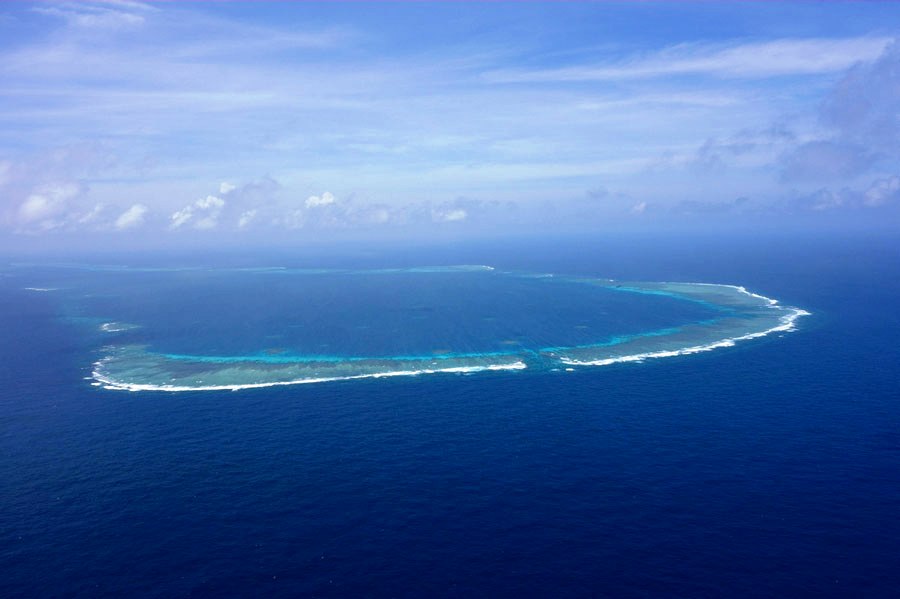
Since President Marcos Jr. came to power, the Philippines has taken provocative actions and created incidents in Huangyan Island, Ren'ai Reef, Tianxian Reef and Xianbin Reef. The United States and some other Western countries have carried out "joint air and sea patrols" and military exercises from time to time with the Philippines, hyped up the illegal arbitral award on the South China Sea disputes, and backed this Southeast Asian nation's illegitimate claims and infringement. At the same time, with cognitive warfare tactics, the Philippines is playing up the South China Sea issue, calling white black, deliberately distorting China's policy on the South China Sea, and smearing China's international image in international media.
What's more, the Philippines is attempting once again to abuse the United Nations Convention on the Law of the Sea (UNCLOS) and employ political blackmail against China in the South China Sea issue in the name of international law.
Since last September, senior officials of the National Security Council, the Office of the Solicitor General and the Department of Justice of the Philippines have threatened on different occasions that they would initiate another international arbitration against China on the so-called "protection of the marine environment in the South China Sea" and other related issues, claiming that evidence for the new initiation would be ready in a few weeks.
Facing political and legal provocations from the Philippines, China will surely take robust responses and countermeasures. The Philippines' adventure is bound to fail. Nor will it have any substantial impact on China's legitimate claims in the South China Sea and its legitimate actions to safeguard its territorial sovereignty and maritime rights. Nevertheless, it may be taken advantage of by non-resident forces with their own agenda, further squeeze the political space for China and the Philippines to properly address their disputes, disrupt the pace of maritime cooperation and rule-building, and undermine peace and stability in the South China Sea region.
What are the origin and central issue of the South China Sea disputes between China and the Philippines?
The South China Sea issue is unique and complex among maritime governance issues in China's neighborhood. It is essentially an issue of territorial and maritime disputes left over from history, but is largely dragged into the geopolitical competition among major powers. Against this backdrop, although the disputes have been managed well as a whole, some differences and frictions still arise from time to time. The situation there is obviously complex and fragile.
The South China Sea issue was caused by the illegal occupation of some islands and reefs in China's Nansha Islands by the countries concerned. The development of the international law of the sea has led to large overlapping in the maritime claims of some of the countries concerned. This is the root cause of the disputes between China and the countries concerned over sovereignty, oil rights, fishing rights, law enforcement rights and jurisdiction in the South China Sea. Despite the changing regional and international landscapes, the central issue of the South China Sea issue remains unchanged—territorial disputes over islands and reefs as well as disputes over maritime delimitation.
China and the Philippines, separated by the sea, have maintained close contacts without territorial or maritime delimitation disputes in the past. However, since the 1970s, the Philippines has illegally occupied some of the islands and reefs in the Nansha Islands. It illegally occupied Mahuan Island in August 1970 and Feixin Island in the following September; Nanyue Island and Zhongye Island in April 1971; Xiyue Island and Beizi Island in July 1971; and Shuanghuang Sandbank in March 1978 and Siling Reef in July 1980. In this way, it was the Philippines that created its territorial question with China over some islands and reefs in the Nansha Islands.
The coast of China's land territory and that of the Philippines are facing each other across the South China Sea with less than 400 nautical miles apart. With the development of the international law of the sea, the areas of maritime rights and interests claimed by both countries in the South China Sea became overlapped, which also gave rise to the disputes over maritime delimitation. Since then, the Philippines has kept escalating the disputes, harassing the normal production and operation of Chinese fishing vessels, and maltreating Chinese fishermen. According to statistics available, from 1989 to 2015, there were a total of 97 incidents of illegal violations of the safety and property security of Chinese fishermen by the Philippines in the waters of the Nansha Islands, including 8 shootings, 34 robberies, 40 arrests, and 15 chases, involving nearly 200 Chinese fishing vessels and close to 1,000 fishermen. For example, on April 27, 2006, an armed Philippine fishing boat intruded into the shallow waters of Nanfang Shoal of China's Nansha Islands and fired directly and continuously at the driving panel of the Chinese fishing boat Qiongqionghai 03012, resulting in the deaths of four Chinese fishermen on the spot.
What is the international arbitration on the South China Sea issue that the Philippines may initiate?
As in the case of the unilaterally initiated South China Sea arbitration in 2013, the Philippines may also initiate a new international arbitration against China by invoking the UNCLOS, including Annex VII.
Under the UNCLOS, the Parties can choose between four different ways of dispute settlement—the International Tribunal for the Law of the Sea (ITLOS), the International Court of Justice (ICJ), UNCLOS Annex VII arbitration and Annex VIII special arbitration. Annex VII arbitration is a means of compulsory dispute settlement under Part XV of the UNCLOS.
In terms of procedure, Annex VII arbitration is "compulsory" in the sense that no prior or subsequent special agreement between the parties to the dispute is required for the initiation of arbitration; as long as one of the parties to the dispute sends a notice of arbitration to the other party in accordance with the regulations, the arbitration proceedings can be initiated without the need for the other party's consent, whether express or implied.
The "compulsory" nature of Annex VII arbitration also implies the unilateral nature of the progress of its arbitral proceedings, which can be seen in two aspects: first, in the event that one of the parties fails to respond, the claimant may request the arbitral tribunal to continue with the proceedings and to render an award, and the failure of one of the parties to respond does not prevent the proceedings from moving forward. Second, in the event that the parties to the dispute do not agree on the appointment of the remaining three arbitrators of the arbitral tribunal, any party may request the ITLOS President to make such an appointment and to choose from among them the President of the arbitral tribunal.
The unilateral nature of the procedures for initiating and pushing forward Annex VII arbitration has, to a certain extent, subverted the fundamentals of traditional arbitration, giving the arbitral tribunal vase space for discretion and a decisive position when the parties to the dispute disagree or fail to reach a consensus on the matter of arbitration. This may turn Annex VII arbitration into a form of dispute settlement determined by the will of a single party with flaws in procedural safeguards.
In current international practice, it is not uncommon for international judicial and arbitration institutions to expand their jurisdiction arbitrarily, for the parties to pack ulterior motives in their claims, and for international judicial and arbitration institutions to have tacit coordination with one party. Disregarding the substance of the disputes between the parties, tribunals have a growing tendency to establish jurisdiction over cases through derivative and subsidiary issues. Moreover, the threshold for the claimant to initiate "provisional measures" is so low that, to date, there has never been a circumstance or case in which the tribunal refuses to take "provisional measures" due to a lack of prima facie jurisdiction.
At the same time, as a by-product of international judicial and arbitration activities, the issue of "judicial law-making" has become increasingly prominent. In the process of interpreting and applying international law, international judicial and arbitration institutions have frequently exceeded their mandates by modifying or creating rules, to substantially affect the development of international law. As a matter of fact, international judicial and arbitration institutions should act within their mandates of "interpreting and applying the law", whether they are settling disputes in litigation and arbitration cases or answering questions in advisory opinions. Judicial law-making has exceeded the expectations and authorizations of the parties to a dispute, making international judicial and arbitration institutions, which already have limited authority, even more vulnerable to questions of legitimacy.
What are the ulterior motives of the Philippines in abusing international arbitration?
Under international law, states have the right to choose means of dispute settlement. The exercise of jurisdiction over inter-state disputes by any international dispute settlement mechanism must be based on the consent of the states concerned, that is, the principle of consent.
This principle comes from the fundamental principle of respect for the sovereignty and equality of states in international law. It is clearly manifested in the Charter of the United Nations and many international documents, including the Declaration on Principles of International Law concerning Friendly Relations and Cooperation among States in accordance with the Charter of the United Nations and the Manila Declaration on the Peaceful Settlement of International Disputes. Likewise, Article 36 of the Statute of the International Court of Justice provides for jurisdiction in the settlement of disputes between States, whether voluntary, by agreement, or optional and compulsory, depending on the consent of the parties. Thus, consent of the States constitutes the basis and prerequisite for the jurisdiction of the Court.
As noted earlier, the central issue of the China-Philippines South China Sea disputes is territorial disputes over islands and reefs as well as disputes over maritime delimitation. First, territorial disputes are governed by general international law, including customary international law, and the UNCLOS dispute settlement mechanism is not competent to deal with it. Second, with regard to the maritime delimitation disputes, they have been excluded from the compulsory dispute settlement procedure by China's declaration in exercise of its rights under the UNCLOS. These two points are also the "safety valve" for China to resist the malicious abuse of international judicial procedures related to maritime issues.
The Philippines has long harbored illusions about some of China's islands and reefs in the South China Sea, but it has adopted different ways to cover them up under different times. The abuse of international judicial procedures is one of the despicable tactics adopted by the Philippines at the instigation of the United States. Behind the judicial abuse, which clearly violates the principle of consent, is a well-designed legal trap.
Since the release of the 2016 South China Sea Arbitration Case illegal award (hereinafter referred to as "2016 illegal award"), the Philippines has taken a number of small actions in diplomacy, legislation and judiciary as well as on the sea, in order to substantiate the "arbitration conclusion" that "China's claims to the South China Sea are not legitimate". In the view of the Philippines, any new arbitration on the South China Sea to be initiated by the Philippines will no longer need to discuss the legality of China's claims, but will be directed at the legality of China's maritime activities. It can be inferred that the Philippines not only has the intention to initiate a second arbitration, but even a third or fourth arbitration, to force its way to confirm the 2016 illegal award through this series of arbitration and "whitewash" its unlawful claims in the South China Sea.
The Philippines threatens to initiate a South China Sea international arbitration on the grounds of marine environmental protection. In essence, it takes what belongs to China to lodge a lawsuit with China, in an attempt to use the UNCLOS sea dispute settlement mechanism for legal swindling. Its ultimate goal is to consolidate its illegal gains and impose its claims and solutions on China. It should be recognized that, rather than an isolated step, the Philippines' second initiation will be a complete chain of steps, ranging from publicity packaging, pleadings drafting, evidence collection, public opinion campaign, arbitral defense and media hype-up. The second arbitration, inextricably linked to the 2016 illegal award, will a follow-up and supplementary move in essence.
What is the danger of the Philippines' abusive litigation to the international rule of law?
If the Philippines once again unilaterally submits the disputes to compulsory arbitration, ignoring that the central issue of the China-Philippines South China Sea disputes is those over territorial sovereignty and the overlapping of maritime rights and interests, it will not only break the consensus it confirmed with China on many occasions and its commitments under the UNCLOS, but also infringe on the legitimate rights that China shall enjoy, as a sovereign state and a State Party to the UNCLOS.
China made a declaration in 2006 in accordance with the provisions of Article 298 of the UNCLOS, excluding matters involving maritime delimitation and other issues from the mandatory dispute settlement procedures provided for in the UNCLOS. The Philippines has packaged territorial issues that do not fall within the regulation of the UNCLOS and disputes that have been excluded by China as issues concerning the interpretation or application of the UNCLOS, in violation of international law and the UNCLOS.
The Philippines ignores the realities and attempts to force the disputes into the so-called "judicial settlement track". The third-party compulsory settlement procedures, which lacks the consent of the states, is a departure from the original purpose of the States Parties to the UNCLOS in designing the dispute settlement mechanism. Abusive packaging of claims will only further undermine the States Parties' confidence in the dispute settlement mechanism of the UNCLOS.
The Philippines is making a renewed attempt to unilaterally initiate an arbitration and bent on pushing the case forward. It denies China's territorial sovereignty and maritime rights and interests in the South China Sea, and tries to force China to make compromise. This will not only make the South China Sea disputes more complex and difficult to resolve, but also further jeopardize the integrity of the UNCLOS and undermine the order of the international law of the sea.
Ding Duo is deputy director and associate research fellow at the Research Center for Ocean Law and Policy at the National Institute for South China Sea Studies. The views don't necessarily reflect those of China Daily.
If you have a specific expertise, or would like to share your thought about our stories, then send us your writings at opinion@chinadaily.com.cn, and comment@chinadaily.com.cn.