Chinese catfish









Editor's note: The world has undergone many changes and shocks in recent years. Enhanced dialogue between scholars from China and overseas is needed to build mutual understanding on many problems the world faces. For this purpose, the China Watch Institute of China Daily and the National Institute for Global Strategy, Chinese Academy of Social Sciences, jointly present this special column: The Global Strategy Dialogue, in which experts from China and abroad will offer insightful views, analysis and fresh perspectives on long-term strategic issues of global importance.
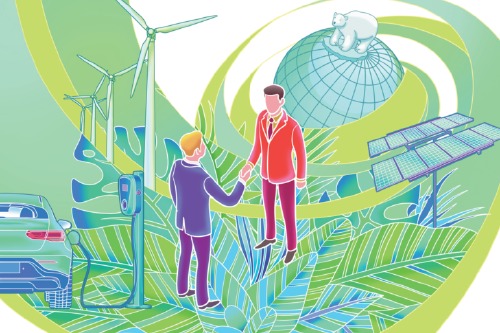
Rather than engaging in a race to the bottom, there needs to be a race to the top to develop the clean technology the world desperately needs
In June, I had the opportunity to visit Urumqi in the Xinjiang Uygur autonomous region with my daughter. It was like stepping into a vision of the future — endless stretches of desert now home to the world's largest single photovoltaic project. It has a breathtaking 3.5 gigawatts of installed capacity. That's enough to power many medium-sized developing nations for a year. But the journey didn't end there.
We also visited Goldwind, the global giant in wind energy, which produces four times Norway's total hydroelectric output. Seeing their large blades, each 120 meters long, which sweep across an area as vast as seven football fields with every rotation, was nothing short of inspiring.
Goldwind tells a powerful story: China is now the indispensable nation in the global fight against climate change. With an astounding $890 billion invested in renewable energy in 2023 alone, China is leading the green revolution. China provided two-thirds of all new solar energy globally last year.
However, there has been a buzz in Western media lately about China's so-called overcapacity in green products such as solar panels. This concern seems to stem from strategic anxieties, with growing unease about China's leadership in green energy. The complaint is counter-intuitive. Isn't "overcapacity" in green products what world leaders have called for over the past decade? Wouldn't it be good if more countries followed China's lead and produced cheap high-quality electric cars and batteries, solar panels and wind turbines?
Erecting tariffs and creating barriers will stifle innovation and inflate costs. Such policies will make it more difficult for Western companies to access cutting-edge technology and maintain their competitive advantage. This approach will drive up the cost of green technology. It will push the dream of building a clean global energy system further out of reach.
In the end, it is Western companies, workers and innovators — particularly those in the United States — that will bear the brunt of these misguided policies. The 2018 tariffs imposed by the Donald Trump administration on Chinese solar panels are a vivid reminder of this, having led to an estimated loss of $19 billion in new private investment, 62,000 jobs, and the delay of 10.5 gigawatts of solar capacity that could have powered 1.8 million homes. The policies slowed down the US progress on the path toward solar and made China even more dominant.
Embracing collaboration and competition is the most viable strategy for the West to close the gap with the world's leading supplier of clean technology. Rather than engaging in a race to the bottom, we should race to the top, striving for excellence in innovation and sustainable practices. By adopting this approach, Western nations can leverage China's advancements while simultaneously driving their own industries to innovate and compete on the global stage. The effectiveness of this strategy hinges on a deep understanding of how China achieved its leadership position in renewable technology. The West should apply that knowledge to bolster domestic industries through strategic trade and investment partnerships.
To be very direct, Europe and the US should roll out a red carpet for Goldwind and Envision, for CATL and BYD, for Tongwei, Jinko and Longi. More Chinese green investments in the West will help create more hard-sought-for jobs, help share the most advanced technology and create green competition in Western markets.
China's green industrial policies have been instrumental in the rapid ascent of its renewable energy sector. The government has acted as a steward, nurturing innovation through a variety of research programs and project funding. These green policies reflect China's focus on developing homegrown technology to strengthen its industrial base. Meanwhile, the entry of foreign giants such as Tesla into the Chinese market serves to act like a catfish in the pond. They stir up competition and drive domestic companies to innovate and sharpen their competitive edge.
China is not unique in implementing such policies. The US 2022 Inflation Reduction Act also offers substantial financial incentives, including up to 30 percent tax credits, to support domestic clean energy firms. Given these complexities, nations have a mutual benefit in formulating industrial policies where market failures occur. It's particularly important to address early-stage funding for innovation and the trial of new technologies. This ultimately helps unite the world back toward our ambitious climate goals.
Many innovative opportunities stand to gain from increased collaboration with China. Despite the fragile geopolitical climate, countries should revitalize the World Trade Organization as the forum to solve trade disputes.
Another vital issue that often surfaces is how important it is to take a people-centered, not a technology-centered, approach. When I was in the Norwegian government a decade ago, we approached wind energy as a purely technological and financial challenge. We failed. Very soon local people started asking "what is in it for us". Wind turbines may be good for the planet they said, maybe even for the nation, but not for us; my community has gained nothing. The policies boomeranged.
Huge solar plants like the one I saw near Urumqi are wonderful and impressive. They are like the ocean, you see solar panels to the horizon. But unless local communities are invited into the room when decisions are made and unless economic windfalls from renewables are left with local communities, they will struggle to get accepted. China, India and the Western countries and others should compare notes on our experiences with dialogues with local people and the structure of compensation to communities affected.
A people-centered approach will also encompass what I observed in Inner Mongolia autonomous region — the coexistence of solar panels and agriculture. Farmers were raising chickens and growing tomatoes under the solar panels. They get double incomes, from agriculture as well as from renewables. This is a win-win proposition for the local people.
Safeguarding the interests of local communities and biodiversity, while fulfilling social responsibilities, will be a crucial next step for Chinese companies. Partnering with reputable international organizations to explore ecological compensation through biodiversity offsets and credits is another highly strategic approach.
It's also time to look a step further. Investing in recycling of solar panels and wind blades now is both timely and essential. I am glad to see China putting recycling on the agenda. We should also not allow the renewable revolution serve as an excuse for uncontrolled mining in the deep seas. It's true that China currently dominates nearly all value chains for minerals needed for the renewable revolution. But deep sea mining will be slow and costly and may do irreversible damage to fragile marine ecosystems. That's why so many nations as well as huge global companies call for a ban. According to a recent study, by embracing innovation through renewable and recycling techniques, we could reduce the mineral demand by as much as 30 percent between 2022 and 2050. A more balanced and sustainable green future is within our grasp.
The author is vice-president of the Green Belt and Road Coalition and former executive director of the United Nations Environment Programme. The author contributed this article to China Watch, a think tank powered by China Daily.
The views do not necessarily reflect those of China Daily.
Contact the editor at editor@chinawatch.cn.