Staying the course with guochao
Made-in-China goods have carved a niche for themselves domestically, sparking fierce competition and forcing a rethink of pricing strategies. Luo Weiteng looks at how Chinese brands are appealing to younger consumers in a bid to stay ahead of the pack.









One of the Chinese mainland's top e-commerce influencers, Li Jiaqi — widely known as the "Lipstick King" for convincing followers to spend billions of yuan on beauty products — made a comeback in August after causing a furor.
However, it hasn't all been plain sailing.
The public uproar created by Li in September 2023 after he told off a livestream viewer who had taken issue with the price of Huaxizi's (Florasis') 79-yuan ($11) eyebrow pencil has yet to subside. And the once red-hot Chinese cosmetics brand, which is still struggling to recover from its setback, hasn't fared much better.
Li's chastising of the fan appears to have served as a wakeup call for Chinese consumers, prompting many to reconsider whether high-flying domestic brands have inflated the value of their products. "Finally, we've returned to some level of rationality," says Li Yingtao, director of retail and brand analysis at market research firm, Analysys.
Embattled Huaxizi faces a long bumpy ride ahead to repair its batted image. Not every firm is so fortunate. Tiger Attitude Chartered Pastry Bank — a Sequoia capital-backed startup once valued at two billion yuan and hailed as the flag-bearer of traditional Chinese pastry — filed for bankruptcy earlier this year amid financial hiccups.
"It seems like only yesterday when big name investors went all out to fund these rising stars with little regard for whether they were worth their salt, drawing flocks of buyers to emptying the shelves, seemingly oblivious to whatever the prices were in store," recalls Feng Jidong, who runs a training institute for postgraduate entrance and civil service exams in Yunnan province, groaning about the loss of hundreds of yuan on prepaid purchase cards.
The tales of the rise and fall, struggles and resurgence of businesses point to a mixture of hard work, new-found wealth and a bubble created by a growing taste for local brands that carry serious Chinese cultural connotations.
Redefining Chinese chic
Guochao (national wave), China-chic and neo-Chinese style: Different descriptions that capture the fervor accompanying millennial-savvy brands when they have brought their goods to the market in recent years.
Established brands as well as those previously considered outdated, such as sportswear maker Anta and down clothing producer Bosideng, have reimagined themselves to appeal to younger audiences who aren't as attached to foreign names as their parents. Historical or time-honored White Rabbit candy, skincare brand Pechoin, and the country's oldest sneaker maker, Warrior, have drawn on nostalgia to revive dormant beauties. Newcomers, including cosmetics maker Huaxizi, and Chinese bubble tea chains Heytea and Naixue, boast incredible sales seemingly out of nowhere with their guerilla marketing tactics.
The response from other market players has been: If you can't beat them, join them. Multinationals have clambered aboard the bandwagon, launching guochao-inspired products to win plaudits.
It has proven to be a fertile source of revenue, creating a lucrative business expected to surpass 3 trillion yuan by 2028, according to iiMedia Research. No bar has been set for cashing in on the China-chic fad, with even street restaurants scrambling for a piece of the pie with their guochao takeouts.
"The guochao takeouts are nothing but cookie-cutter packaging featuring a comic girl painted with a facial makeup of the Beijing Opera and carrying a Chinese folding fan," says Feng. "Somehow, it becomes an excuse for pre-cooked food with unsatisfactory taste, inadequate hygiene conditions, shoddy cutlery and unreasonable prices."
With an expanding pool of competitors, it is hard to say whether the guochao zeitgeist has gone any deeper. What have gone up are prices. "There has been self-mocking among young consumers that the once-affordable homegrown products have gone out of our league," Feng observes. "You know, the Huaxizi eyebrow pencil brouhaha is no exception."
As superficial, repetitive China-chic narratives flood the market, consumer fatigue has followed. Even after sportswear brand Li-Ning made a splash with its uniquely Chinese take on athleisure at its New York Fashion Week debut in 2018, there has been an abundance of brands keen to interpret the guochao story with the same tired formulas, featuring meaningless Chinese motifs like brush calligraphy, cranes, auspicious clouds and ceramics.
Such interpretations, bearing the imprint of Orientalism and exoticism with "othering" characteristics for the West, is no different from outdated marketing gimmicks of foreign brands, which still miss the good, old days when they could sell brand stories across the globe in a one-size-fits-all approach with scant regard for Chinese consumers' thoughts and passions.
"It's all about discerning customers refusing to pay a premium for a basic 'China-chic' concept without much depth," says Li Yingtao. "The heyday should be over when putting an existing product in Chinese-style packaging, with well-crafted, hungry marketing and whimsical branding, could reap a fortune."
But how could guochao sustain its new-found popularity and make itself grow in scope and visibility?
Relating inclusive narratives
Despite all the hype and fatigue, veteran interpreter and translator Shen Youzhi has set her sights far away — on countries and regions long invisible among global communities and where vast underserved populations have been crying out for adequate supply of everyday products. Shen, who has been involved in foreign affairs activities organized by various municipal governments on the Chinese mainland, jokingly describes an important part of her work as a volunteer shopping guide for foreign delegations, most of whom put "buying everything" on their China tours.
"At first, I didn't quite understand why they always went on buying sprees with a sense of urgency as if 'if you miss this village, there won't be another shop'," recalls Shen.
She had tried to persuade them to shop around for bargains before pulling out their wallets in a rush. "But then I was told this is just how life is like in their home countries, where they have long been beset with limited or no access to industrial products, even if money is not an issue."
The "must-haves" on their shopping lists range from polo shirts, sports windbreakers, shoes and sneakers to smartphones, electronic watches, electric razors, Bluetooth headsets and even drones. An African diplomat, calling himself an ardent admirer of Chinese car brands, possesses several models exported directly from Lianyungang Port, Jiangsu province, to his country. "Even with freight and miscellaneous expenses included, it still costs 20 to 25 percent less than purchasing the same type of vehicles in Africa," Shen was told.
This year, the super-cheap Chinese electric "beng bengs", comprising a motorcycle-like front with handlebars and a lightweight pickup rear, have sparked a sensation in the United States. The three-wheelers also drew great interest from the diplomat, who asked Shen if it was possible to import them from China. When Shen said yes, the diplomat replied excitedly: "I'm incredibly happy that our people can actually use electric vehicles made in China. This means a whole new opportunity for many in our country who rely on farm tricycles to earn a living. They can finally keep up with China's pace."
Dismissing tariffs and China's "overcapacity puzzle", Shen believes that the world's manufacturing giant can tell its compelling story by improving people's livelihoods in a more inclusive, equal and sustainable manner. "Isn't it one of the coolest China-chic narratives?"
Rewriting a shared future
At home, guochao has found a more inclusive, grassroots interpretation in lesser-known towns and remote villages that make up the often-overlooked, yet booming segment of the China-chic economy.
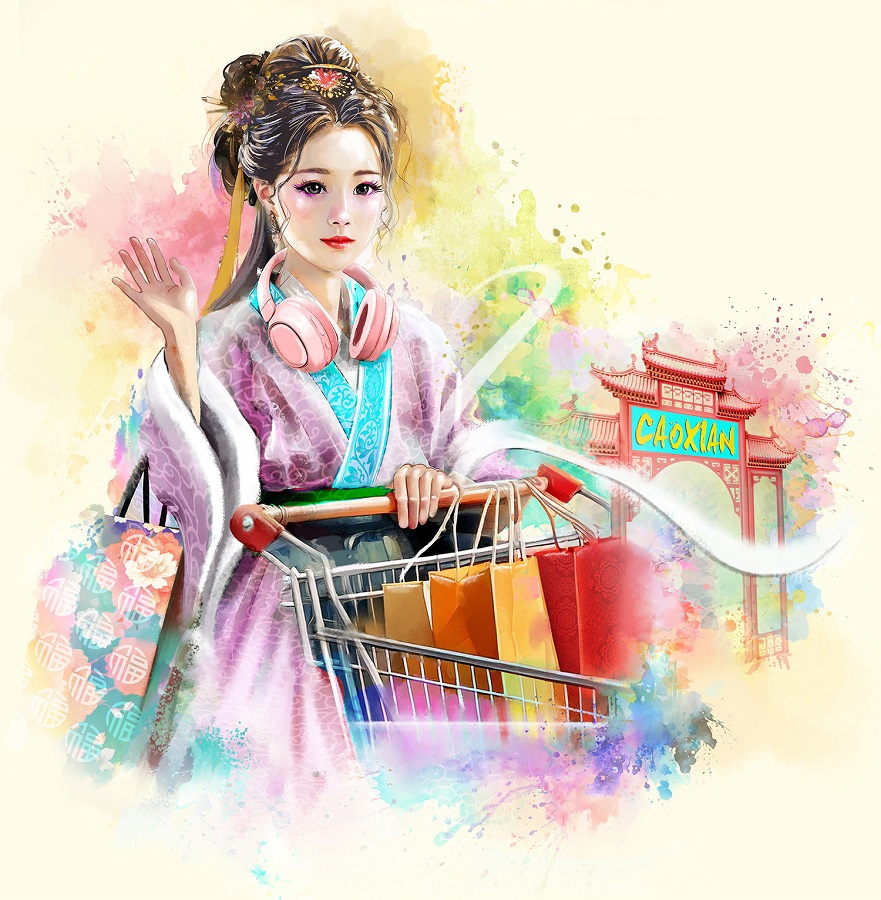
Caoxian, a small county tucked away in east China's Shandong province, was catapulted into the limelight with growing popularity of the "horse-face pleated skirt" — hanfu style clothing known as mamianqun in Putonghua. The traditional dress, dating back to the Song Dynasty (960-1279), came to the fore in 2022 when Dior's cultural appropriation sparked a backlash among young, proud Chinese.
While guochao makes a fair contribution to revitalizing hanfu, Caoxian has added a meaningful footnote to the dynastic-era traditional Chinese Han dress with flowing robes and multilayered ensembles, going from an obscure subculture to the mass-produced mainstream.
In the first quarter of 2024 alone, Caoxian nearly doubled its hanfu sales to 1.98 billion yuan, with mamianqun boasting its 900 million yuan in online sales. Once among China's poorest counties, Caoxian is now home to more than 2,200 hanfu-related enterprises and over 10,390 e-commerce stores, accounting for 40 percent of the nation's billion-dollar hanfu market.
The local fully-fledged hanfu business timed its takeoff with the county's decades-long experience in costume production and the nationwide meteoric rise of livestreaming e-commerce. But what essentially gave Caoxian a firm footing in the hanfu market is consumer affordability, with prices ranging from 100 to 500 yuan a piece.
"In the early days, hanfu, coupled with Lolita dresses and JK uniforms, were dubbed the 'Three Broke Girls' by netizens," reminisces Wu Yi, a long-standing enthusiast who owns a wardrobe full of hanfu, referring to the US television sitcom, 2 Broke Girls. "Due to complex craftsmanship and limited production, the fancy price has confined hanfu to a niche, cash-burning interest."
Caoxian has its own way. Fabric stores sell cloth, workshops cut it, factories stitch pieces together, and vendors sell the end products. The town hosts a complete supply chain that enables local producers to cut costs, paving the way for hanfu's reach into the mainstream.
However, there have been twists and turns. The Wild West and gold-rush mentality used to make Caoxian a byword for poor quality, imitation and inferiority among hanfu traditionalists.
"Back then, when I saw the 'Made-in-Caoxian' label, my heart began to sink. Now, it's a quality, yet budget-friendly response to our desire to reconnect with, and reclaim a sense of cultural pride. It genuinely makes hanfu affordable for ordinary people and integrate with traditional clothing into everyday life," notes Wu.
Caoxian's U-turn is an epitome of how Chinese companies have grown in stature to the point where, in many areas, they're now seen as the pinnacle of business innovation.
A contributing factor in the county's journey toward originality and craftsmanship has come from young people returning to their hometowns, promoting time-honored Chinese clothing techniques, original design, brand building and overseas sales with a keen sense of business and entrepreneurial aspirations.
Having worked as a fashion designer in Hangzhou, Zhejiang province, for years, Li Ailing joined some 100,000 locals among the county's 1.7 million population in the hanfu business. "I can now work close to home, and my daughter doesn't have to grow up as a left-behind child," she says.
Talented young people aren't the only ones reaping the benefits. Next to Li Ailing's bright showroom, where young livestreamers showcase neat rows of mamianqun, middle-aged workers keep themselves busy with fabric-cutting machines.
"Skilled workers are very much in demand, thanks to the sheer number of orders. They're paid on a piecework basis, and on a more flexible freelance basis, with salaries comparable to those in Hangzhou and other cities," says Zhang Longfei, director of Caoxian's e-commerce service center, calling it an "ideal job situation that many people aspire to".
The once-typical left-behind town has overturned its fortune with the China-chic fad, telling a vivid story of rural vitalization and helping guochao grow into a mainstream cultural staple. Ambitious local manufacturers now look to build up names on the global stage with the help of Chinese diaspora, giving guochao resonance and reach among a much broader audience.
"Many brands native to China have done their homework well for years. Today, they've all the elements and essential identity needed to look cooler than ever, and represent the way of a shared future," says Shen.
"These are the more relevant guochao accounts we have for our people and the world."




- Xi's discourses on work related to women, children, families published in English
- Global scientists discuss the role of big data in advancing UN goals
- Ferry routes and schools closed as Typhoon Tapah nears Guangdong
- Xi to attend BRICS leaders virtual meeting
- China activates emergency flood control response in Guangdong, Guangxi
- Australian expert lauds China as a global leader in nanoscience