Challenging Resolution 2758 will 'inevitably fail'
Taiwan Affairs Office rebukes distortion of United Nations General Assembly document that embodies one-China principle









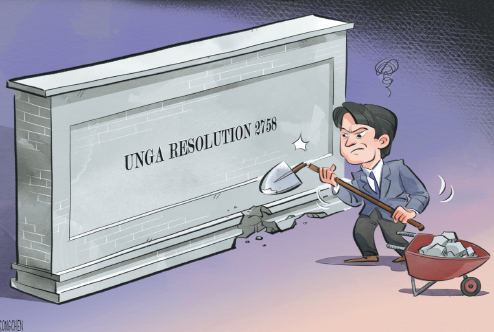
Editor's note: On Oct 25, 1971, the 26th session of the United Nations General Assembly adopted Resolution 2758 with an overwhelming majority. The resolution saw the UN's restoration of the representation and seat of China, including Taiwan, to the government of the People's Republic of China, under the premise of recognizing Taiwan as an inalienable part of China. Recently, the Democratic Progressive Party authorities, for the purpose of seeking "Taiwan independence" secession, have colluded with external forces to distort and smear UNGA Resolution 2758, attempting to mislead the people of Taiwan and international public opinion. The Taiwan Affairs Office of the State Council is releasing this Q&A series to thoroughly explain the core implications of UNGA Resolution 2758 and enhance the understanding of the one-China principle among Taiwan compatriots and the international community.
Q1: Why did the United Nations General Assembly adopt Resolution 2758 in 1971? What problem did it solve?
A: The United Nations was founded in 1945, with China as a founding member and one of the five permanent members of the UN Security Council. In 1949, the government of the People's Republic of China was established, replacing the government of the Republic of China as the sole legal government representing the whole of China. It was a change of government without changing China as a subject of international law. Rightfully, the government of the People's Republic of China fully enjoys and exercises China's sovereignty, including that over Taiwan.
Within the UN system, it was only natural for the government of the People's Republic of China to appoint representatives to participate in the work of the UN General Assembly and its related organs, expelling representatives of the Taiwan authorities that could no longer represent the Chinese people. However, due to interference from the government of the United States, China's UN seat was illegally occupied by the authorities in Taiwan for a long time.
After the founding of the People's Republic of China, the Chinese government and the Chinese people engaged in a resolute struggle to restore their legitimate seat at the UN, garnering increasing support from a growing number of peace-loving and justice-upholding nations.
In the 1960s, with the rise of China's international status and the continuous entry of many newly independent countries in Asia, Africa and Latin America into the UN, the US found it increasingly difficult to obstruct the People's Republic of China from reclaiming its rightful seat at the UN.
As the saying goes: "A just cause enjoys abundant support while an unjust cause finds little." On Oct 25, 1971, the 26th session of the UN General Assembly passed Resolution 2758 by an overwhelming majority: 76 votes for, 35 against and 17 abstentions. The resolution decided to restore all the rights of the People's Republic of China at the UN, recognize the representatives of the government of the People's Republic of China as the sole legitimate representatives of China at the UN, and return the representation and seat of all of China, including Taiwan, to the government of the People's Republic of China.
For the Chinese people, this was a belated justice, completely resolving the representation question of all of China, including Taiwan, at the UN.
Q2: What is the content of UNGA Resolution 2758?
A: UNGA Resolution 2758 reads:
"The General Assembly,
Recalling the principles of the Charter of the United Nations,
Considering that the restoration of the lawful rights of the People's Republic of China is essential for the protection of the Charter of the United Nations and for the cause that the United Nations must serve under the Charter,
Recognizing that the representatives of the Government of the People's Republic of China are the only lawful representatives of China to the United Nations, and that the People's Republic of China is one of the five permanent members of the Security Council,
Decides to restore all its rights to the People's Republic of China and to recognize the representatives of its Government as the only legitimate representatives of China to the United Nations, and to expel forthwith the representatives of Chiang Kai-shek from the place which they unlawfully occupy at the United Nations and in all the organizations related to it."
Though brief in length, the resolution delivers a powerful and unambiguous message. It resolved the question of China's representation in the UN once and for all — politically, legally and procedurally. It clearly affirmed that there is only one seat for China in the UN and there is no such thing as "two Chinas" or "one China, one Taiwan".
Q3: What is the historical significance of UNGA Resolution 2758?
A: The historical significance of UNGA Resolution 2758 lies in it being the result of the collective efforts of all countries that love peace and uphold justice worldwide. It signified that the Chinese people, who account for a quarter of the world's population, had returned to the stage of the UN, making the UN truly the most universal, representative and authoritative intergovernmental international organization.
This was a victory for the Chinese people and for the people of the world, carrying significant meaning and a profound impact on both China and the world.
The restoration of its legitimate seat in the UN opened a new chapter of cooperation between China and the UN. For over 50 years, the People's Republic of China has consistently upheld and fulfilled its responsibilities and missions as a permanent member of the UN Security Council, defended the UN Charter and principles, safeguarded the authority and status of the UN, supported the UN in playing a central role in international affairs, practiced multilateralism, and deepened cooperation with the UN. It has made significant contributions to upholding international fairness and justice, promoting world peace and development, strengthening friendly cooperation among countries, and advancing the cause of human progress.
Q4: What is the relationship between UNGA Resolution 2758 and the one-China principle upheld by most of the international community?
A: UNGA Resolution 2758 is a political document that embodies the one-China principle. The resolution fully reflects and solemnly affirms this principle, stating that there is only one China in the world, and Taiwan is a part of China, not a separate country.
Resolution 2758 clearly stipulates that the United Nations and related organizations must adhere to the one-China principle. Since its adoption, the UN, its specialized agencies, and other international and regional organizations have strictly followed this resolution in handling Taiwan-related issues. The UN official documents refer to Taiwan as "Taiwan, province of China", and the UN Office of Legal Affairs has issued several clear legal opinions emphasizing that "Taiwan is a part of China", "Taiwan has no independent status as a province of China", and "Taiwan authorities do not hold any form of governmental status". Over the decades, UN secretaries-general and their spokespeople have consistently reiterated that the UN follows Resolution 2758 and upholds the one-China principle in dealing with Taiwan-related issues.
Resolution 2758 reinforces the global adherence to the one-China framework. The resolution solidifies the one-China principle as a universal consensus of the international community and a basic norm of international relations. Before the resolution's adoption, only 64 countries had established diplomatic relations with the People's Republic of China. Afterward, many countries quickly established diplomatic ties with China. As of March 2025, China had established diplomatic relations with 183 countries, all based on the one-China principle. This demonstrates that adherence to the one-China principle is in line with the greater good and the prevailing trend of the world, has the overwhelming support of the international community and reflects an unshakable and unchallenged international consensus.
Q5: Why is it groundless to argue that UNGA Resolution 2758 "has nothing to do with Taiwan"?
A: Taiwan has been Chinese territory since ancient times. The history in China, which encompasses 10,000 years of culture, and more than 5,000 years of civilization, records that our ancestors moved to Taiwan to live and thrive; that our compatriots on both sides of the Taiwan Strait jointly resisted foreign aggression and regained Taiwan; and that the compatriots from both sides are working together for national rejuvenation.
Due to the defeat in the First Sino-Japanese War in 1895, the government of the Qing Dynasty (1644-1911) was forced to cede the island of Taiwan and the Penghu Islands to Japan. Taiwan was occupied by foreign forces for half a century. The 1943 Cairo Declaration and the 1945 Potsdam Proclamation clearly stipulated that the Chinese territory stolen by Japan, including Taiwan and the Penghu Islands, should be returned to China.
On Sept 2, 1945, Japan signed the Instrument of Surrender, and pledged to faithfully fulfill the obligations enshrined in the provisions of the Potsdam Proclamation.
On Oct 25, the Chinese government announced that it was resuming the exercise of sovereignty over Taiwan, and the ceremony to accept Japan's surrender in Taiwan province of the China war theater of the Allied powers was held in Taipei. From that point forward, China had recovered Taiwan de jure and de facto through a host of documents with international legal effect. Taiwan does not have any other international legal status apart from being a part of China.
The UNGA Resolution 2758, passed in 1971, based on the fact that China is a complete country and Taiwan is part of China, resolved the question of who is the legitimate representative of China. The resolution explicitly declared "to expel forthwith the representatives of Chiang Kai-shek from the place which they unlawfully occupy at the United Nations and in all the organizations related to it". Chiang Kai-shek was the leader of the Taiwan authorities at that time, and the "representatives of Chiang Kai-shek" referred to the representatives of the Taiwan authorities.
During the discussions that led to Resolution 2758, the United States had teamed up with a few countries to try to create "two Chinas" or "one China, one Taiwan", and to push through a "dual representation" proposal. Many countries stepped forward, voicing their clear opposition and stressing that the proposal was "illegal and inconsistent with reality, justice and the principles of the UN Charter". In the end, the proposal failed to make it to a vote and was discarded.
The "representative of Chiang Kaishek" also acknowledged, "Other countries have always emphasized that Taiwan is part of China's territory; I couldn't agree more", and "The people of Taiwan are Chinese in terms of race, history and culture".
From the text and discussions of UNGA Resolution 2758, it is evident that both the recognition of the representatives of the People's Republic of China government and the expulsion of the "representatives of Chiang Kai-shek" were carried out within the framework of one China simultaneously. Some forces clamoring that the resolution "has nothing to do with Taiwan" are baseless; this is either due to historical ignorance or ulterior motives.
Q6: Why are some people in the United States attempting to maliciously politicize UNGA Resolution 2758?
A: The United States, as a signatory to the Cairo Declaration and the Potsdam Proclamation, is fully aware of the historical and legal fact that Taiwan is part of China. The one-China principle forms the political foundation of Sino-US relations. The US made serious commitments on the Taiwan question in the three joint communiques it signed with China. The US side clearly stated that the US Government recognizes the Government of the People's Republic of China as the sole legal Government of China, and acknowledges the Chinese position that there is but one China and Taiwan is part of China. This political commitment forms the political foundation for Sino-US relations, represents the essence of the US' one-China policy and is fully aligned with the spirit of Resolution 2758. Since then, every US administration has made clear commitments on the Taiwan question, acknowledging that adhering to Resolution 2758 is an obligation the US must fulfill as a member of the United Nations.
In recent years, some in the US have backtracked to make a fuss about UNGA Resolution 2758, claiming that the resolution did not address Taiwan's political status. But the so-called undetermined status of Taiwan is nothing more than a revival of the "one China, one Taiwan" narrative from 1971. Behind this is the US hegemonic mindset and Cold War thinking that sees China as the US' primary strategic rival and severest long-term challenge. In light of this, the US is trying to contain and suppress China by playing the "Taiwan card".
Challenging Resolution 2758 disregards historical and legal facts and contradicts the serious political commitments made by successive US administrations in the three Sino-US joint communiques. This exposes some US forces' double-standard and hegemonic practice of using international law and basic international relations principles when they suit, and discarding them when they are inconvenient. The era of hegemony and force dominating international relations is long gone. Playing the "Taiwan card" and trying to use Taiwan as a pawn to suppress China run counter to underlying global trends and will inevitably fail.




- Shanxi traffic crash kills 3, injures 6
- Xizang's natural drinking water listed as target for industry cultivation
- China's carrier strike groups conduct training in Western Pacific
- Former CPC chief of Pudong New Area in Shanghai expelled from Party, public office
- Intl training course on AI empowered early warnings kicks off in Shanghai
- China's island province issues alert for typhoon