Joining hands to build a high-level RCEP









Against the backdrop of profound and complex changes in the global geopolitical and economic landscape, and significantly increasing economic and trade uncertainties, the Regional Comprehensive Economic Partnership (RCEP), with free trade at its mainline, has not only become a new engine for regional economic growth, but also shows positive momentum in leading Asia-Pacific economic integration. Jointly building a high-standard RCEP is a major strategic choice for promoting regional economic integration amid dramatic changes unseen in a century, and will surely inject strong vitality into both regional and global free trade.
I. Jointly building a high-level RCEP to inject vital certainty into the global economy fraught with increasing uncertainties
Jointly building a high-level RCEP entails three key tasks. First, high-level opening-up, so as to achieve regional market integration across a wider scope and at a deeper level. Second, high-standard rules, so as to enhance the breadth and depth of regional economic and trade cooperation. Third, high-quality development, so as to foster a new development landscape of industrial coordination and regional balance in key areas such as trade in services, the digital economy, and the green economy.
Leading the process of Asia-Pacific economic integration through jointly building a high-level RCEP
At present, the momentum of global free trade is weakening, and regional free trade has become a priority for advancing open cooperation. As of 2024, the number of regional free trade agreements that have entered into force globally increased from 83 in 2000 to 375, 71 of which have entered into force cumulatively since 2020.
The entry into force and implementation of RCEP has injected significant momentum into free trade within the region. Over the past two years, more than 45% of goods exported within the RCEP region have flowed to member markets, an increase of nearly 9 percentage points compared to 2020. Meanwhile, the proportion of imported goods within the region has approached 54%, up 12.1 percentage points from 2020. Currently, rising geopolitical risks have risen significantly, and geopolitical games have impacted free trade in the RCEP region. Between 2021 and 2024, Japan's and Korea's trade with other RCEP members fell by 9.7% and 2.5% respectively. To address the challenges of unilateralism and protectionism, RCEP must eliminate external disruptions and jointly advance a high-level free trade process.
Forging a new engine for Asia-Pacific economic growth through joint construction of a high-level RCEP
Development remains the core interest of RCEP members, and free trade continues to be a key driver of economic growth in the region. From 2021 to 2023, RCEP member economies recorded an average annual GDP growth rate of 3.5%, 0.5 percentage points higher than the global average. The region's share of the global GDP rose to 31%. IMF predicts that from 2025 and 2030, the RCEP region will see a cumulative GDP increase of $10.9 trillion, contributing more than 32% to global economic growth.
In sharp contrast to so-called "reciprocal tariffs," a high-level RCEP will be established upon markets and rules, and it will bring about inclusive and sustainable growth within the region. Looking ahead, an RCEP with higher standards, a broader scope, and more inclusive development will surely inject important certainty into the global economy.
Promoting deep integration of regional industrial and supply chains through jointly building a high-level RCEP
The deep integration of industrial and supply chains serves as a stabilizer for regional economic integration. In recent years, the layout of supply chains across the RCEP region has continued to improve, driving rapid growth in intermediate goods trade. From 2021 to 2024, the share of intermediate goods in total trade within the RCEP region rose from 65.0% to 68.3%.
From a practical perspective, there is still a need to reduce the cost of restructuring industrial and supply chains within the RCEP region. For example, in 2024, the coverage rate of "zero tariff" for China's exports to ASEAN under zero-tariff treatment under the RCEP framework was approximately 70%, lower than the 97% zero-tariff coverage under the China-ASEAN Free Trade Area Agreement (CAFTA). Building a higher-level RCEP requires not only expanding the zero-tariff rate for goods, but also advancing higher-level market openness for overall trade in services within the region. This will facilitate the extension of regional industrial chains from processing and manufacturing toward higher value-added links, thereby enhancing the region's position in global value chains.
II. Jointly promote RCEP's transition from the world's largest Free Trade Area to a high-level Free Trade Area
In recent years, RCEP has continued to unleash development dividends, laying an important foundation for proceeding towards a high-standard regional economic integration. Overall, both the timing and conditions are now relatively ripe for RCEP to evolve from the "largest Free Trade Area" to a "high-level Free Trade Area".
Achieving new breakthroughs in bilateral and multilateral free trade within the region
— Signing and implementing the China-ASEAN Free Trade Area Version 3.0 within the year.
China and ASEAN serve as the main engines to drive free trade under the RCEP framework. On May 20, China and the ten ASEAN countries fully completed negotiations on Version 3.0 of the free trade area, marking a critical step toward scheduled signing and implementation of the agreement within the year. CAFTA 3.0 will send a strong message in support of free trade and open cooperation, create an inclusive, modern, comprehensive, and mutually beneficial FTA, strongly support the construction of a China-ASEAN community with a shared future, and form an important driving force for building a high-standard RCEP.
— There may be new breakthroughs in the China-Japan-Korea FTA negotiations within the year.
While the entry into force of RCEP has for the first time established a free trade institutional arrangement for market opening and tariff reduction between China and Japan, and Japan and South Korea, nevertheless, the transition period is long, and the tariff reduction commitments are lower than the overall RCEP level of 90%. Achieving important breakthroughs in the China-Japan-Korea FTA negotiations is of great significance for jointly building a high-standard RCEP. At present, new progress has been made in the negotiations on the China-Japan-South Korea free trade agreement, and it is predicted that some important breakthroughs will be achieved within this year. This will not only have a major impact on the stable growth of the three economies, but also give full play to the driving role of China, Japan and South Korea in building a high-standard RCEP.
Achieving breakthroughs in RCEP expansion
The importance of RCEP expansion has become increasingly prominent at present. So far, Hong Kong Special Administrative Region of China, Sri Lanka, and Chile have submitted applications to join. Take Hong Kong as an example: 70% of its trade and investment occurs within the RCEP region. Hong Kong's accession will not only boost regional trade growth but also drive regional financial development and enhance the internationalization of regional industries. If Chile joins, it would mark an upgrade of RCEP from a purely regional arrangement to a cross-regional one.
At present, there is growing anticipation among members for an early establishment of RCEP Secretariat, so as to strengthen the coordination and implementation of major RCEP matters. This is crucial for the timely expansion of RCEP and the full play of its role.
Promoting RCEP expansion is conducive to reinforcing ASEAN's central role. First, it will allow ASEAN to reap growth dividends brought by the complementarities of a larger market and help ASEAN become the world's fastest-growing economy. Second, it will enable less-developed members to share the benefits of trade and strengthening by adhering to openness and inclusiveness, thereby better leveraging ASEAN's important role in leading equitable development. Third, maintaining the free trade order will give full play to ASEAN's role in broader rule integration, in institutional arrangements for regional free trade, and in related agenda-setting. At the same time, the expansion and upgrading of the RCEP will promote the reform of the World Trade Organization (WTO), enabling it to play a vital role in advancing global free trade.
Accelerating upgrading of RCEP economic and trade rules
— Strengthening the Resilience of Regional Industrial and Supply Chains through upgrading tariff reduction rules. This requires RCEP members to, on the basis of existing commitments, shorten the transition period for zero tariffs as soon as possible and substantially reduce non-tariff barriers.
— Launching and concluding follow-up negotiations on rules of origin.
Promoting the transition from "partial accumulation" to "full accumulation" and simplifying the original determination procedures.
— Promoting the upgrading of rules on liberalization and facilitation of trade in services and investment to drive a deep integration of industrial and supply chains within the region. This requires relevant members to accelerate the transition of services trade from a positive list to a negative list approach and establish a mechanism for the periodical reduction of restrictive measures in the negative list for trade in services.
— Deepening RCEP e-commerce rules. Aligning with the Digital Economy Partnership Agreement (DEPA) to achieve higher-level unified institutional arrangements on key issues such as free flow of cross-border data, data localization requirements, non-discriminatory treatment of digital products, digital trade facilitation, and protection of digital intellectual property rights.
III. China's expansion of voluntary and unilateral opening-up becomes a key driver for building a high-level RCEP
As the largest market in the RCEP region and an open economy with enormous potential and continuous expansion, China's move to expand voluntary and unilateral opening-up will first turn its vast domestic market into a shared market for all RCEP members, thereby becoming a major driving force for forming a unified large regional market.
China's economic structural transformation will create major opportunities for promoting the formation of a unified large market of the RCEP region
Market is the scarcest resource. In 2023, the final consumption market in the RCEP region accounted for 62% of GDP, 10 percentage points lower than the global average. With the tightening of the external markets, insufficiency of local final demand has become a significant constraint on economic growth in the region.
Over the next decade, China's producer services sector, with a focus on research and development (R&D), is poised for a 20–30 percentage point of growth potential. Services consumption is expected to expand by 15–20 percentage points, while urbanization rate will likely rise by at least a 10 percentage points. The combined effect of China's continuously expanding market, structural transformation and unilateral opening-up policies, will inject strong momentum into the development of a unified large RCEP market.
China's unilateral opening to share of its 1.4 billion-people market will bring major benefits to the formation of a unified RCEP market
In 2023, China absorbed 20.1% of the total consumer goods exported from other RCEP members, a scale 5.6% larger than that of the United States. China is the largest export market for consumer goods from South Korea, Japan, Singapore, Malaysia, and Australia. China is also the world's second-largest importer of services after the United States, with a service import volume equivalent to 75% of that of the US between 2025 and 2030, China's cumulative imports from developing countries are expected to exceed $8 trillion.
To share China's vast market of over 1.4 billion people, RCEP member economies need to accelerate the implementation of tariff reduction commitments and transform country-specific tariff reduction schedules into a unified tariff reduction schedule. They should further ease market access restrictions on RCEP members in fields such as finance, education, healthcare, and logistics. Through jointly establishing a standardization system, most technical trade barriers for goods and services should be eliminated, and the free and efficient flow of production factors should be guaranteed based on the principle of mutual recognition.
China is now advancing unilateral opening-up voluntarily and pragmatically
— Implementing a comprehensive zero-tariff policy for ASEAN. It is recommended to expand coverage from the least developed members to the entire ASEAN region and expand import scale of bulk commodities, raw materials, intermediate goods, and agricultural products originating from ASEAN.
—Voluntarily opening up China's goods and services markets such as automobiles and performing arts to Japan and South Korea. It is proposed that China take the initiative to liberalize its import market for complete vehicles and auto parts from Japan and Korea, focus on performing arts and healthcare to proactively expand unilateral opening-up to Japan and South Korea, and strengthen alignment with the service markets of Japan and South Korea in terms of service rules, regulatory measures, management methods, and mutual recognition of standards.
— Giving play of the special role of the Hainan Free Trade Port in China's unilateral opening. Hainan is located in the centre of the RCEP region, set to start independent customs operation within this year, and its free trade port policies and institutional system with the core of "zero tariffs, low tax rates, and a simple tax regime" will enter comprehensive implementation. Relying on its status as the special customs supervision zone system of "inside the country but outside the customs territory" , Hainan Free Trade Port is well positioned to serve as a key intersection point connecting China and RCEP's other markets, and become a pilot zone for China and other members to jointly build a high-level RCEP.
To jointly build a high-level RCEP amid profound and complex global changes, all parties need to grasp the general trend, enhance consensus, eliminate interference, and take joint actions. They need also to give full play to the roles of media and think tanks in the region to jointly build an intellectual support platform for RCEP.
In 2021, China Institute for Reform and Development and China Daily co-launched the RCEP Regional Development Media and Think Tank Forum, which has held five sessions to date. In 2022, CIRD initiated the establishment of the RCEP Think Tank Network, currently covering 18 think tanks from 13 member states, and the Network will realize full coverage of all 15 member states within this year. In 2024, the RCEP Research Institute was founded to carry out research and discussions on major issues concerning RCEP. Hereby, we hope that think tanks and media will actively participate and work together to contribute their wisdom to the joint construction of a high-level RCEP!
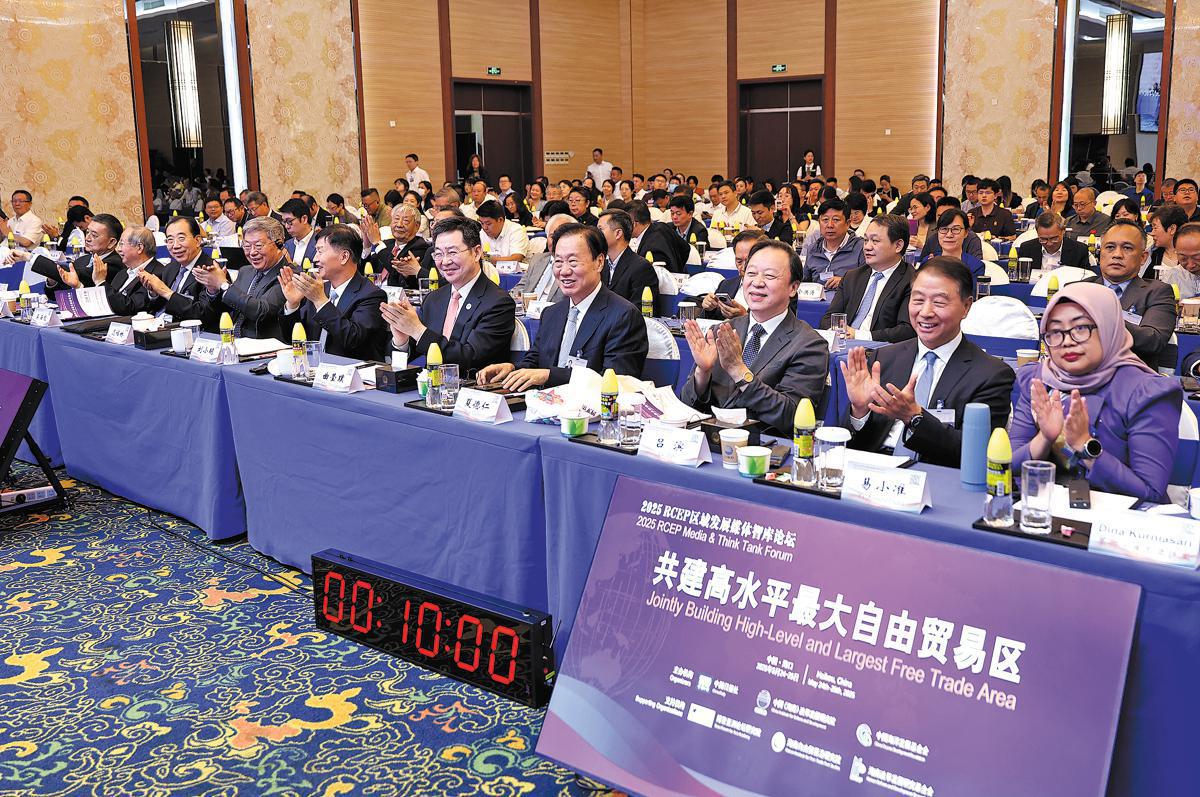
The speech was delivered by Chi Fulin at the 2025 RCEP Media and Think Tank Forum which was held on May 25 in Haikou, Hainan province.