Are we ready for the AI surge?
Editor's note: The second part of the AI series examines the role of the Hong Kong Special Administrative Region government in dealing with the transformative effect of AI on human capital and labor market policies as well as its innovation and economic integration in Hong Kong.









The education system should incorporate artificial intelligence knowledge at all levels, with practical cases from industry partnerships. Sector-specific AI transitions need to be mapped for orderly change and retraining. Ethical AI development requires clear guidelines for transparency and accountability, and the city lacks supercomputing power, finds Oswald Chan in Hong Kong.
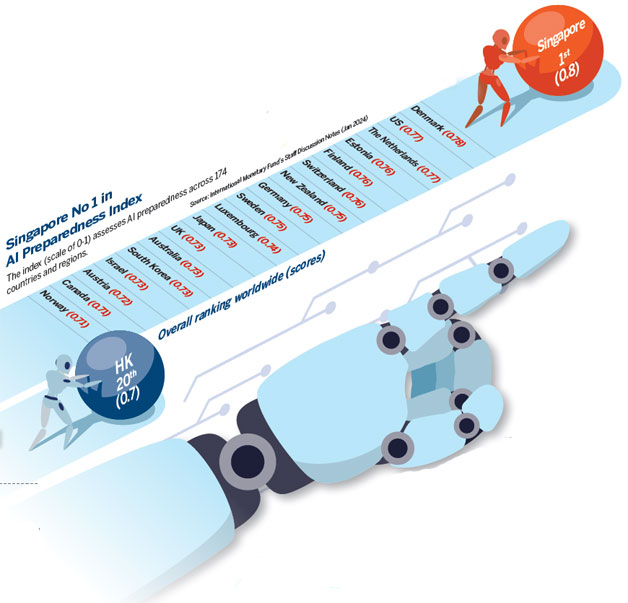
The International Monetary Fund's 2024 AI Preparedness Index (AIPI) Dashboard ranks Hong Kong 20th out of 174 countries and regions. The AIPI scores readiness to harness AI potential and to manage inherent risks from large-scale AI adoption. Singapore is rated the world's "most-ready" country to embrace AI effectively. On a scale of zero to one, a higher AIPI score indicates better AI preparedness. Hong Kong's score was 0.7 at 20th in the AIPI league, behind Singapore at 0.8 — with 18 other countries wedged within the 0.1 spread.
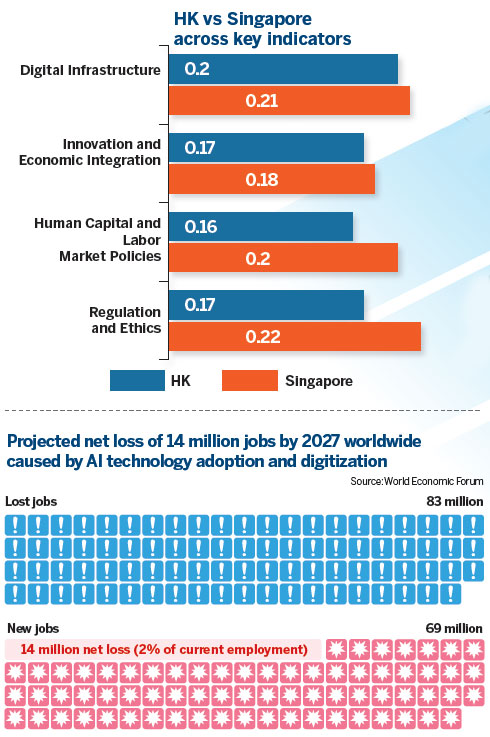
The matrix taps multiple macro-structural indicators that cover four broad dimensions: digital infrastructure, human capital and labor market policies, innovation and economic integration, and regulation and ethics. It combines hard data and survey perceptions, deriving an astonishing exactitude of assigned decimal values.
The index is a secondary gathering, from many sources, of data originally recorded for other purposes. It should not be read as anything but a matrix of indicators for policy guidance to prioritize areas for action. It shows which countries lead, in which dimensions, for others to learn from. It is not a definitive ranking of likely national AI implementation outcomes.
The numerical scores are conflated from hard data and perception surveys from eight institutions — the Fraser Institute, the International Labor Organization, the International Telecommunication Union, the United Nations, the United Nations Conference on Trade and Development, the Universal Postal Union, the World Bank, and the World Economic Forum. The methodology is inexact and the International Monetary Fund (IMF) advises using it with caution.
Business consultancies, industry leaders, AI experts, and academics, tell China Daily that the Hong Kong Special Administrative Region government carries the major responsibility for education, regulation, skills upgrading, and infrastructure, to accelerate readiness for the AI surge. The city cannot afford to lag. The foundation of hard infrastructure and AI innovation capacity has to be configured from the ground up. There are no shortcuts.
Total AI education
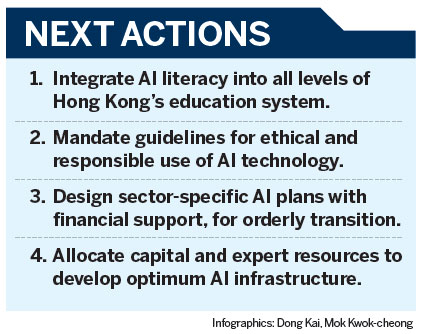
To ensure a pipeline of AI-competent talent to power its transformation, AI knowledge and training should span primary, secondary, tertiary, and continuing education, embedding AI into all relevant disciplines. It should not be treated as an optional, stand-alone academic subject. AI should figure as total education at every level. Equipping educators with core AI literacy is an urgent task.
Some things can only be achieved with purposeful agenda-setting and leadership. As with government agencies everywhere, civil servants are efficient at following successful precedents. When a new challenge on this vast scale appears, civil servants need leadership and direction from above. AI preparedness needs urgent capacity-building spanning all aspects of learning, practice, and transition plans for work.
"The administration should proactively promote coding and data literacy by implementing an AI-focused academic curriculum from primary to tertiary education. Schools and AI technology companies should proactively collaborate to provide students with firsthand information on the real-world applications and development of AI," argues Wilson Chow Wai-yin, global TMT industry and China AI leader at PwC.
"The SAR government should work with regulators around the globe and professional parties to define attestation and assurance standards for companies deploying AI technology," says Chow. "Data privacy is another key concern for the government to mandate data privacy rules to limit the use of personal data in all AI initiatives."
Richard Chen, Greater China regional vice-president at UiPath — an enterprise automation and AI software company, says: "A fundamental step involves embedding computational thinking, algorithmic thinking, and data literacy into early education. The school curriculum must emphasize automation and robotics training and practical context, so that students learn to apply AI to solve real-world problems."
He adds that AI education must extend beyond theoretical knowledge to encompass training in essential skills and ethical awareness, to prepare students for the future of work.
Renny Thomas, a senior partner at McKinsey & Company, concurs. "Building these skills will need going beyond classroom training, enhancing businesses and cross-functional squads with embedded full-stack AI capabilities, and reimagining operations, by staying on the cutting edge of available AI technologies," he says.
Regulatory guidance
Chen urges the administration to establish a regulatory framework and practical guidelines for companies and employees, to promote responsible AI development and deployment, factoring ethical considerations. "The framework should include data privacy, algorithmic transparency, and accountability, to build public trust in AI systems," he says.
Hong Kong's governance framework on the ethical and responsible use of AI remains fragmented. Public concerns about data privacy, fairness, cybersecurity, and job displacement can inhibit faster and broader AI adoption, if these are not comprehensively addressed.
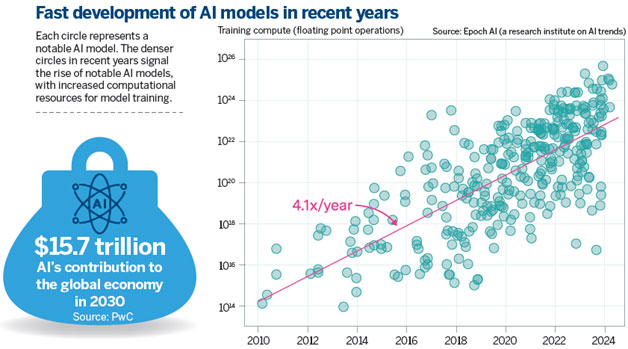
Business advisory firm PwC estimates global economic growth could rise by 14 percent in 2030 from AI applications, equivalent to an additional $15.7 trillion — from increased productivity and demand-side pull. But that transition to AI-generated growth will come with disruptive job restructuring and the displacement of non-AI-enabled employees.
Job losses
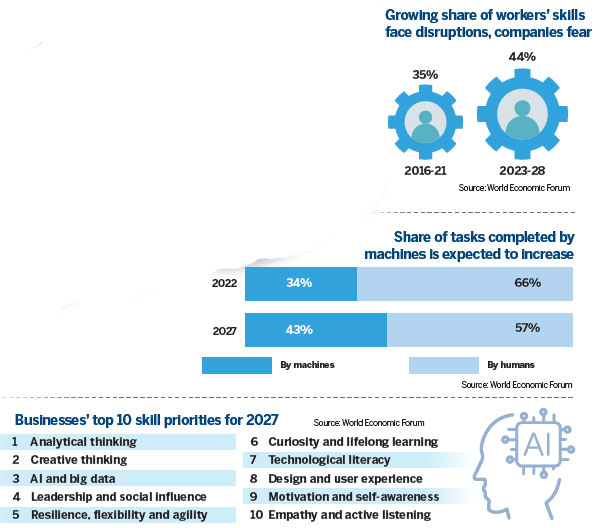
The World Economic Forum (WEF) estimates that AI technology will lead to the net loss of 14 million jobs, equivalent to 2 percent of existing global employment, over the next five years. The WEF's Future of Jobs Report 2023 expects big data analytics, climate change mitigation technology, encryption and network security, biotechnology, digital platforms and apps, e-commerce, and digital trade to drive employment growth. The largest job losses will hit traditional administrative, security, factory, and commerce roles.
The WEF expects 44 percent of workers' skills to be obsolete over the next five years. Reskilling and upskilling the workforce is urgent, as the report says six in 10 workers will require training before 2027, but not all will have access to adequate training opportunities.
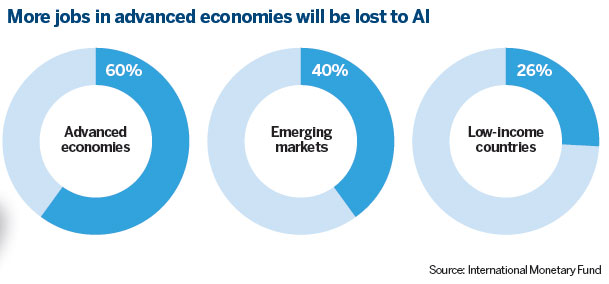
Cognitive skills for problem-solving, creative and analytical thinking, plus technology literacy, are considered the top three core business skill sets of the future global workplace. The IMF estimates that almost 40 percent of global employment will face AI disruption. The ratio is higher for advanced countries, at about 60 percent, due to the greater prevalence of cognitive-task-oriented jobs.
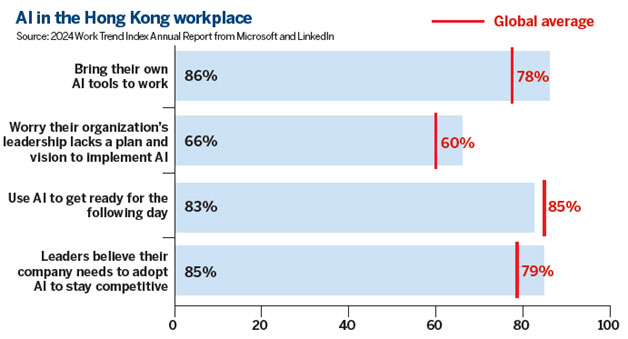
The 2024 Work Trend Index report compiled by Microsoft and LinkedIn highlights a growing awareness of AI's importance among both employers and employees. Notably, 66 percent of surveyed workers in Hong Kong fear a lack of employer plans and vision for AI implementation.Furthermore, 86 percent admit to bringing their own AI tools to work, potentially exposing corporate data to security threats. Meanwhile, 77 percent of leaders in Hong Kong prefer to hire less experienced candidates with AI skills over more experienced candidates without them. The survey sampled 31,000 individuals across 31 countries and regions, including 1,000 knowledge workers in Hong Kong.
"AI applications are poised to transform Hong Kong's labor market by automating complex workflows and enabling more intelligent automation," says UiPath's Chen.
Orderly AI transition
Hong Kong lawmaker and barrister Eunice Yung Hoi-yan suggests the SAR government can upgrade AI skills by developing sector-specific transition frameworks in collaboration with industry bodies, labor organizations, and academic institutions. "These frameworks could identify likely automation trends within each sector, map out emerging roles that complement AI systems, and develop training pathways that move workers from vulnerable positions to more sustainable careers, reducing transition costs for workers and businesses," Yung says.
In Yung's view, the administration should manage the AI impact on the city's labor market. "Those sector-specific transition frameworks are also useful to monitor and analyze how AI adoption affects job creation, displacement, and transformation, across different sectors and occupational categories, to provide an evidence base for policy responses," she adds.
Yung suggests the financial support mechanism could be an AI proof-of-concept fund, allowing small and medium enterprises and nongovernment organizations to test AI solutions before making larger investments. She feels a dedicated AI investment tax credit program, for SMEs and NGOs to commit to AI investment, and an AI adoption grant program, offering matching funds for qualified AI projects, could reduce the financial risk of early AI investment.
Financial incentives
UiPath's Chen suggests that the government provide financial incentives for AI adoption and systematic employee AI training. "Hong Kong needs to continue developing a robust AI infrastructure, including advanced computing facilities, data centers, and high-speed connectivity," he says.
Hong Kong's computing infrastructure is underdeveloped relative to digitally advanced cities. The first phase of Cyberport's Artificial Intelligence Supercomputing Center — one of Asia-Pacific's large-scale supercomputing facilities — only generates a computing power of 3,000 petaflops, equivalent to processing 10 billion images an hour, far below the estimated 15,000 petaflops of computing capacity needed by 2030.
"Preferential policies include tax incentives for computing infrastructure investments, accelerated depreciation schedules for AI hardware, subsidized electricity rates for data centers (power is a major operational cost), and streamlined approval processes for facility construction," adds Yung.
The lawmaker recommends that the administration develop zones specifically for data center development by providing a reliable power supply, cooling infrastructure, and high-bandwidth connectivity. It should also consider a coordinated computing resource network, integrating public and private facilities to enhance the city's AI preparedness.
Data center infrastructure is a prerequisite to support citywide implementation of AI-driven big data analysis for government, research and development work at universities and corporations, and for professional users, all of which places severe strain on existing capacity.
Data centers consume enormous amounts of power and generate high temperatures 24 hours a day, which requires large-capacity cooling. The city does not have surplus domestic power generation to meet a surge in demand. Will we have clean energy to scale for data centers here, or will Hong Kong need to tap power from the Chinese mainland?
Contact the writer at oswald@chinadailyhk.com






- Dinosaur footprints from about 200m years ago found in China
- Free shuttles provided for residents affected by Tai Po fire to vote
- Global influencers unlock scenic and cultural charms of Hechi
- Chinese Navy accuses Japan of interfering with training operations
- 'We can manage for now': HK rallies with fire recovery efforts on track
- Foreign media urged to report truthfully on HK matters