Is US tariff deal good or bad for Indonesia?









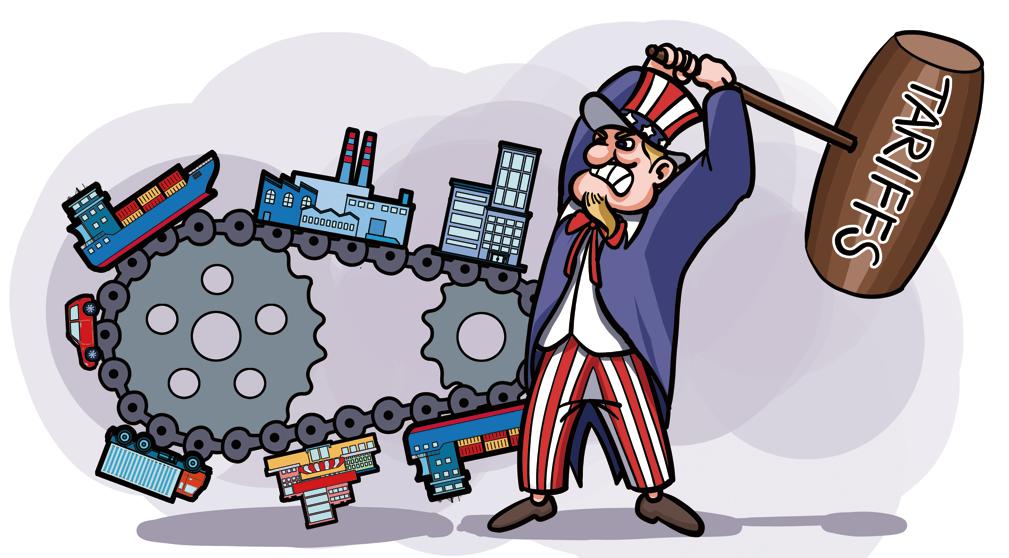
Indonesia secured a trade deal with the United States on July 16, which, at first glance, looks like a lifeline, as it locks in a maximum 19 percent tariff on Indonesian exports to the US through 2029. The deal was struck at a time of intensifying US protectionism, and offers what appears to be a temporary shield to Indonesia.
But while the Indonesian government deserves credit for navigating an increasingly unpredictable global trade landscape, the devil, as always, is in the details. The US has agreed to Indonesia's offer, but what it has offered is little more than a token rollback of President Donald Trump's unilateral tariffs — highly conditional and tied to his ever-expanding wish list.
The deal may protect Indonesia from ad hoc tariff hikes that the US has subjected China and some other economies. Yet certainty should not be confused with favorability.
It's important to understand what's at stake. Indonesian officials argue that while the US only accounts for about 9.9 percent of Indonesia's total exports, the trade relationship is disproportionately important due to the labor-intensive nature of the goods involved. Indonesian exports to the US, including clothing, footwear, furniture, rubber products and electronics, support a substantial number of jobs across Java, Sumatra and other Indonesian regions.
But the 2024 trade data suggest Indonesia's top exports to the US remain concentrated in sectors that are particularly vulnerable to Washington's protectionist impulses. Palm oil accounts for 4.9 percent of Indonesia's total exports to the US, followed by footwear at 4.7 percent, electrical machines and apparatus at 3.9 percent, telephone sets at 3.4 percent and rubber tires at 3.0 percent. These industries are the ones most exposed to tariff hikes, especially if they incorporate inputs from China, now a primary target of US trade restrictions.
The first major uncertainty is: Does the 19 percent cap apply uniformly to all Indonesian exports, or are some products — particularly those containing Chinese inputs — still subject to steeper duties?
The US has announced a complex, tiered tariff regime: 25 percent on labor-intensive goods such as textiles and footwear, key sectors for Indonesia; 40 percent on goods suspected of transshipment or Chinese-origin content; 50 percent on so-called strategic sectors including aluminum, copper, semiconductors and pharmaceuticals; and certain percentage through anti-dumping measures.
On top of these, an additional 10 percent levy would apply to exports from BRICS member states, of which Indonesia is a member. Layered on top are anti-dumping duties, often steep, inconsistently applied, and politically driven. Together, these measures deepen uncertainty for exporters while landing hardest on US importers and consumers.
The Indonesian government must demand full clarity. Are all its exports genuinely shielded from the punitive classifications, or is the real cost of the deal still hidden in the fine print? If Indonesia remains vulnerable to these sector-specific penalties, then the much-publicized 19 percent ceiling becomes largely symbolic.
Another concern is the scale of Indonesia's political and financial commitments to seal the deal. Jakarta has reportedly agreed to purchase 50 Boeing aircraft, commit $15 billion in US energy imports (nearly 40 percent of Indonesia's total energy imports), and import $4.5 billion worth of US agricultural products. There appears to be an undisclosed deal on copper, too.
Besides, one Boeing aircraft costs about $400 million. So how will the purchases be financed, and under what terms? What are the specifications, unit costs, and delivery timelines? Who will oversee the procurement, and how will transparency be ensured? Most crucially, are these transactions commercially sound, or merely political gestures with economic consequences?
Also, since Boeing has been involved in a string of quality and safety scandals in recent years, are Indonesia's airlines prepared to take the risk, or bear the cost of sidelining Airbus and other alternatives? Likewise, bulk agricultural imports from the US could flood Indonesia's market, undercutting local farmers and risking breaching commitments under the ASEAN and other trade agreements.
The deal must also be viewed through a broader global trade lens. Indonesia has already concluded comprehensive trade agreements with major partners, including Australia, China, India, Japan, the Republic of Korea and New Zealand. It is close to finalizing one with the European Union, and has recently launched trade negotiations with the United Arab Emirates. These countries could now demand comparable market access, or question Indonesia's commitment to fair competition.
At the same time, the agreement risks eroding Indonesia's carefully maintained strategic neutrality. Jakarta has long sought to balance its relations between Washington and Beijing, but this deal could be seen as a shift toward the US.
Indonesia should take three critical steps to ensure the deal serves its national interests. It should demand clarity from Washington on the scope and depth of the 19 percent tariff cap. It should publish the full details of its procurement commitments, particularly the purchase of Boeing aircraft, US agricultural products and energy products, because transparency is essential to assess the financial implications and strategic value of the deal. And, most importantly, Indonesia should revert to its long-term trade strategy — one anchored in diversification, rules-based agreements, and regional leadership — to avoid becoming overdependent on any single trade partner.
Only by doing so can Jakarta ensure a handshake in Washington does not become a handcuff at home. As former US secretary of state Henry Kissinger said, "It may be dangerous to be America's enemy, but to be America's friend is fatal."
Lili Yan Ing is secretary general of the International Economic Association; and Yessi Vadila is a research fellow at the Wiratama Institute, Indonesia. The views don't necessarily reflect those of China Daily.
If you have a specific expertise, or would like to share your thought about our stories, then send us your writings at opinion@chinadaily.com.cn, and comment@chinadaily.com.cn.