Breaking the mold









MA XUEJING/CHINA DAILY
The BRI's potential to act as a powerful driver of transformation across the Global South needs to be fully tapped in a tariff-turmoiled world
In an era when some major powers are increasingly reaching for tariffs to score tactical wins, China's Belt and Road Initiative offers something rarer: a long-horizon platform for productivity, connectivity and structural transformation. The tariff war that the United States initiated in 2018 intensified in 2024, with steep new levies on targeted Chinese goods such as electric vehicles, solar cells and semiconductors. These attacks have disrupted supply chains and raised uncertainty across global and regional value chains. The official rationale is strategic; the practical effect is fragmentation. Even the International Monetary Fund warned in 2023 that persistent geoeconomic fragmentation could reduce global GDP by up to 7 percent in the long run, with disproportionate costs for developing countries that rely on open trade to climb the technology and income ladders.
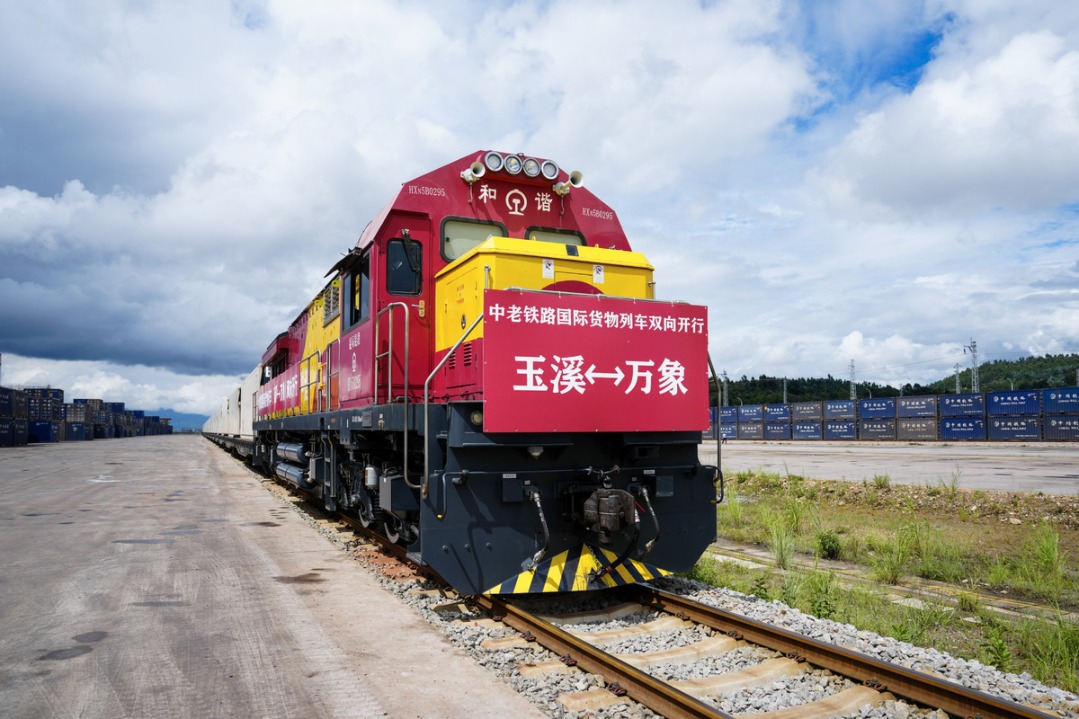
Against that backdrop, the BRI's emphasis on hard infrastructure, cross-border logistics and complementary industrial capacity remains one of the few scalable development propositions available to the Global South. It is not a panacea, and its outcomes vary with domestic governance, project selection and macro-management. But the BRI tilts toward fundamentals that raise total factor productivity: ports, railways, power plants, digital links, and the institutions and skills that make them useful.
Consider Nigeria, Africa's most populous economy and a bellwether for West Africa. Over the past decade, a set of BRI-aligned projects has begun to address longstanding logistics bottlenecks that keep the products of Nigerian companies expensive at home and uncompetitive abroad. The Lagos-Ibadan Standard Gauge Railway, inaugurated in 2021, reduced the travel time along a core freight and passenger corridor and relieved pressure on the Apapa road spine that had long throttled port access. Its completion followed the earlier Abuja-Kaduna railway, which demonstrated how rail connectivity can catalyze local commerce and commuter flows when paired with security and last-mile infrastructure.
On the coast, the Lekki Deep Sea Port, formally opened in 2023, created Nigeria's first modern deepwater gateway with draft and equipment able to handle the newest generation of container vessels. With annual capacity projected in the multimillion-TEU(twenty-foot equivalent unit) range as operations scale, Lekki is already re-routing West African shipping patterns, reducing feeder dependence and lowering logistics costs for both imports (capital goods, intermediate inputs) and exports (agri-business, light manufacturing products). The port's complementing with the Lekki Free Zone and new expressway links exemplifies how BRI-related projects can be nested in industrial ecosystems to maximize spillovers.
These projects are more than isolated builds; they form the backbone of Nigeria's long-delayed structural transformation. When freight becomes predictable and affordable, producers can access inputs at lower cost, turn over inventory more efficiently, and achieve economies of scale in manufacturing. This shift opens the way for countries to move beyond raw-commodity dependence toward higher value-added roles in regional and global value chains. Evidence shows that well-executed infrastructure investment can lift growth by approximately 2 percentage points a year, while also reducing inequality and improving welfare.
But infrastructure alone is not enough. Transformation depends on embedding these assets within credible national strategies, backed by transparent procurement, sound debt management and realistic demand forecasts. By aligning BRI corridors with industrial policies — such as agro-processing clusters, pharmaceuticals or light engineering — and pairing them with power-sector reforms, countries such as Nigeria can turn transport corridors into true productivity drivers. The same logic extends across Africa: rail and roads only achieve their full impact when complemented by special economic zones, customs modernization and vocational training.
The comparative calculus looks even more favorable when set against a tariff-heavy global policy mix. The US' recent tariff actions, including 2024 increases on EVs to 100 percent and hikes on solar cells, semiconductors, cranes, and more, will undoubtedly reshape trade in those sectors. But for the Global South, the broader collateral damage is the signal: policy risk is rising in legacy markets just as developing countries are trying to climb technology ladders and lock in export contracts to amortize new capital. Companies are hedging by shortening supply chains and "friend-shoring", but the IMF's empirical simulations suggest that persistent fragmentation reduces efficiency, scale and knowledge diffusion — exactly the channels latecomers need most. In practice, this means fewer orders, thinner technology spillovers and a harder slog to catch up.
In contrast, the BRI's project pipeline — when selected well — pushes capital toward bottlenecks that have historically deterred private investment: long-gestation transport, energy and digital backbones. AidData's landmark dataset documents hundreds of billions of dollars in Chinese development finance since 2000, the bulk of it targeting low- and middle-income countries that traditional investors have often deemed too risky.
Of course, the BRI must keep evolving. Its next phase should focus on selecting high-quality projects with strong governance, where transparent tenders, independent reviews and climate-resilient designs ensure long-term durability. Just as important is linking transport investments with reliable power, harmonized standards and easier trade facilitation so that lower logistics costs translate into real export competitiveness. Finally, the "soft" side of the BRI — human capital and technology transfer — needs greater emphasis, from vocational training and ensuring that skills and institutions grow as steadily as the infrastructure itself.
Tariffs may redirect some trade in the short run, but they rarely build capacity; they tax consumers, sow uncertainty and invite retaliation that narrows markets. The IMF's modeling is a sober reminder that when the world fragments, latecomers pay twice: once through lost efficiency and again through foregone learning.
The case for the BRI, then, is not ideological; it is developmental. It rests on a simple, empirically grounded proposition: long-term prosperity in Nigeria, Africa and across the Global South requires cheaper, faster and more reliable movement of people, power, data and goods — plus the skills and standards to use those factors well. In a moment when tariff politics threaten to shrink horizons, the BRI — done right — expands them. The task for policymakers is to make the most of that opening: insist on quality, align projects with strategy, protect fiscal sustainability and invest in people so that it becomes concrete capability.
If they succeed, the dividends will multiply over decades — not just in headline GDP figures, but in what truly matters: diversified exports, resilient supply chains, healthier populations and a greater share of value added retained at home. In today's tariff-first world, failing to pursue meaningful global engagement is not simply a missed opportunity; it risks being overtaken by a model that prioritizes cooperation, opens markets and builds a more balanced global economy. For Nigeria, Africa and the wider Global South, such engagement is not a luxury — it is a development necessity.
The author is an associate professor and executive director of the Center for Nigerian Studies under the Institute of African Studies at Zhejiang Normal University. The author contributed this article to China Watch, a think tank powered by China Daily.
The views do not necessarily reflect those of China Daily.
Contact the editor at editor@chinawatch.cn.