Beyond the strings
Hong Kong makers and players of the ancient Chinese zither, the qin, navigate tradition and transformation through a quiet return to the instrument's inner significance: where heritage lives through change, and meaning lies beyond sound. Luo Weiteng writes.









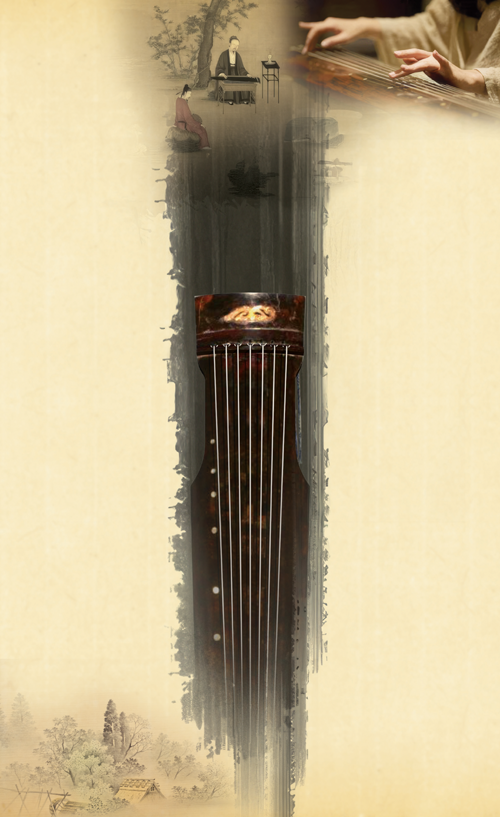
Tao Yuanming (365-427) — a paradigm of the recluse and cultural paragon of ancient China — famously played a stringless qin, declaring: "If one knows the inner significance of the qin, why make the effort to put on strings and pluck them?"
The stringless qin is the ultimate in refinement and reflects the literati attitude of valuing the spirit of the instrument over technical prowess. For Yao Gongbai, it was more than a metaphor — it was a spiritual companion in solitude at a time when the ancient zither, which represents China's foremost solo musical tradition, had itself retreated into near-silence.
In the 1960s, Yao was sent to the rural reaches of Yunnan province. With no qin to touch, he sketched one on sheets of newspaper — seven strings with 13 hui (marks) — reconstructing from memory what he could not hold. During the instrument's quiet era, he played in utter silence — no strings, no sound, only the melodies that lived within. The paper wore thin, tore under his hands, yet he redrew it again and again — each line a thread of unceasing devotion.
The nation at the time was emerging from hardship and rebuilding from ruins. In those early years, when the demand of survival speaks far louder than the call of beauty, few had the luxury to listen, let alone play, the qin.
As the millennia-old instrument stood quietly at the margins, its worth fell to a mere shadow of itself. In the early 1950s, Master Jiang Kangsheng was said to have bought a qin attributed to the Prince of Lu in the Ming Dynasty (1368-1644) for just 10 yuan ($4 at the time) at a Beijing marketplace. Earlier still, during the wartime years, Master Yang Xinlun was said to have acquired three truckloads of antique qin across Guangzhou — a scene that, in the words of Liang Jiyong, president of the Hong Kong Gu Qin Association, "beggars the imagination".
Silent for decades, the guqin — as the instrument is commonly known today — found its moment in 2003 when the art form was designated a Masterpiece of the Oral and Intangible Heritage of Humanity (currently the Representative List of the Intangible Cultural Heritage of Humanity) by UNESCO. Since then, Yao has felt the pulse of renewed interest — from eager learners to captivated audiences.
The surge of enthusiasm was also vividly mirrored in the auction room. In 2003, the celebrated Tang-Dynasty (618-907) qin named Jiuxiao Huanpei fetched 3.5 million yuan ($422,858 at the time), setting a record for qin sales. Later that autumn, the Dasheng Yiyin, once in the collection of the late connoisseur Wang Shixiang, was sold for 8.9 million yuan.
Echoes of tradition
The ebb and flow of fortune echo the shifting fate of the qin, tracing the subtle highs and lows of a life devoted to its resonance. In 2008, Yao was named the youngest among the first batch of 10 national-level inheritors of the art of the guqin under China's intangible cultural heritage program. The following year, the retired mathematics teacher accepted an invitation from the cultural department of Hong Kong Chi Lin Nunnery to be a researcher and moved to the city.
The wind of change has been reshaping the rhythms of Hong Kong, yet the qin community remains quietly anchored in time. From pottery figurines to ancient paintings, historical artifacts indicate that the instrument has maintained its form since the Han dynasty (206 BC-AD 220) and Jin dynasty (265-420). The art of qin-making, called zhuoqin, is a 1,800-year-old art that is virtually unchanged. Remaining true to this time-honored tradition, local qin players and makers continue to cultivate themselves in the manner of old literati, share music in intimate gatherings with close friends, and shape their instruments by hand following centuries-old practices.
Unlike on the Chinese mainland, where professional qin players are trained within the formal structure of music colleges, the musical tradition in Hong Kong lives on in the hands of a few dedicated amateurs. "Freed from the weight of livelihood and career, you need not measure the worth of this path in money. All that matters is sound at its purest, wood at its finest, and a qin shaped with utmost care," says Wee Lian Hee, a council member and instructor of the Choi Chang Sau Qin-Making Society, named after renowned Hong Kong qin-maker Choi Changsau (1933-2025).
An amateur in name, yet a master in spirit, Yao walks in the footsteps of his father, Yao Bingyan (1921-1983), who, although an accountant by profession, left an enduring legacy through his brilliant reconstitutions of nearly 50 qin pieces from ancient qin scores.
Yao treasures the freedom that comes with being an amateur, yet he is acutely aware of the quiet power of formal music education.
"Music conservatories equip qin performers with accurate pitch, precise rhythm, and gracefully flowing melodies, building a solid technical foundation even within a Western-based training system," he says. "A missing puzzle of such system, however, is a grounding in traditional Chinese culture."
Cultural revival
The instrument's ethereal melodies, the subtlety of its techniques, and the expansive interpretative possibilities of qin scores require a degree of knowledge and insight to fully appreciate. "Without these, it's like a tree without roots or water without a source," he says. Here, the classical idea of "stringless qin" lingers gently, revealing that the essence of the instrument matters more than its sound.
Traditionally, the qin's voice is soft and low-pitched, keeping it mostly confined to private spaces and away from public performances or ensemble play. With modern sound amplification, its gentle whispers can now reach beyond secluded chambers to embrace attentive audiences in grand halls. Years ago, the advent of steel strings offered another quiet revolution — sparing performers the constant, unexpected tuning of silk strings and allowing the instrument to grace the stage with ease and calm assurance, Yao says.
Yet in Hong Kong, the qin community tends to turn inward, known for its emphasis on the refinement and cultivation of moral character. The qin's dignified tone and difficulty of technical mastery are cherished not for applause, but as a means of an essential simplicity and self-sufficiency. This inward-facing pursuit naturally favors the delicate acoustics of silk strings.
For Wee, silk strings embody the very essence of his aesthetic values: "meeting the deepest expectations of what the qin should truly sound like".
Between steel and silk, the qin holds space for all. "The qin's broad tonal range lends it an inclusiveness that bridges contrasts — professional and amateur, public stage and private gathering, steel and silk alike," he says.
Yao embraces this spirit of inclusiveness. To him, the joy once savored in solitude may also be shared with many. From structured teaching at conservatories and the arrival of amplification devices to the mass production of steel strings, each, in its own way, carries the qin from solitary delight to the realm of collective joy.
Time changes, and the silk strings available today can hardly produce "tones that echo with the purity of metal and the weight of stone", as once drawn from instruments of elder masters. Even in his later years, Yao's father Yao Bingyan began performing on steel strings, while other traditional Chinese stringed instruments, such as the pipa, guzheng and erhu, have almost entirely transitioned to steel, their original voices giving way to a brighter, more piercing timbre.
Yao meets these changes — the inevitabilities and compromises of history — with integrity and openness. During the pandemic, he refused to move his qin teaching to livestreams, convinced that the essence of instruction would be lost online. Yet, he fully understands the rise of qin learning apps today — the steep cost of small, in-person classes and the difficult access to a worthy teacher naturally test the resolve of serious students, while quietly turning away many in the wider public who are willing, or able only to acquaint themselves with the instrument rather than to pursue it deeply.
Amid the shifting tides, most Hong Kong players regard the qin's transmission with a sense of letting things take their natural course. The city is now home to more than 50 players who perform on instruments crafted with their own hands in what could be an ages-old tradition of experiencing the qin in its wholeness.
"We belong to a quiet lineage — those who still touch the timeworn ways of the qin," says Kelwin Kwan, vice-president and instructor of the CCS Qin-Making Society. "To let this sound continue, passed from hand to hand, is simply enough."
During the stillness of the pandemic, the society organized qin-playing classes for beginners. Over 100 stepped in within just two years, though most soon slipped away. Still, among those who endured, three kindred spirits joined the path of qin-making. Then the city awoke and travel resumed, enthusiasm waned, and classes fell silent. The society now looks ahead with a patient hope.
For Kwan and his peers, the question is not mere survival, but authenticity. "We're more concerned about it being passed on incorrectly or becoming distorted." Yao feels this keenly. Through public lectures, he strives to articulate the principle of "what it truly means to be the qin". Without a genuine grasp of the Chinese heritage it embodies, the qin's legacy is no more than a rootless tree or a springless stream. Only in the depth of insight can one touch the realm of the "stringless qin" — bare in form, yet full in meaning; silent in sound, yet resounding in spirit.
At the turn of the century, Yao recalls, when China began to unveil its cultural treasures to the world, Kunqu Opera — one of the oldest forms of Chinese opera still performed today — teetered on the brink of disappearance. The qin endured — scores preserved, masters living, lineage sustained carefully through generations. Precisely, this relative completeness of inheritance makes the qin the second Chinese gem to earn the world cultural heritage status, following the more endangered Kunqu Opera.
In 2014, the arts of the guqin (the craft of qin making) were named as Hong Kong's intangible cultural heritage to the national list, and Master Choi was designated as the national-level representative inheritor in 2018 — the third one from the special administrative region.
Embracing new paths
Along with policy support and society-wide attention come innovative efforts to make the instrument "more fashionable and international". Attempts to use the qin to play modified or rearranged contemporary music, and concerto pieces with an orchestra, or even "visually modernize" the instrument itself began to appear.
Yao and the CCS Qin-Making Society take a sober look at the delicate balance between the qin's classical ethos and its contemporary reimagining.
Citing the famous saying by Chinese social anthropologist Fei Xiaotong — "Appreciate the beauty of each culture, recognize the beauty in others, share the beauty together, and achieve harmony in the world" — Yao believes every path of innovation carries significance, and each may take its rightful place within the living continuum of the qin's heritage. However, some so-called innovations, in his view, are "surface-deep, formalistic and out of place", often coming from those who barely know the instrument or see it only through Western musical lenses.
Yao has nothing against chasing the world. Years back, he was invited to collaborate with a United States-based symphony orchestra. "Such cooperation can be meaningful, yet the qin, by nature reserved and introspective, must always hold the lead — never overshadowed, never subordinate."
This cultural self-assurance finds its root in the qin's singular place within Chinese heritage. Foremost among the traditional four arts cultivated by Chinese literati, alongside weiqi (the ancient Chinese board game), calligraphy and painting, its name — the qin — has long stood alone in meaning. In modern times, the character qin has come to embrace instruments more broadly, from native strings to Western arrivals like the violin (xiaotiqin) and piano (gangqin).
At the end of the day, every true innovation in this art form, Yao says, should show due respect for this unparalleled musical tradition, and return to a shared origin — a quietly evocative sense of beauty that is distinctly Chinese.
Between the pull of modernity and the weight of heritage, "The qin is cool in its own right. What belongs to a nation belongs to the world," says Kwan. The instrument does not cater to borrowed elegance or dilute itself for foreign admiration. It stands quietly and unyielding — like the qin without strings, whose silence speaks of a self-defined and self-sustained beauty that needs no translation.
Contact the writer at sophialuo@chinadailyhk.com