
British invasions probed as root cause of Tibetan separatism
Updated: 2008-04-08 07:35
|
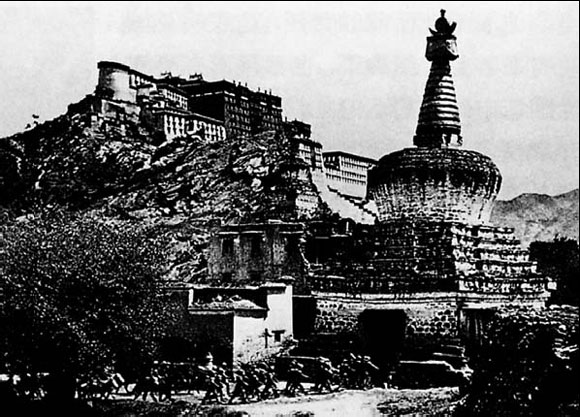
British troops lay siege to the city of Lhasa in 1904. File photo |
From today, China Daily will carry a series of in-depth reports about the Tibet autonomous region:
Britain, France and other Western nations tried to subjugate China under their colonial rule following the Opium Wars in the 1840s.
Meanwhile, some also coveted parts of the country, such as Tibet, which had long been an inalienable part of Chinese territory and part of the multinational Chinese family. Thus, the so-called issue of "Tibet independence" is originally an outcome of aggression by imperialist nations, a Chinese scholar has said.
Britain launched two invasions of Tibet in 1888 and during 1903 and 1904 - in an attempt to build up an exclusive colonial influence in the region. It also tried to separate Tibet from China to ultimately turn it into a "buffer zone" against British-controlled northern India, Hu Yan, a professor from the Party School of the Central Committee of the Communist Party of China, said.
"These two wars shall never be forgotten.
"You may tell those Tibet separatists that Chinese people will never forget history, and it was imperialist nations that invaded Tibet and had been trying to separate Tibet from China," he said.
First invasion: Violation of Chinese sovereignty
After the Opium Wars, Britain planned to build a road as a trade channel between Yunnan province and Myanmar in a move to secure more economic benefits in the region.
During the pre-construction research session in 1875, a translator named Augustus Raymond Margary from the British consulate in Shanghai was killed as a result of local protests. Britain grabbed the opportunity and managed to force the Chinese Qing government to sign the Chefoo Convention, which allowed the British to "visit and explore" Tibet.
Having realized the greedy nature of the British invaders, the local Tibetan government built heavy fortifications on Ling Tu mountain along the border between Tibet and Sikkim in 1886.
Britain, which allegedly claimed the fortified area within the British-controlled Sikkim territory, warned the Qing government of military action unless the defensive measures were dismantled in time.
Having tried in vain with warnings, in 1888 Britain launched military attacks against Tibet. Tibetan troops were defeated largely due to their outdated weapons and shortage of supplies.
After the war, the Qing government signed two more treaties with Britain in 1890 and 1893.
As a result, the Qing government acknowledged that Sikkim remained under British control and accepted Britain's proposal of border divisions between Tibet and Sikkim.
The Qing government also agreed to open the southern Tibetan city of Yadong (Chomo) as a business hub where Britain was granted extraterritoriality and exempted from trade duties for five years. The treaties not only violated China's sovereignty but also infringed the local Tibetans' interests.
In spite of the treaties signed, Tibetans continued to herd in their pasture lands. They even managed to destroy the border stones erected by Britain in an open protest against the border division and the treaties.
Second invasion: Massacre of Tibetan soldiers and civilians
At a time when Britain used India as its staging ground to press ahead its invasion plan of Tibet, the Qinghai-Tibet plateau also became the target of aggression by czarist Russia.
Britain considered the Himalayas as the barrier of the Indian subcontinent and Tibet, located just on the other side of the mountains, should belong to Britain's sphere of influence.
If Tibet were to fall into the hands of Russia, British India would be completely exposed to the threat of Russia.
Governor-General and Viceroy of British India Goerge Curzon believed Britain should pursue the Forward Policy to preempt Russia in the scramble for control of Tibet.
In July 1901, Secretary of State for British India George Hamilton delivered a note to the Russian Foreign Ministry, claiming Britain would not keep silent on the contacts between Russia and Tibet.
In a letter to Hamilton, Curzon even proclaimed: "We regard the so-called suzerainty of China over Tibet as a constitutional fiction - a political affectation, which has only been maintained because of its convenience for both parties." He urged the government to approve the plan of the British invasion of Tibet.
In 1903, in the name of negotiations, an invading army sent by the government of British India crossed the borderline into Tibet.
Led by F. E. Younghusband, the British Army went into Pagri through Yadong.
On March 31, 1904, the invading troops clashed with Tibetan troops in Qumigxung, north of Pagri.
Armed with outdated weapons, including swords, spears and matchlock guns, most of the 1,000-odd Tibetan troops were injured or killed by the British troops - an old colonial power - with maxim guns and big guns, the most advanced weapons of the day.
Gyangze county fell twice, on April 11 and on July 6, 1904. On Aug 3, British troops invaded Lhasa, the first time the ancient holy city had been trampled under the iron heel of imperialists.
Days before the British invasion, the 13th Dalai Lama left the Potala Palace with a few followers and fled to Outer Mongolia. The invading British troops withdrew from Lhasa in late Sept 1904, as supplies could not be guaranteed.
Britain's two invasions in Tibet were blatant armed aggression, Hu said, adding that it has been the longest among all the aggressive activities launched by imperialists in Tibet.
Ill intentions, intrigue no secret
Britain expanded its influence in Tibet after the two wars of aggression, which also fostered a hotbed for the emergence of the pro-Britain upper-class elements in Tibet, Hu said.
After realizing that the plateau could not be conquered by armed forces, the Britain imperialists began to build up their influence among the upper-class elements of Tibet, instigating them to oppose the Chinese government in a bid to separate Tibet from China, bring it into the British sphere of influence and become its dependency as well as a buffer zone in protection of the northeastern border of British India, Hu said.
"This was an invasion," said Patrick French, a British scholar and author of Younghusband, the Last Great Imperial Adventurer, when talking about Great Britain's invasion of Tibet in 1999. During a small workshop held in London in the autumn of 2003, a number of British scholars, including French, reached consensus that robbery admittedly occurred during the Tibet war.
In his book Duel In The Snows published in 2004, British scholar Charles Allen points out that in order to become the first group of Europeans in that area, F. E. Younghusband and his clique created all kinds of conspiracies and intrigues to cheat the public.
These were the most commonly used despicable means by imperialists at the time, Hu said.
History is a mirror of reality. Anyone's attempt to agitate for "Tibetan independence", like the serious crimes of aggression against Tibet committed by imperialist powers in the past, is doomed to failure, the scholar said.
Xinhua
(China Daily 04/08/2008 page5)
|
||
|
||
|
|
|
|