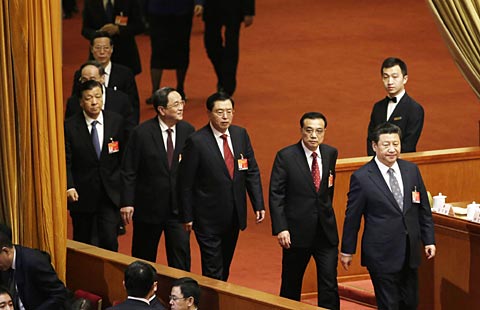
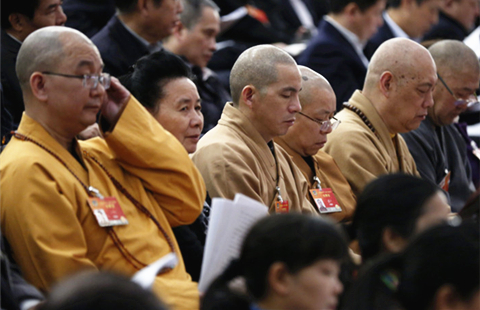
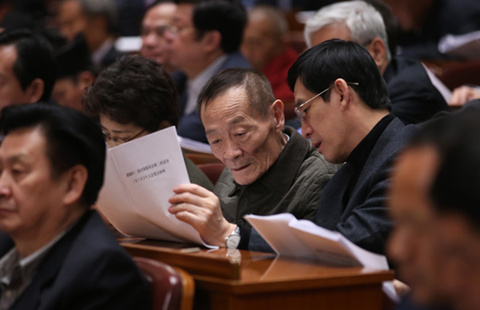
BEIJING - Following is the full text of report on the implementation of central and local budgets for 2014 and on draft central and local budgets for 2015, which was submitted for review on March 5, 2015 at the Third Session of the 12th National People's Congress and was adopted on March 15:
REPORT ON THE IMPLEMENTATION OF THE CENTRAL AND LOCAL BUDGETS FOR 2014 AND ON THE CENTRAL AND LOCAL DRAFT BUDGETS FOR 2015
Third Session of the Twelfth National People's Congress
March 5, 2015
Ministry of Finance
Fellow Deputies,
The Ministry of Finance has been entrusted by the State Council to submit this report on the implementation of the central and local budgets for 2014 and on the drafts of the central and local budgets for 2015 to the Third Session of the Twelfth National People's Congress (NPC) for your deliberation and for comments from the members of the National Committee of the Chinese People's Political Consultative Conference (CPPCC).
I. Implementation of the Central and Local Budgets for 2014
Faced with a complex and changing international environment and formidable tasks of domestic reform, development, and stability in 2014, the Central Committee of the Communist Party of China (CPC) and the State Council have grasped the overarching trend of development, adhered to the general principle of seeking progress while keeping performance stable, deepened reform in all respects, continued to develop new ideas and methods for exercising regulation at the macro level, and effectively implemented proactive fiscal policy and prudent monetary policy. As a result, the economy has performed within an appropriate range, and development has become more balanced and sustainable. Both the central and local government budgets were well implemented.
1. Implementation of the NPC's budget resolution
In accordance with the resolution of the Second Session of the Twelfth NPC on the report on both the implementation of the central and local budgets for 2013 and the central and local draft budgets for 2014 and the review of that report by the NPC's Financial and Economic Affairs Commission, we have deepened reform of the fiscal and tax systems, strengthened budgetary management, and made full use of the role of public finance.
Major progress has been made in reforming the fiscal and tax systems.
The overall plan for deepening reform of the fiscal and tax systems was deliberated over and passed at a meeting of the Political Bureau of the CPC Central Committee.
First, substantive progress has been made in reforming the budget management system. We cooperated with the NPC on revising the Budget Law and saw the completion of its revision, and moved faster to revise the regulations on its enforcement. We issued the decision on deepening reform of the budget management system. We formulated the guidelines on carrying out medium-term fiscal planning, and began work on developing a national fiscal plan on a rolling three-year basis. We drew up the proposal on reforming and improving the system of transfer payments from the central to local governments and optimized the structure of payments, cutting the number of items receiving special transfer payments by over one third compared with the previous year and increasing transfer payments to old revolutionary base areas, areas with concentrations of ethnic minorities, and border areas by 12.1%.
Second, systematic steps have been taken to reform the tax system. We further extended the trials to replace business tax with value added tax (VAT) to include, on a national scale, the railway transport, postal, and telecommunications industries. We drew up a plan for the reform of consumption tax and improved related policies. We implemented nationwide reform to levy a price-based resource tax on coal, adjusted the rates of resource tax on crude oil and natural gas, and cleared up and standardized administrative charges and government funds related to coal, crude oil, and natural gas. We cooperated with the work of the NPC on tax-related legislation, including preparatory work on legislation on environmental protection tax, and submitted to the NPC a suggested timetable for work on the implementation of the law-based taxation principle.
Third, with a view to creating a better fit between government powers and spending responsibilities, we made a systematic review of how powers and expenditure responsibilities are allocated in mature market economies, researched into the current allocation of powers and spending responsibilities in sectors including national defense, public security, and food and drug regulation, and achieved initial results in our research on fiscal structural reform.
In addition, we published the guidelines on improving and strengthening management of central government-funded research programs and their funding. We formulated a plan for deepening reform of the management of science and technology initiatives (projects and funds) financed by the central government, restructuring the system of management for such initiatives (projects and funds), dividing them into five categories, and gave impetus to the transformation of the government's functions of managing science and technology and the ways it exercises management. We carried out pilot reforms on management of the use and commoditization of and the distribution of profit from scientific and technological advances. We finished formulating the Regulations on the Enforcement of the Government Procurement Law. We drew up regulations for managing the government procurement of services and organized the launching of trials for governments to procure services. We also gave our support to reforms in state-owned enterprises (SOEs) and in the judicial, state capital, financial, and other important sectors.
Constraints on budgets were tightened.
We worked diligently to implement NPC-approved budgets and maintain their authority. Despite a slowdown in the growth of government revenue and mounting pressure on expenditure, the deficit was kept at the same level as the figure budgeted in early 2014. We examined and approved the budgets of central government departments within the stipulated time frame, kept under strict control additional items in their budgets for which funds may be appropriated and the time frames within which such appropriations may be made, and reduced adjustments to departmental budgets. We sped up the process of making central government transfer payments available to local governments, shortening the time needed for general transfer payments from within 90 days to within 30 days of the approval of a budget. We improved the methods for evaluating the progress of implementation of budgetary expenditures by local governments, and promptly urged localities where spending had fallen behind schedule to speed up their implementation. We intensified efforts to develop an accurate picture of carryover and surplus funds, and launched ten specific policies and measures to make better use of available government funds. We thoroughly reviewed and standardized local governments' special accounts and closed approximately 12,000 accounts that ran counter to relevant regulations.
Fiscal and budgetary management was made more standardized.
We reviewed and standardized preferential policies in taxation and other areas. The implementation of any preferential policy that was in breach of laws or regulations was, as of December 1, 2014, terminated without exception, while those that were retained after the review, along with any new preferential policies are all to be brought under permanent mechanisms and standardized management. We further standardized the management of budgets for government-managed funds, and established a mechanism for moving funds for which use should come under overall planning from the budgets of government-managed funds to the general public budgets. We improved management of state capital operations budgets and further raised the share of profits from the operations of central government enterprises turned over to the central government. Funds transferred from the budgets for central state capital operations to general public budgets were increased to 18.4 billion yuan from 6.5 billion yuan in 2013. The budgeting for national social security funds was included in the draft budget for the first time.
Further improvements were made to the system for managing government debt.
We introduced the guidelines on strengthening management of local government debt; established a standardized mechanism for local governments to secure financing through bond issuance; put into practice controls on the scale of local government debt, budgetary management, and early warning against risk; and established a local government debt management mechanism under which the borrowing, use, and repayment of funds are integrated. We worked to develop a clear picture of the outstanding debts of local governments. We formulated methods for assessing and giving early warnings on risks relating to local government debt. A total of 400 billion yuan worth of local government bonds were issued in 2014, and trials were successfully launched in ten regions for local governments to issue their own bonds and repay their own debts. We improved the system for managing the outstanding balance of government bonds, increased the types of bonds included within the trials of when-issued trading of government bonds, improved the mechanism for the periodic issuance and reissuance of government bonds of key terms, and for the first time, released the yield curves of key-term government bonds. We developed a reform plan to introduce a system for comprehensive government financial reporting based on accrual accounting, and clearly delineated the basic thinking on, major tasks for, concrete substance of, and steps for establishing such a system. We encouraged innovations in investment and financing mechanisms, and promoted the use of the public-private partnership (PPP) model, formulating guidelines on such partnerships and initiating projects that demonstrate how the model works in practice.
Financial discipline was strengthened.
We intensified efforts nationwide to tighten up financial discipline and deal with unauthorized departmental coffers, and investigated and prosecuted all types of financial behavior in violation of the law or discipline. Irregularities to the sum of 140.6 billion yuan were discovered in areas including budgetary revenue and expenditure as well as government procurement, and 1,538 individuals were held to account. We strictly enforced the requirement that increases are not to be tolerated in spending on official overseas visits, official vehicles, and official hospitality, and that such spending should be cut. We reduced expenditures on meetings; put a stop to the use of official vehicles and office space by officials in excess of standards; and kept under strict control the construction of new government buildings, increases in the total number of government employees, and the use of government funds to host gala parties or other events. We basically completed the reform of the system for the use of official vehicles by agencies of the CPC Central Committee and the central government. We improved financial and accounting systems underpinning the Regulations on Practicing Thrift and Opposing Waste in Party and Government Bodies. Having basically achieved complete coverage of all budget-preparing departments at and above the county level with the centralized treasury payment system, we moved forward with the reform of town and township institutions according to their types. We pushed for the implementation of digital centralized treasury payment by all provincial-level finance departments. We actively promoted the system of listing items requiring procurement through government credit cards. We strengthened the development of mechanisms for dynamic monitoring of the implementation of budgets, with a focus on intensifying monitoring over spending on meetings, training, hospitality, and major programs. We redoubled efforts to ensure that budgets and final accounts are released to the public, increasing the number of central government departments that release their budgets and final accounts to 99 and adding into budgets and final accounts a table specifically showing government spending on official overseas visits, official vehicles, and official hospitality. The budgets and final accounts released by the central government and its departments were detailed down to the subsection level - the lowest level in the classification of functions of expenditure, and the budgets of special transfer payments released were detailed down to the specific project. Thirty-one provinces, autonomous regions, and municipalities directly under the central government released their general public budgets and the budgets of their departments.
Copyright 1995 - 2015 . All rights reserved. The content (including but not limited to text, photo, multimedia information, etc) published in this site belongs to China Daily Information Co (CDIC). Without written authorization from CDIC, such content shall not be republished or used in any form. Note: Browsers with 1024*768 or higher resolution are suggested for this site.
License for publishing multimedia online 0108263 Registration Number: 130349