|
Home>News Center>Life | |
|
|
|
|
|
|
|
|
|
|
|||||||||||||||||||||||||||||||||||||||||||||||||||||||||||||
|
|
City protects its East-West architecture
Riding their bicycles past it every day, Nanjing residents are very familiar with the complex of elegant, old two- and three-storey houses along Zhongshan Avenue, amidst a forest of modern structures.
They and other buildings completed after the First Opium War (1840-42) in the capital of East China's Jiangsu Province, especially those built when Nanjing served as the national capital from 1912 to 1949, are an important and unique part of the architectural history of the country. "The more than 1,000 existing buildings built in China's Republican minguo Era, mostly in the 1920s and 30s, document a transitional stage in which modern Chinese architects were seeking and achieving an independence from the overwhelming influence of architectural trends in the Western world," said Liu Xianjue, professor with the architecture department of Southeast University in Nanjing. "It was a time when the first generation of architects returned after their studies abroad. The modern ideas in their minds clashed with the national patriotism in their hearts roused by the semi-colonial society."
The institute revealed its plan in an exhibition last year, which surprisingly turned out to be the most popular exhibition of the year. Faced with the city's rampant urban construction, the plan calls for protection of both those architectural structures that have been listed as cultural heritage sites at the national, provincial or municipal level, and those that haven't, said Liu Zhengping, the institute's chief designer. It included 134 buildings, which were selected by the city's residents after the institute published a list of candidates on the media early last year, with the final choices being made by a group of scholars and authorities. Protection and restoration work has been intense this year, as the city is to host the World Historical and Cultural Cities Expo from April 30 to May 5. The expo involves more than 20 ancient cities from China and abroad, including Barcelona, Daejeon, Florence, Kyoto, Leipzig, Malacca, Nagoya, St Petersburg and Vienna.
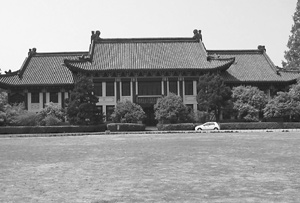
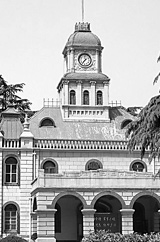
Among ancient cities, Nanjing's charm lies partly in its modern architecture, which demonstrates a clear line of development from 1840 to 1949, said city spokeswoman Xu Ning. One of the earliest extant pieces of modern architecture in Nanjing, which is well preserved on the campus of Jinling Middle School, is the bell tower of the Huiwen Academy, which was built by the United States Society of Jesus in 1888. The buildings of the academy, designed by US architects, were in the American Colonial style typical of the architecture of New England, which had its origins in Europe. The brick tower has a finely decorated base and eaves. Representative works of Western architects in Nanjing include the American Colonial Style buildings of the Jesuit Hospital, which was opened in 1892 by the US Jesuit Society, and was known among Nanjing residents as the "Marlin Hospital," after its first president, a Canadian whose surname was Marlin. The buildings are still in use today as part of the Gulou Hospital. Modern buildings mushroomed in Nanjing after 1898, when foreigners forced the country to open the city's Xiaguan Harbour on the Yangtze River to Western tradesmen and missionaries. Reformists of the Qing Dynasty (1644-1911) were also enthusiastic about such buildings. The Jiangsu provincial senate building, completed in 1909, was in the French Renaissance Style. Changes took place in the early 1920s when young Chinese architects, born at the turn of the century, returned after being educated in Japan, the United States and Europe and opened their own offices. Among them are many names that are still remembered, including Lu Yanzhi (1894-1929), a graduate of Cornell University; Guan Songsheng (1891-1960), a graduate of Harvard University; Liu Guozhen (1897-1968), a graduate of the Tokyo Engineering Academy; Zhuang Jun (1888-1990), a graduate of Illinois University; Xu Jingzhi (1906-), a graduate of Michigan University, to mention some of the most famous. It was some of these young men who started modern architectural training and research in China, with the founding in 1923 of the country's first department of architecture in the Suzhou Engineering School, which became part of Central University in 1928 and is today the architecture department of Southeast University. In 1928 some of these young men founded the department of architecture in Northeast University, which became part of Peking University in 1938. They organized the Chinese Architects' Society in 1927 and published a monthly journal. Architectural work in Nanjing was given a great boost by the formulation of the "Capital Plan" in 1929. Under the plan, American architect Henry M. Murphy (1877-1954), the chief designer and his assistant, also his student Lu Yanzhi decided the major avenues of downtown Nanjing today and divided the city into six districts: the central public affairs, municipal public affairs, industrial, commercial, educational, cultural, and residential districts. "Looking back at the history from our vantage point today, we can see that the basic layout of Nanjing has not been left to us by the Southern Dynasties (AD 420-589) or the Ming Dynasty (1368-1644), which had the city its capital, but by the Republic of China," said Liu Xianjue, who was the student of famous architects Yang Tingbao (1901-83) and Liang Sicheng (1901-72). The plan encouraged the construction of buildings of the Chinese Palatial Style and with modern structural features. Most major public buildings built at the time in Nanjing were of this type. Typical were the buildings of the then Executive Yuan (central executive organ), the Ministry of Transportation, the Central Research Institute and the Central Museum, which are all well preserved and still in use, said Liu Zhengping. The crowning work of this style of architecture is the Dr Sun Yat-sen Mausoleum, designed by Lu Yanzhi in 1925. Located on the southern side of Purple Mountain, the mausoleum covers 80,000 square metres, the imposing structure matches the character of Sun, and also established the status of the then 31-year-old architect. Despite their impressive appearance, buildings in the Chinese Palatial Style were costly and sometimes flawed in design detail. Adventurous Chinese architects then abandoned the complexities, heavy roofs and exterior decoration of the Chinese Palatial Style, and adopted the flat roofs and simple structure of modern buildings, but they maintained Chinese structural components and decorations at such parts as eaves, entrances and windows. This became known as the Chinese Neo-ethnic style. Typical buildings include those of the then Ministry of Foreign Affairs (completed in 1933), the Citizens' Great Hall (1935), the National Art Museum (1935), Central Hospital (1933), Central Stadiums (1933) and the Music Terrace of Dr Sun Yat-sen's Mausoleum. The Central Stadium, designed by Yang Tingbao, was at that time the largest stadium complex in the Far East, covering 800,000 square metres. The complex is used today by the Nanjing Sports Institute. The architects showed their mastery of Western-style designs best in the Yihelu Community, which consists of more than 340 two- and three-storey houses, each with a garden. The quiet community, hidden in a triangular area beside the Shanxilu and Hunanlu shopping centres in the downtown, is a collection of Western styles such as Classical, Neo-Classical, Neo-Romanesque, Regency and Spanish. The houses were embassies and homes of high-ranking officials in the Kuomintang government. Today mostly ordinary citizens live in these homes with their grapevine covered courtyards and rose sheds. The Yihelu community and the Meiyuan Xincun community, where old houses are clustered, are now protective zones where the municipal government requires residents to maintain the exterior appearance of the houses, said Liu Zhengping. The homes of Wang Jingwei (1883-1944) and George Marshall (1880-1959), US President Truman's special representative to China, in the Yihelu community, are cultural heritage sites under the Cultural Heritage Protection Law. Stress is put on the protection of the more than 40 buildings built in the 1920s and 30s along Zhongshan Avenue which cuts through downtown Nanjing. Inappropriate structures around the protected buildings are being taken down to display the protected buildings to the best effect. The campuses of Central University (today's Nanjing University and Southeast University) and Jinling Women's University (Nanjing Normal University), site of the Central Research Institute, which is used today by the Nanjing Institute of Geology and Paleontology, Chinese Academy of Sciences, have been listed as cultural heritage sites at the provincial level. Not only buildings at the sites but also any surroundings that are in harmony with the buildings are also under protection, said Liu Zhengping. The protective measures are expected to give full play to the cultural and historical aspects of this economically powerful city in the Yangtze River Delta, said Xu Ning. Experts say it is easier to protect the old city of Nanjing than most other ancient Chinese cities, as the city has a modern urban planning base that is no more than a century old. |
|
|
|
|
||||||||||||||||||||||||||||||||||||||||||||||||||||||||||
|
|
|
|
|||||||||||||||||||||||||||||||||||||||||||||||||||||||||||||