China, Africa to fight poverty together
China and Africa must work together to tackle poverty.
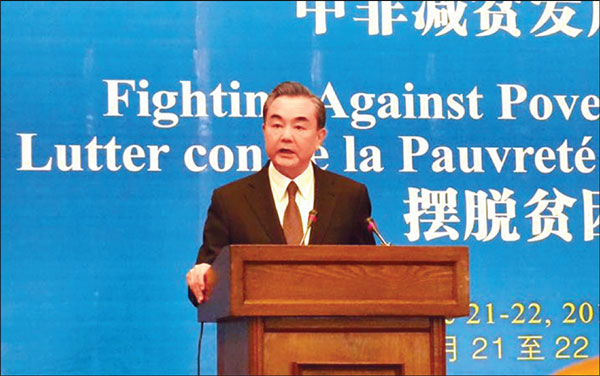
This was the keynote message of Chinese Foreign Minister Wang Yi to the Africa-China High-Level Dialogue and Think Tank Forum: Fighting Against Poverty for Common Prosperity held recently in Addis Ababa, Ethiopia.
He made clear that poverty still afflicted the world's second-largest economy, with 40 million people still living in poverty in China, although this is a small number compared with the 400 million living below the poverty line in Africa.
And Wang said it was vital that the problem is dealt with now and not put off to a later date.
|
Foreign Minister Wang Yi addresses the Africa-China High-Level Dialogue and Think Tank Forum: Fighting Against Poverty for Common Prosperity, held recently in Addis Ababa, Ethiopia. Provided to China Daily |
"This is the responsibility we should shoulder today for our future generations. This is also the common goal Chinese and African people are working for," he told the meeting.
The two-day forum at the African Union Conference Center was co-chaired by the AU Leadership Academy and the Institute of African Studies of Zhejiang Normal University.
It was attended by politicians, academics and experts from across Africa and China, who looked at ways China and Africa could work together to tackle poverty.
Central to the many debates and panel sessions was a new book, Up and Out of Poverty, containing speeches and articles written by President Xi Jinping when he was Party chief of Ningde prefecture of Fujian province almost 30 years ago.
When Xi went to the province in 1988 at the age of 35, the prefecture had a per capita GDP of $198 (173 euros). Last year it was $8,000.
"The thoughts and ideas of the book are important, such as the emphasis on clean government and the focus on the economy. They are as important today for China to eradicate poverty but also for developing economies," Wang told the forum.
"The book has been warmly welcomed in many, many countries. I believe it can also shed light on useful experience for our African friends."
Poverty remains a crucial issue in Africa. Although the proportion of Africans who are poor fell from 56 percent in 1990 to 43 percent in 2012, according to the latest World Bank figures, the numbers are actually rising due to population growth. Between these two time points the number of people in poverty actually rose from 280 million to 320 million.
China itself since reform and opening-up in the late 1970s, has famously experienced the largest poverty reduction in human history, with some 700 million raised above the threshold during the past 40 years.
Wang emphasized at the forum that the Chinese government remains committed to eliminate all poverty in China by 2020. This, he said, is a key part of its central goal to become a "moderately well-off society" in time for the 100th anniversary of the founding of the Communist Party of China.
"Eradication of poverty is one of the important preconditions for this," he said.
Moussa Faki Mahamat, chairperson of the African Union, told the forum that China and Africa were united in their determination to eliminate poverty and that both could learn from each other.
"It is a two-way relationship and we can learn considerably with humility from one another," he said.
One of the focuses of the meeting was how important industrialization was in lifting Africa out of poverty.
Ethiopia has been one of China's manufacturing success stories, with the Chinese-owned Eastern Industry Zone on the outskirts of Addis Ababa being the home of Huajian, the Chinese shoemaker, one of the best-known examples of light manufacturing on the continent.
Before the meeting, a report in the Financial Times highlighted World Bank data that showed that manufacturing as a proportion of Ethiopia's gross value added (a measure of national output) fell from 7.8 percent in 1997 to 4.1 percent in 2015.
Emmanuel Nnadozie, executive secretary of the African Capacity Building Foundation, which aims to foster industrialization on the continent, said nobody said industrialization was going to "go in a straight line".
"You will have bumpy roads here and there. The most important thing is that you have launched yourself on a trajectory toward being a more industrialized society, and I believe Ethiopia has taken that first step," he said.
Arkeby Oqubay, inter-ministerial coordinator to the Office of the Prime Minister of Ethiopia, admitted that Ethiopia was still one of the least-developed African countries, but with double-digit growth for the past 14 years, it was still on target to achieve middle-income status by 2025.
He said foreign direct investment was creating millions of jobs in the manufacturing sector, but there needed to be more special development areas like the Eastern Industry Zone, which is an isolated example.
"This is not typical even of the rest of Ethiopia, never mind the rest of the continent," he told the forum.
"One of Ethiopia's aims is to lead the way for Africa to become the manufacturing workshop of the world."
Those attending the summit visited the Eastern Industry Zone on the second day of the forum, where they saw the Huajian factory in operation as well as cars coming off the production line at Yangfan Motors, the Chinese car maker, as well as tile production at Di Yuan Ceramics, another Chinese company.
Huajian currently employs 6,000 but this is set to increase to 40,000 within five years when the $1 billion Ethio-China Huajian Light Industrial Park is completed in another area of the city.
Huajian already makes shoes for some of the world's leading brands in Ethiopia, including Coach and Versace, as well as for the mass market.
Frezer Genene, a 26-year-old superviser, said the workers are is very dedicated and greatly appreciate the opportunity given to them by the company.
"I love working with Huajian, as the company really has a bright future," he says.
Frezer, who is originally from Asela in Ethiopia's Oromia region, started work for Huajian after graduating from a local university.
He has since been sent by the company to study Mandarin, at Huajian's base in Dongguan in Guangdong province.
"My parents are proud of me, as they sometimes can see me on television when Huajian is featured," he says.
"I welcome the opportunity to grow with the company. I believe I am capable of supervising even a much larger factory, say, a factory of about 5,000 or even more workers," adds Frezer, who now speaks very good Chinese.
Wang Yiwei, director of the European Research Center at Renmin University of China, one of the high-profile Chinese academics who attended the forum, said Chinese companies investing in manufacturing in Africa are an example of a new global supply chain emerging.
"China's own economic growth model is going from labor to captive intensive and some of the production chain is being shifted to Africa," he said.
"China's global supply chain and the Belt and Road Initiative are now huge drivers of global growth. There are still challenges in Ethiopia, however, with the restrictions on hard currency leaving the country, but these can be overcome."
One area of debate was whether the Chinese investment in industrial zones was a new version of the special economic zones that kick-started China's development in the 1980s.
One of these was Xiamen SEZ on China's eastern seaboard, which was founded in October 1980 and was one of the five original zones, along with Shenzhen, Zhuhai and Shantou in Guangdong province and the entire province of Hainan.
Xiamen's GDP has increased 35-fold since it was inaugurated with per capita income of the residents increasing from 700 yuan ($103; 90 euros) to 20,000 yuan. By November last year, it had investors from more than 100 countries, and 59 of the Fortune 500 companies were based there.
Huang Meibo, director of the Institute for International Development at Xiamen University, has done a special study on how the SEZ concept might relate to African development.
"I have visited a number of the Chinese-invested industrial zones, not just in Addis Ababa, but also in Zambia and Mauritius. They are essentially different from Chinese SEZs because it is Chinese companies that are driving them and not the government," he says.
"The Chinese SEZs were of huge scale involving the whole of the city and not just parts of it. There is nothing to stop African governments from doing something similar and offering preferential land and taxation policies."
Huang, however, says African governments could put in place policies to attract foreign direct investment, generally without the cost of building expensive industrial zones.
"It is often forgotten in the China development story that China had an open policy across the country for FDI and it was not all about the SEZs, although they obviously had the most favorable policies."
In his book, President Xi argues that to eradicate poverty it is important to adhere to four principles: shaking off any poverty mentality; adopting development measures suitable to local conditions; showing strong leadership and coordination; and making sure not to invest in grandiose projects just because they might be popular.
"We must eradicate the 'poverty' that exists in our minds before we can eradicate it in the regions we govern, before we can help the people and the nation out of poverty and embark on the road to prosperity," he writes in the book.
Huang Youyi vice-president of the Translators Association of China, who was responsible for the translation of the book, said the essential message was that poverty can only be eradicated by people not looking "to others for the answers" to their problems, but looking to themselves.
He said the success Xi achieved in Ningde was about each village in the prefecture specializing in what it did best.
"Each village focused on a specialized product whether it was grapes, tea, mushrooms or aquatic products," he said.
"Since the local industry was rather weak, he proposed they develop the processing industry by using local resources."
Funeka Yazini April, a research specialist at the Africa Institute of South Africa, the Pretoria-based think tank and research organization, says the book deals with some deep development issues.
"The book is very, very relevant. The issues it deals with are something that everybody is grappling with, not just Africa but everywhere," she says.
"It deals with local governance, industrialization and it is not just for Africa and the BRICs countries but everyone."
Dr Emmanuel Akwetey, executive director of the Institute of Democratic Governance, one of Ghana's leading research and advocacy organizations, said the book reflected the strength and vision of the author.
"I was curious to understand how China worked, and his ideas in terms of the rule of law, clean governance, low levels of corruption, accountability and zero tolerance of criminality were consistent with some of the things we strive for in Africa but often can't attain.
"I was interested in how he confronted problems and how he dealt with people. I find it useful to go back into the history of strong leaders and you find out that they really listened to people at the grassroots level. This is the certainly the case with Xi."
Arkebe Oqubay from the Office of the Prime Minister of Ethiopia said the book certainly had valuable lessons for countries like Ethiopia, which is trying to establish itself as a major manufacturing center.
"At the center of the book is the perspective of how prosperity is important to the well-being of the people. We believe industrialization is important to lifting people out of poverty," he said.
Zhou Yuxiao, the Chinese Ambassador for Affairs of the Forum on China-Africa Cooperation, said the forum made clear that cooperation was vital in order to alleviate poverty.
He said this had been underlined at the coordinators' meeting of the FOCAC summit in Beijing in July last year.
"If China and Africa can continue to deepen their collaboration in various fields, they can certainly shake off poverty at an early date, generate sustained development and share peace and prosperity together."
Charles Onunaiju, director of the Center for China Studies in Abuja, Nigeria, believes increased cooperation between China and Africa is the route to both economic development and the reduction of poverty.
"With a rising China and its unique and robust, friendly and functional cooperation with Africa, the continent stands at the cusp of a great opportunity of the rejuvenation of its economic and social fortunes to the benefit of all people."
Huang at Xiamen University believes it is possible that Africa can achieve similar success to China.
"Many parts of Africa are now where China was in the 1980s, and 1990s and I think if governments have the same kind of open policies, industrialization will come. China learned from other countries - from East Asia and Europe and the United States - and from encouraging inward investment with the setting up of SEZs and other polices. Africa can do the same."
Nnadozie of the African Capacity Building Foundation and a leading Nigerian economist, said the forum set an optimistic tone and that industrialization and the alleviation of poverty could come to Africa much faster than many now envisage.
He believes this could be well before the African Union's own targets set out in its Agenda 2063 goals for development.
"It will come long before 2063. It may not be uniform across the continent, but we see countries such as Ethiopia and Rwanda that have very good potential for becoming the workshop of the world already."
Contact the writers at andrewmoody@chinadaily.com.cn
Getachew Yalew contributed to this story.