In her office in Kabete Technical Training Institute in Kenya's capital, Nairobi, Valerie Mbathe Kamanda proudly shows China Daily the sample of machine parts her students made.
"I have never seen this technology before," she says, referring to how the parts were manufactured.
Kamanda, deputy head of the department of production at Kabete, says her students managed to make the "complicated" parts after six weeks' training by Chinese engineers and technicians.
In September, with these parts, Kamanda's team won a top spot in the Africa Tech Challenge, a joint program launched over the summer by Kenya's Ministry of Education, Science and Technology and China's AVIC International Holding Corporation. Beijing-based AVIC is a large entity involved in international aviation, trade and logistics, electronic high technology and many other fields.
Kamanda should be especially proud of her students because her school's program is troubled by a lack of machine tools used as teaching aids. Ideally, there should be at least 20 lathes for the 200 students in related majors, but there are only two, not counting outdated ones that can't be used.
What makes Kamanda most proud is that her students, together with students from Nyeri Technical Training Institute, will be provided contracts from Chinese companies to manufacture parts because of the students' excellent performance.
Eighteen teams from various universities or technical training institutes all around Kenya were involved in the ATC in 2014. Each team had three students.
To make ATC different, all the students participating in it were trained first before they went into the competition, she says.
"We have never had a competition like ATC before. During the ATC, they polish the skills of the students. They also let us know what other countries do and what other institutes do," says Kamanda.
ATC is the latest effort of a Chinese company to help improve the system of technical and vocational education and training in Africa.
There are about 2,000 Chinese companies in Africa. ZTE, a prominent Chinese information and communications technology company, for example, has built three training centers in South Africa, Ethiopia and Algeria.
The training center in Algeria has a capacity of at least 800 participants a year and the one in South Africa has a capacity of 300 participants, according to ZTE.
At the end of 2012, China had trained more than 53,700 Africans in China and sent more than 350,000 technical personnel to Africa.
China has also provided $10 million to the International Money Fund to help improve the employment skills of African laborers, according to Chinese Premier Li Keqiang.
Though the latest model, ATC, has been widely applauded as a new starting point to improve the technical and vocational education and training system in Africa, that system remains troubled by a lack of equipment and competent trainers, and often fails to offer to industry the skills it really needs its workers to have.
Experts and officials also say that China can play a bigger role in revitalizing the technical and vocational education and training system in the continent, which would benefit both Africa and China.
Africa is the youngest continent in the world, with half of its population of more than 1.1 billion under 25. Each year between 2015 and 2035, there will be half a million more 15-year-olds than the year before in the continent, according to the World Bank.
This offers the continent an unprecedented opportunity to develop its economy, while the population in many other parts of the world is, or will soon be, aging.
However, this also raises concerns that many youth left unskilled, unemployed and frustrated may constitute a latent problem that has not been resolved, at least in part because of the underdeveloped technical and vocational education and training system in the continent.
According to Global Employment Trends for Youth 2013, published by the International Labor Organization, the unemployment rate for youth aged 15 to 24 in North Africa is forecast to be about 24 percent, and about 11.7 percent in sub-Saharan Africa, from 2013 to 2018.
However, the rate is high for vulnerable employment, which includes unpaid family contributors and those working on their own account without employees. In sub-Saharan Africa, it was estimated at 77.4 percent in 2013, which is the highest of all regions, according to Global Employment Trends 2014, also published by the ILO.
As the young population rises, the number of youth unemployed or underemployed with vulnerable jobs may rise as well, even though the rates may not change too much.
"Every year, 8 million to 10 million poorly skilled young Africans make the difficult transition from school to the labor market, where they end up in insecure employment with no prospect of further education or developing their skills," says George Afeti, former secretary-general of Commonwealth Association of Polytechnics in Africa, and also an international technical and vocational education and training specialist and consultant from Ghana.
Afeti says this has become a huge challenge for many African countries because it has "implications for both social cohesion and national security, since a large number of unskilled, unemployed and frustrated youth constitute a ticking social time bomb".
In many developing economies, manufacturing has served as an engine of paid employment creation; this, however, hasn't happened yet in many African countries.
The industrial sector in Ghana, for example, is comprised mainly of mining and construction, while manufacturing has been declining as a share of GDP in the past two decades, according to the African Development Bank.
At the regional level, the share of industry as part of GDP also decreased slightly, from 30.7 percent in 1991 to 29.7 percent in 2011, but the share of manufacturing decreased significantly in this period, from 16.7 to 11.1 percent, according to the World Bank.
The current technical and vocational education and training system actually has created obstructions for manufacturing development in Africa, some industrialists say.
In Kenya, the ninth-largest economy in Africa, for example, manufacturers have complained about the skills technical training institutes teach being very much a mismatch with the skills industry needs, which raises their costs.
According to Edwin Tarno, principal of Rift Valley Technical Training Institute and also the chairman of the association of technical training institute principals, there are currently more than 122 technical training institutes in the country, which has a population of 44.35 million. There are projected to be another 30 new institutes as of the coming financial year.
The quality of the training in those institutes is not always up to scratch, many say. "There is a noted mismatch between the labor market's needs and what is being offered in our institutions of learning, such that hands-on experience must be got at workplaces," says Betty Maina, CEO of the Kenya Association of Manufacturers.
Maina says that the recruitment of skilled workers is costly because they have to turn to employment agencies and headhunters. To make the cost even higher, "training is still required" after hires are made.
"For technology, many employers usually have significant upskilling on the job, which leads to some high-cost training.
"Still, within the companies, many are seeking to update equipment, but on the other hand, it calls for the company concerned to incur high training costs if the new machinery is installed," Maina says.
In other countries, the technical and vocational education and training system may be even worse because of the lack of training institutes.
The current such systems in Africa, dominated by informal training providers, "are not technologically robust enough to give young people the employability skills they need for decent jobs in the modern labor market or employment sector", says Afeti.
"In some countries, especially in West Africa, about 90 percent of skills acquisition takes place in the informal economy through the apprenticeship system. In most cases, the quality of training is poor."
The school-based or formal training system in Africa follows "a standard but very often outdated curriculum", while "suffering from inadequate or obsolete training equipment, inexperienced teachers with very little professional or workplace experience, and inadequate material and human resources", says Afeti.
He says this results in "theory-dominated" training and "student assessments heavily based on passing theoretical examinations rather than on a demonstration of practical skills competence by the students".
Kamanda acknowledges the problem. "The syllabus to the workshop in our institute is theoretical. ATC is competence-based."
Many believe the competence-based ATC can help a great deal in changing lingering problems with the system of technical and vocational education and training in Africa.
"This model should be promoted and intensified by the Chinese government since it is promoting technology transfer and assimilation into Kenya and the African region," says Makworo Edwin Obwoge, lecturer at Kisii University, Kenya. "It leads to both economic development of the country in terms of infrastructure and human capacity enhancement for further development. I think this would be the best model to quickly develop Kenya and the African region."
Tarno, the principal, says ATC set a benchmark that made it possible to tell if what the youths were doing was good enough or not. "If we continuously engage using the ATC systems, it means that we will keep improving."
The ATC is an "eye-opener, both to our training institutions together with our industries", says Zachary Ooko, principal technical education officer at the Ministry of Education, Science and Technology.
He says ATC offers an opportunity to test young graduates to see if they are able to make products or not. "If not, let's sit back and see what changes should be made to the current training system," Ooko says.
It also offers an opportunity for curriculum developers to find problems and "do the correction and then bring it to another ATC to check if that meets the needs of industry", he says. "The idea should be expanded as much as possible."
Ooko says it would be good to expand ATC to regional levels. "In that case, everybody will have a chance. It can be a very big forum in the technical and vocational education and training sector in the future."
He says they are expecting more companies to join in ATC. That would allow the youths to be given skills in more fields and also be exposed to more employment opportunities since "many of the companies will see the value in our youth", Ooko says.
Qi Lin, project manager of the ATC program for AVIC International, confirms that they plan to involve more Chinese companies next year so more tech skills will be part of the competition.
"The purpose of launching ATC is to offer a platform that can bridge the technical training institute and the industry," says Qi. Program managers also hope the competition will build the confidence of local industry and local people so that they can see that spreading the "Made in Africa" label is not so difficult.
With Kenya as the starting point, AVIC will work to spread ATC to other countries in East Africa first and then to the whole continent, Qi says. Officials from Rwanda were observers at the competition and indicated their willingness to participate in the future, he says.
Afeti says China, which shares "similar demographic characteristics and development trajectory with Africa", can do more to help build the training system in the continent.
"There is no doubt that the rise of China as an economic powerhouse owes a lot to the strength of its technical and vocational education and training system. Africa can benefit, not only from the experience and economic history of China, but also from the surplus of its professional training teachers.
"However, this should be done within a carefully designed strategic framework that addresses the language needs of the Chinese teachers and the training needs of the host training institutions in Africa. It seems to me that such a technical assistance program will result in a win-win situation for China and Africa."
Afeti adds: "China could therefore consider expanding its current scholarship programs for Africans to cover practical training internships and students in Chinese factories and companies.
Obwoge, of Kisii University, also emphasizes the importance of training. "Chinese investment in Africa can engender long-term benefits for both China and Africa only if the investments include investing in the formation of high quality indigenous human capital.
"Large Chinese companies investing in Africa should explore the possibility of partnering with existing training institutions to locally produce the skilled personnel they would need to ensure the long-term profitability of their investments. Such partnerships may include the provision of Chinese technical assistance to selected institutions that are well managed," says Obwoge.
Liu Naiya, an Africa analyst at the Chinese Academy of Social Sciences, says one thing China has to do when deepening its trade relationship with Africa is to optimize its industrial structure and transfer its excess capacities.
"The transfer meets the need of many African countries, creating huge cooperation opportunities," says Liu.
However, Liu says training industrial workers in Africa is a must to make the transfer successful and to attract more Chinese investors to Africa.
"In the past few years, we mainly have trained African technical talent in China. Now we should send the technology to Africa and train technical talent there, which is more timesaving and efficient," Liu says.
Liu says training like ATC will be mutually beneficial, helping Chinese businesses in Africa boom and promoting the development of local economies.
A survey done of 63 executives of private Chinese companies that have businesses in Africa found that 45 percent of the companies were willing to invest in manufacturing in Africa.
The survey, done by Liu Qinghai, an Africa analyst at the Institute of African Studies at Zhejiang Normal University, also shows that the company leaders consider the technical and educational levels of the labor force in Africa to be the eighth most important challenge among 14 listed. The top three factors are the tariff and trade systems, power supply and transport.
She says it is still expensive for Chinese companies to hire African skilled labor, which is in short supply in many countries.
"Only when it's much cheaper to hire a local skilled labor force than to hire Chinese can Africa attract more Chinese manufacturing companies.
"Technical training assistance from Chinese companies can reduce their costs in Africa," she adds.
However, people's attitudes toward technical training may hinder its development and the arrival of more Chinese investment in manufacturing industries.
In Kenya, not all available seats are taken at the country's training institutes.
"As a country," says Edwin Tarno, "we have challenges in getting new students to join technical and vocational education and training and basically the single reason is an attitude problem. People in Kenya generally feel like technical education is of less value. We inherited this from the British system, which gives more emphasis to white-collar jobs as opposed to technical jobs. We have to work to change the problems."
houliqiang@chinadaily.com.cn
|
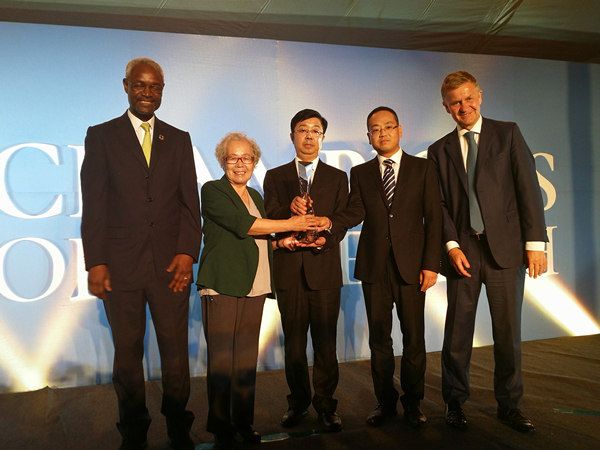
The closing ceremony of the Africa Tech Challenge in October. Three African students won the opportunity to study in China. Provided to China Daily |
|
A Chinese engineer gives training to two African students in the Africa Tech Challenge program. Provided to China Daily |
(China Daily Africa Weekly 01/16/2015 page6)
 Overhauling China's organ transplant system could take some time
Overhauling China's organ transplant system could take some time

Copyright 1995 - . All rights reserved. The content (including but not limited to text, photo, multimedia information, etc) published in this site belongs to China Daily Information Co (CDIC). Without written authorization from CDIC, such content shall not be republished or used in any form. Note: Browsers with 1024*768 or higher resolution are suggested for this site.
License for publishing multimedia online 0108263 Registration Number: 130349