Bright future for Africa


|
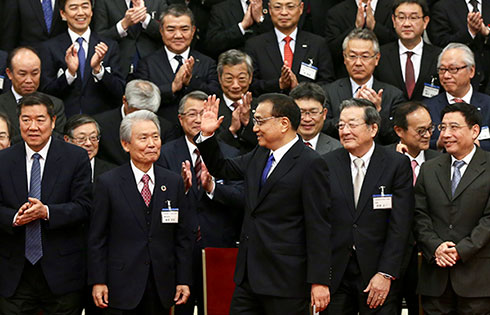
The 2nd Investing in Africa Forum opens in Guangzhou, Guangdong province, on Sept 7. More than 300 leaders and representatives from 38 African countries, including South African President Jacob Zuma, Chinese Vice-Premier Ma Kai, World Bank executives and academics, took part. Liang Xu / Xinhua |

China and World Bank unite in their commitment to helping continent thrive in years ahead
A somewhat rainy Guangzhou, a city with historic trading ties to Africa, was the venue for a major conference on investment in the emerging continent.
Leaders and representatives from 38 African countries, including South African President Jacob Zuma, Chinese Vice-Premier Ma Kai, World Bank executives and academics, descended on the city's White Swan Hotel for the 2nd Investing in Africa Forum.
The two-day meeting - as with the first forum in Addis Ababa, Ethiopia, last year - was seen by many as another key staging post in the evolution of China's relationship with Africa.
This was seen as the Washington Consensus, under which institutions such as the World Bank and the International Monetary Fund, had imposed their prescriptive recipe of encouraging more private sector development on the continent since the 1990s.
The forum - organized by the Guangdong government, China Development Bank and the World Bank Group - was a marker of the closer cooperation between China and the Washington international financial institution on African development issues.
Haleh Bridi, director of partnerships and external communications for the Africa Region at the World Bank, said at the conclusion of the forum that it was important now for China and the World Bank to work together.
"China is one of the biggest trading partners and one of the biggest investors in Africa, as well as a major aid provider. Similarly we, through our International Finance Corporation arm, are also a large investor, as well as a major aid provider and source of guidance to African countries. Given that, it is surely natural we would want to work together and organize a triangular partnership with African countries."
The forum, which will hold its next meeting in Dhaka, Senegal, next year, shared some of the agenda of the Forum on China Africa Cooperation (FOCAC), which held its second summit in Johannesburg in December.
It was there that Chinese President Xi Jinping announced a tripling of aid to the continent to $60 billion, which many saw as the world's second-largest economy reaffirming its commitment to the continent.
Liang Huijiang, director-general of the international finance department at China Development Bank, the China policy bank with a major role in Africa, says it is important to work with the World Bank in three key areas.
These are producing a joint development plan for upgrading the African economy, fostering industrialization and providing financial support and expertise.
The new cooperation will be combined with a doubling of the resources available to the CDB's China Africa Development Fund to $10 billion and increasing loans to African small and medium-sized enterprises from $1 billion to $6 billion.
"We are going to work closely with the World Bank to support the industrialization of Africa," he says.
Okechukwu Enelamah, Nigeria's minister of industry, trade and investment and a speaker at the forum, says he welcomes the cooperation of all parties in African development.
He believes China has played a crucial role on the continent, particularly over the past 15 years.
"What it has done has been more important than any other country. It has been very committed to working with us, particularly in the infrastructure space, and if you look at a lot of the high-profile infrastructure projects we are doing, quite a lot of them have Chinese content, if not entirely financed by Chinese partners."
Guang Zhe Chen, senior director of Water Global Practice at World Bank Group, also believes it is important for his institution and China to work together.
He says China's relationship with the continent has often been unfairly criticized, particularly in the Western media.
He believes this was particularly the case in relation to Chinese companies importing Chinese labor to work on infrastructure projects and being reluctant to recruit and train local Africans.
"I think this was a misconception. Chinese private enterprises and state-owned enterprises all operate on a commercial basis. If they could find skilled or semi-skilled workers in the local environment they would, since the local workers would be a seventh or an eighth the equivalent cost here," he says.
"Where Chinese enterprises have been working in Africa for a long time, like one state-owned enterprise I know which has been operating in Ethiopia for 25 years, they train local workers."
"Some of the media were exaggerating this. Yes, it was happening, but it is not for profit reasons. The Chinese companies were doing it simply out of necessity."
One of the key issues at the forum was what development model Africa should pursue.
Some have argued that it should skip the manufacturing stage and move directly from primary industries like agriculture and mining straight to services, which would suit its young and increasingly educated demographic.
This would be completely contrary to China becoming the workshop of the world in the 1990s after first reforming its agricultural base.
Vera Songwe, regional director for western and central Africa for International Finance Corp, the World Bank Group's investment arm, insists it has to develop both manufacturing and services.
"Africa is 1.1 billion people, and the idea you can put 1.1 billion people to work without mass manufacturing is not credible. I think right now people talk about services because that is what is happening faster. The service sector is a much larger part of GDP in most countries than manufacturing."
Enelamah, the Nigerian industry minister, believes that manufacturing is also vital.
"I think the argument we can go straight to services is flawed. Manufacturing is key because it provides jobs, brings in foreign exchange and is a way of copying and transferring knowledge. You don't have to be inventive, and a large part of our population does not have the high level of skills needed for services."
He says he argues this despite Nigeria being home to Nollywood, the third-largest film industry in the world after Hollywood and Bollywood.
"We supply movies to the whole of Africa and the black diaspora, and it's an example of why services are also important. Our service sector provided balance to the economy when we were hit by the commodity price recession."
One of the focuses of the forum was whether Africa could copy China's model of building industrial parks and enterprises like the Special Economic Zones along China's southern and eastern coasts that kickstarted development in the 1980s.
There is one major example of it being replicated in Africa: China's Eastern Industrial Park development just outside Addis Ababa, which is home to Huajian, the shoe manufacturer, one of the most successful examples of Chinese manufacturing on the continent.
Abdoulaye Magassouba, minister of mining in Guinea, believes this is easier said than done.
"It is not about copying, per se. It is about learning about what they have done and applying it to our circumstances. It is no good just setting up something and calling it an industrial zone. This will not bring success. You need a comprehensive approach to make sure the park has all the right infrastructure, not just power but the right management as well."
He believes there is no reason why Africa could not be a major manufacturing center within a matter of decades.
"Asia did it in about 30 or 40 years. There is no reason why Africa should not be able to do it. We have a lot of potential, with all this human capital, much of it young and dynamic, and all these natural resources as well."
The forum also focused on the role of vocational training in developing the skilled workforce necessary for manufacturing.
Richard Jabo, executive director of the Uganda Free Zones Authority, based in Kampala, believes it is vital.
"Vocational training is key to providing proper quality and sustainable jobs. You need skilled workers to transform society in the longer term," he says.
He argues that industrial parks also have a role to play in delivering vocational training.
"You are close to the manufacturing unit, and you can do it on-site and you have this advantage of being closer to industry," he says.
Chen at the World Bank dismisses those who argue that Africans do not have the same work ethic as Asians and cannot adapt easily to manufacturing jobs.
"The first 20 to 30 years of the industrialization process in Guangdong was about turning a lot of rural migrants into workers. Typically, they had just a primary school background and you had to give them skills," he says.
"We now have a problem with vocational training in China. With the one-child policy, people don't want their kid to be a blue-collar worker. So, as a result, China's economy is having to become more service-sector orientated."
Where both Chinese investment and the World Bank have been playing a major role in the continent has been in building infrastructure.
Africa has a huge deficit in all aspects of infrastructure, from power capacity, with some of the most expensive electricity in the world, to a lack of highways, with trade between neighboring countries and region sometimes almost impossible.
Many places remain in desperate need of modern ports, airports and basic facilities.
It is estimated by the World Bank that lack of infrastructure wipes up to 4 percent off the continent's GDP.
Tony Oteng-Gyasi, managing director of Tropical Cable and Conductor, based in Tema, Ghana, believes Africa can go nowhere without proper infrastructure.
"Infrastructure is critical. Without it there can be virtually no development," he says.
He believes the Chinese have been far more effective in delivering infrastructure projects than the World Bank and other institutions.
Sino Hydro built Bui Dam, a 400-megawatt hydroelectric project that began operating in 2013, and took just four years to do it.
"It was completed in record time with Chinese money. It had been on the drawing board since the 1950s, but the Chinese came here and within months the project was off the ground," he says
"The Chinese have a much faster decision-making process and I think that is a major difference (between them and the World Bank)."
"Their projects always come with finance and contractors, and fewer people are involved in the final decision as to whether a project goes ahead."
Joseph Onjala, senior research fellow at the University of Nairobi, agrees that the Chinese have had an impact on infrastructure, particularly on new roads easing congestion in the often gridlocked city where he is based.
"The problem is that a lot of it is grand and nice looking but when you go back five or 10 years later you find it not very well maintained," he says.
"Some the roads are not well designed, even those funded by the World Bank and other agencies. They are meant as bypasses, but eventually the traffic finds its way back into the city center."
A number of other initiatives were launched at the forum, including the Investing in Africa Think Tank Alliance aimed at fostering the intellectual resources of the CDB's Research Academy and the World Bank.
"Knowledge is a very important part of this partnership, taking it beyond just investment," adds Bridi from the World Bank.
"I hope it will underpin some of the investments with research, so hopefully making these investments better. We would also like to use the knowledge and experience of the Chinese academic think tank to strengthen the research of African universities in this area."
Jiang Haiyan, deputy secretary-general of the Guangdong government, said at the final news briefing that the forum provided the opportunity to link with the World Bank and coordinate with wider initiatives such as China's Belt and Road Initiative and the development agenda set by both FOCAC and the G20 summit in Hangzhou in September.
"A new consensus has been reached for cooperation. Through experience sharing and we must take advantage also of the momentum created by these other major initiatives," she says.
andrewmoody@chinadaily.com.cn