The five critical questions for 2025










Editor's note: It is expected that the global economy and geopolitical situation will face increasing complexity and uncertainties in 2025. How will the global economy develop in 2025? Five experts share their views on the issue with China Daily.
Can China's 'miracle economy' continue?
This year China has tried to promote growth with a huge boost in production and exports. This prompts us to recall Napoleon's words that when China wakes she will shake the world. Exports' growth has been so strong that Europe and the US have felt their own businesses are being threatened, and political forces in the United States have taken the opportunity to label China as a "strategic danger", with targeted sanctions and defensive industry policy to encourage domestic companies. There has been economic retaliation from China, and now all sides are worried about impending trade wars in 2025.
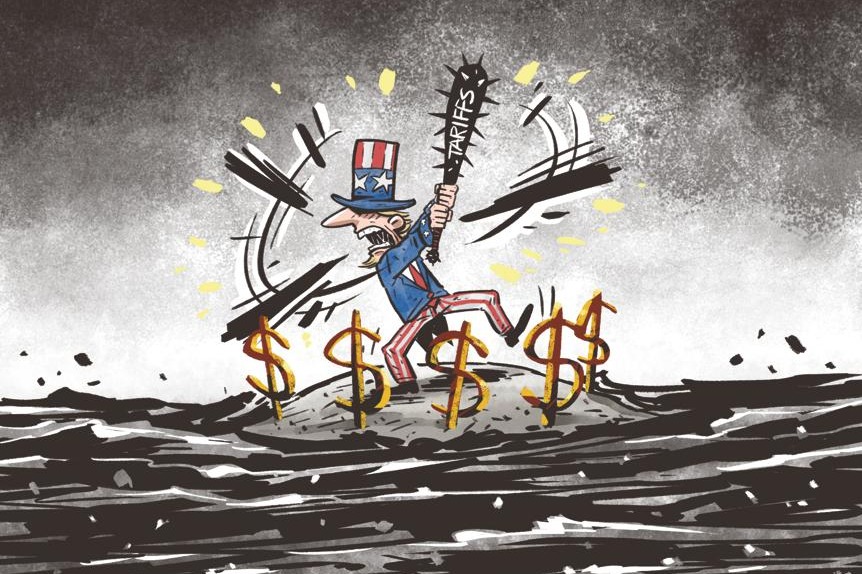
Students used to listen to professors and lecturers telling them how they could improve the world. But now the teaching curricula are moving from David Ricardo's "win-win" trade policies to US President-elect Donald Trump's "win-lose" approach. This includes defensive policies guarding against competitors and aggressive policies to actively damage them. From neo-mercantilism to the weaponization of money, it changes trade relationships and will be a theme for the coming year.
Therefore, China will continue its policies of moving production inland in 2025 to use cheaper domestic labor and establishing supply chains along the overland Belt and Road destinations. This will be closely watched by ASEAN member states which have been reassessing whether their interests are to keep supplying China, or to actively compete with it.
So far the Southern Hemisphere resource suppliers (Indonesia, Australia, New Zealand, Chile and Peru) have enjoyed strong commodity prices and cheap imports of green technology from China, but they are also watching China's policy anxiously.
One big question for Chinese economists in 2025 will be: if the world keeps moving to win-lose policies, should China respond or should it try to lead countries in reasserting open trade?
Another big question for 2025 is how to move to a new growth pathway. First year economics students will recall the famous equation of aggregate demand: Y= C+ I + G+ (X- M). In English, this means GDP is the total of domestic consumption plus business investment plus government expenditure plus the trade balance. In practice, however, economic growth is far more complex, but this simple equation serves to describe different development strategies.
Under China's "miracle economy" strategy, the economic driver was exports driven by strong investment, with government expenditure focused on infrastructure and policy focused on industry promotion. Western economies may all be unhappy in their own ways, but they do all demonstrate much higher consumption, and their government spending is more oriented toward social expenditure. This means they have more scope to use macroeconomic policies (fiscal, monetary and macro-financial policies) to promote stabilization, demand management and growth.
The Chinese government (most recently at the Central Economic Work Conference this month) has said it would like to move further on this path in 2025, and the financial markets agree, but it is proving difficult.
Despite Chinese consumers' famous digital retail habits, so far they have mainly invested in apartments. While savings remain strong, trade surpluses are still growing and unwanted deflationary pressures persist. The year 2025 will be a test: can the Chinese economy continue to move from old "miracle growth" to a modern consumer-led economy in these darker times? Expect more policy announcements!
Alan Bollard, the former director of Asia-Pacific Economic Cooperation, and chair of New Zealand Pacific Economic Cooperation Conference
Will there be another global trade war in 2025?
Flourishing trade relationships between countries are crucial to the international division of labor and welfare. With forthcoming political changes in the United States and Europe, the trade disputes between China, the US and the European Union may become a closely watched global issue.
But will this conflict culminate in another global trade war by 2025, potentially triggering a major economic crisis? Or can a balance between cooperation and confrontation be achieved?
Recent political shifts in the US and the EU, particularly in Italy, France and Germany, have rendered the "Western" world more conservative, nationalistic, and less focused on globalization. Political agendas are overshadowing economic logic. Consequently, China is frequently viewed as a trade powerhouse endangering economic well-being. Incoming US president Donald Trump has proposed significant tariffs on Chinese and EU imports to reduce US trade deficits with these economies.
The EU is urged to increase its oil and gas imports from the US. Regarding China, targeted industries encompass those vital to national security, such as semiconductors, rare earth minerals, and pharmaceuticals, with additional measures controlling sensitive technologies, including artificial intelligence and quantum computing.
The US revoking its "most favored nation" status for China could be a significant initial move.
Trade disputes between China and the EU are mainly focused on the electric vehicle sector, with Europe, particularly Germany, losing its dominance in the car industry. The EU accuses China of unfair trade practices, including company subsidies.
Latin America is another area of trade competition and dispute. The EU-Mercosur agreement, signed by European Commission president Ursula von der Leyen in early December, is a major trade agreement involving the EU and Mercosur countries (Argentina, Brazil, Paraguay and Uruguay). This treaty aims to reduce tariffs and trade barriers, anticipating welfare gains for both regions.
China has funded a new deep-water port in Chancay, Peru, under the Belt and Road Initiative. This port is expected to significantly boost trade between South America and Asia, while also facilitating trade into South America.
As for Trump, he has warned Panama that the Panama Canal, a crucial route for global sea freight, should not fall into the "wrong hands". Additionally, the US is displeased with the Mercosur agreement, as it intensifies competition with the EU.
Anticipating trade conflicts in 2025, China aims to boost domestic demand and industrial upgrading while avoiding structural reforms to mitigate new economic risks while the EU might counter US tariffs by diversifying energy sources, increasing tariffs on US goods and services (such as the Digital Service Tax on imported software services), and pursuing trade partners in regions such as Mercosur, Africa, and the "Indo-Pacific". EU countries need to swiftly ratify the Mercosur agreement, though internal criticism persists as Spain, Germany, and the Netherlands stand to benefit more than France and Belgium.
Investing in negotiations to minimize or avoid trade war damages is beneficial for global welfare. Respecting national cultures, strategies, and borders is essential to prevent political dominance and achieve these gains. Balancing security and economic policy objectives has grown increasingly important. Failing this, greater autonomy, diversified supply chains, and a focus on trading with allied nations would be the only alternative. With this common understanding, a global agreement among major trade players appears feasible.
Klaus F. Zimmermann, a professor at the Free University of Berlin and the president of the Global Labor Organization, a Germany-based worldwide network of researchers investigating the path of globalization
Can cross-Strait ties ease?
As 2024 comes to a close, the Taiwan Strait remains a focal point in geopolitics, with tensions remaining high. The year unfolded as expected, marked by intensified confrontation and strained cross-Strait exchanges. The factors that contributed to the existing situation include a slowing global economy, sluggish cross-Strait economic growth, the restrictive and provocative policies of Taiwan's Democratic Progressive Party toward the Chinese mainland, and Washington's desperate attempts to contain Beijing's rise.
Despite these challenges, the mainland has maintained a firm grip on cross-Strait dynamics, leveraging its robust economy, huge market size and commitment to peaceful reunification.
The mainland has been exploring new pathways for cross-Strait integration, implementing equal treatment policies and establishing cooperation pilot zones. Many Taiwan residents have started realizing the risks of the DPP's provocative actions and the opportunities available on the mainland. The rising number of Taiwan residents applying to settle in the mainland reflects this shift, highlighting growing public dissatisfaction with the DPP's policies.
Looking ahead, the cross-Strait situation in 2025 is likely to be increasingly complex. Under the leadership of "Taiwan independence" advocate Lai Ching-te, the DPP is expected to continue pushing its agenda, bolstered by external anti-Beijing forces. And the US new administration may continue to use Taiwan as a strategic pawn. This interplay of internal and external forces could further raise cross-Strait tensions and complicate Sino-US relations.
The cross-Strait situation is one of structural contradictions. The DPP's refusal to accept the 1992 Consensus that there is only one China, combined with its "Taiwan independence" agenda, reflects the island's changing sociopolitical landscape. Polls show that while most Taiwan residents favor maintaining the status quo, a significant percentage thinks otherwise. This ideological shift has deepened cross-Strait divisions, prompting the DPP to adopt an adversarial stance toward Beijing.
On the other hand, the US is likely to continue playing the "Taiwan card" to contain Beijing's rise. While reaffirming that it adheres to the one-China principle, Washington has been trying to normalize interactions with Taiwan through legislation and unofficial exchanges. Moves such as the deployment of US troops in Taiwan, hosting joint meetings, and pushing for "dual recognition" will all be regarded as blatant provocations to test Beijing's redline.
However, the US is expected to balance its actions, avoiding steps that could lead to a direct conflict or risks of severance of ties with China.
The "Taiwan independence" agenda faces significant limitations. The island's defense capabilities remain weak, and Taiwan residents are generally opposed to war. Additionally, the US is unlikely to militarily intervene in the Taiwan question, preferring to maintain strategic ambiguity. This constraint, combined with Beijing's firm stance and growing global clout, will prevent Taiwan leaders from crossing the redline defined by the mainland's Anti-Secession Law.
In short, the Taiwan Strait will remain a place of competing interests. The DPP and external anti-Beijing forces will intensify their collaboration with "Taiwan independence" forces, undermining peace and stability. But Beijing's increasing national strength and measured approach will ensure that risks remain manageable, while the fundamental reality of cross-Strait dynamics — that Taiwan cannot achieve "independence" — will continue to hold true.
The stakes are high, but with strategic patience and firm resolve, Beijing will successfully navigate this turbulent period while maintaining its long-term goal of peaceful reunification.
Tang Yonghong, a professor at the Taiwan Research Center, Xiamen University
Will the Russia-Ukraine conflict end?
The Russia-Ukraine conflict will enter the fourth year in less than two months and yet there are no signs of the hostilities ending, or the strategy of the United States, as the biggest supporter of Ukraine, changing the outcome of the conflict.
Donald Trump, who is set to return to the White House on Jan 20, said on the campaign trail that, if elected, he could end the conflict "in 24 hours". Recently, he even said that Ukraine will "possibly" receive less military aid once he takes office.
No matter what Trump's future plan regarding the conflict is, it is impossible for Russia and Ukraine, two countries with completely opposite political positions, to reach a compromise easily. The conflict could go any of the following ways.
First, Russia could gain an overwhelming advantage over Ukraine if it receives external support. Yet Russia does not have enough power to achieve its strategic goals on the battlefield based on the current situation.
Second, the US may continue to support Ukraine. But at present, Trump and his team seem unlikely to adopt such a policy.
Third, Russia and Ukraine could be forced to declare a cease-fire under pressure from the US. However, a Korean War-like armistice seems unlikely to be declared in the Russia-Ukraine conflict. And the conflict could still escalate in the long run, endangering the security of the whole of Europe.
And fourth, when the US reduces or stops its aid to Ukraine, European countries may step forward and increase their material support to Ukraine. In such a scenario, the Russia-Ukraine conflict could see a long period of stalemate and war of attrition. But in the end, a seriously "de-industrialized" Russia, may be unable to break the resilience of Ukraine, whose military production is on the right track.
History shows that peace can be long lasting only when it is based on fairness.
Feng Yujun, a professor of Department of History at Peking University
Will the chaos intensify in the Middle East?
The Middle East is caught in a spiral of violence and geopolitical games. The Israel-Palestine conflict intensified after Hamas launched the "Al-Aqsa Flood" operation against Israel on Oct 7, 2023, triggering a chain reaction in the Middle East in 2024, including the sudden regime change in Syria.
As such, the Middle East is likely to remain volatile thanks to the international community's ineffectiveness in mediating peace, the intense power game in the region, and the armed conflict in Syria.
While Hamas and Israel are playing the blame game over the delay in declaring truce in Gaza, a ceasefire agreement between Israel and Hezbollah hangs in the balance. Also, Israel captured Syria's Golan Heights after Bashar al-Assad's government fell, and the temporary ceasefire in the Palestine-Israel conflict is on the verge of a breakdown. On the other hand, Yemen is caught in a civil war, and the unrest in Iraq continues.
All this suggests the Middle East may see more frequent armed conflicts in 2025, characterized by multiple forces' interventions in the region.
In fact, the great power games, including global and regional power rivalries, will emerge from behind the scenes to occupy center stage. The United States, Russia and European Union are engaged in the major global power games either directly or through proxy warfare.
But since US President-elect Donald Trump has vowed to stop the Russia-Ukraine conflict, the US' presence in the Middle East, including more direct "face-to-face" engagement with different parties, will intensify.
Regional powers such as Israel and Turkiye will continue to increase their gains in the Middle East hot wars, with the drastic change in Syria giving Turkiye a chance to expand its influence in the region and challenge Iran. In fact, Syria may become a hot spot in the Middle East, while the development gap among Middle East countries will continue to widen.
In the further polarization of Middle East development, one group of countries advocate for economic diversification, reducing dependence on oil and implementing reforms.
Gulf states led by Saudi Arabia and North African countries represented by Morocco are likely to harvest the fruits of development through deepening reform, probably in new energy, tourism and financial services.
The other group comprises countries that are severely affected by war and side effects of the great power game, such as Libya, Syria and Iraq. But if Syria is caught in a civil war, the chances of extremist forces reemerging will increase.
Besides, there is a great risk of spillover effects from the Iran nuclear issue. Dealing with the Middle East problems is extremely difficult because of religious and ethnic complexities, economic and social issues, and intensive great power games.
While the peace prospects in the Middle East appear dim, the international community, including China, is committed to promoting peace in the Middle East through diplomatic means in 2025. So people worldwide should remain hopeful and make efforts to promote peace.
Hou Yuxiang, a professor at the School of Middle Eastern Studies, Beijing International Studies University
The views don't necessarily represent those of China Daily.
If you have a specific expertise, or would like to share your thought about our stories, then send us your writings at opinion@chinadaily.com.cn, and comment@chinadaily.com.cn.