Rare earths may bridge divide
Valuable minerals could bring pragmatic solution to US-China trade discussions









China's advances across the rare earths value chain are drawing fresh attention as experts suggest that the critical minerals could serve as a potential bridge for the United States and China to engage in pragmatic trade negotiations.
Rare earth elements, a group of 17 critical metals, are crucial for modern technologies spanning from energy to defense, such as electric vehicles, drones, wind turbines and even data centers.
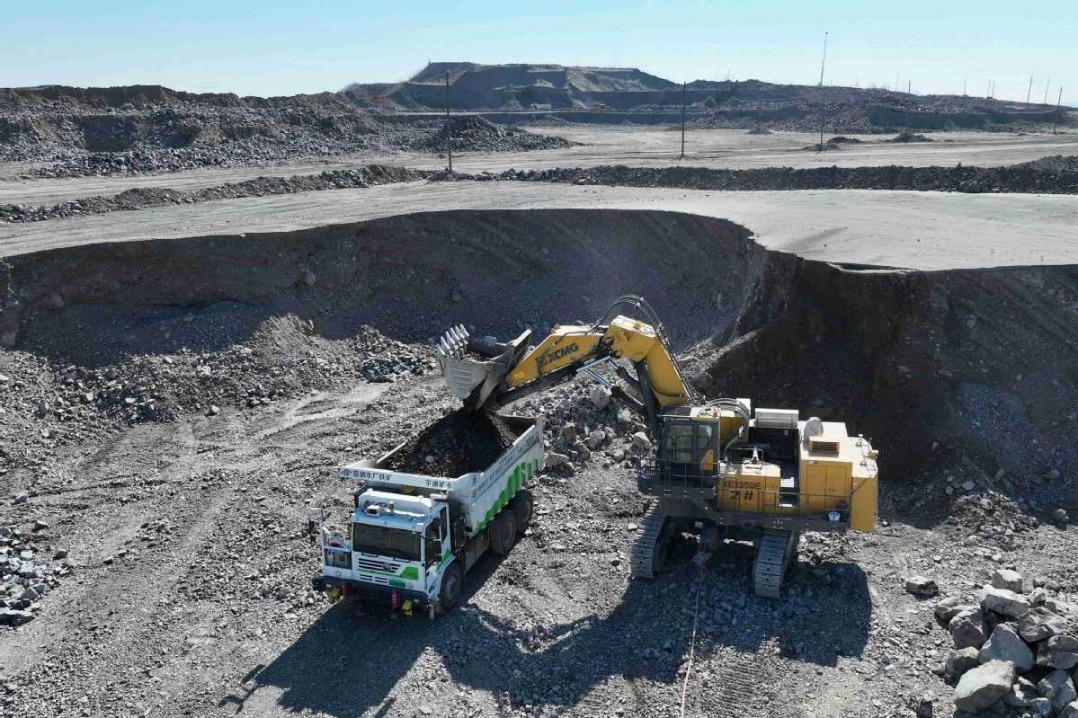
China now controls over half of global mining production and 90 percent of separation and refining capacity, a position built through decades of strategy, scientific expertise and unique geological endowments that has made the country's role in the global supply chain indispensable.
Global trade across industries that rely in part on rare earths exceeded $13 trillion in 2022. Electric vehicles alone — each typically containing a kilogram or more of rare earth minerals — generated $425 billion in global sales that year, according to a June report by the Atlantic Council.
The global economy will increasingly depend on these critical minerals. The International Energy Agency expects demand for rare earths to grow from three to seven times by 2040 as countries pursue net-zero goals.
China has leveraged its market dominance to limit US access to these critical minerals and some rare earth magnets in response to US export controls on semiconductors.
China's recent licensing steps "really got the attention of the White House", Paul Triolo, honorary senior fellow on technology at Asia Society Policy Institute, said at a webinar, citing a temporary shutdown at a Ford EV plant.
Rare earths represent "a bigger problem than just mining rare earths," said Triolo. "Some commentators treat this as an easy issue to solve, saying rare earths aren't really that rare … What's rare is an end-to-end ecosystem that's been developed over decades and that also acts to prevent competitors from jumping in."
While deposits are widely found, rare earths exist in low concentrations relative to other elements, making their extraction and separation challenging and costly.
China is the single largest holder of proven reserves, accounting for 36.7 percent of global reserves, followed by Vietnam at 18.3 percent and Brazil at 17.5 percent, according to the Atlantic Council report.
China's leadership prioritized rare earths as a strategic industry starting in the 1980s, surpassing the US as the largest producer in the 1990s, and building end-to-end capabilities from mining and separation to refining and finished products.
For neodymium-iron-boron permanent magnets, essential for EV motors and wind turbines, China accounts for 58 percent of mine production, 89 percent of separation capacity, 90 percent of refining capacity and 92 percent of magnet output.
Separating and refining each rare earth element requires unique processes, an area in which China has the greatest experience and human capital and has developed the leading technologies, according to the report.
From 1950 to 2018, China filed over 25,000 rare earth patents, surpassing the US's 10,000. Over decades, Chinese engineers perfected the solvent extraction process to refine the rare earth elements that play a critical role in ensuring China's primacy, according to New Security Beat.
China has more than 120,000 skilled personnel working on rare earths and over 30 specialized university programs that graduate about 2,000 engineers annually, according to Triolo. In contrast, the United States has only a few hundred specialists and limited academic pipelines.
The landscape for new rare earth projects is "notably sparse" in the US, according to GlobalData, with just a few projects in active development and facing considerable hurdles.
"Even though we mine those heavy rare earths here in the United States, we have zero capability online right now to separate them here. So, until early this year, even the heavy rare earths that we mined here, we sent to China for separation," Gracelin Baskaran, director of the Critical Minerals Security Program at CSIS, told Yahoo Finance.
The United States is rushing to invest millions — if not billions — in a bid to secure self-reliance in rare earth minerals, but experts caution that such independence will not be easily achieved anytime soon.
Until 1990, the US was the world's top producer. But over decades, mining and refining shifted overseas as companies sought cheaper labor and bigger profits.
Hurrying to redevelop its own rare earth supply chain, the US recently made a few big moves.
Last month, the Department of Defense said it was investing $400 million for a 15 percent stake in MP Materials — the country's sole rare earth miner — to construct a new magnet manufacturing facility. The department will also provide a $150 million loan to help the company's processing capability.
To protect MP Materials from market fluctuations, Washington guaranteed a minimum price of $110 per kilogram for neodymium-praseodymium oxide for 10 years — roughly double the market rate at the time of the announcement.
A few other firms jumped in and announced potential partnerships or mining projects. For example, USA Rare Earth said earlier this year that it had raised $75 million via a private investment in public equity to fund a magnet plant. In addition, the US government proposed to spend close to $1 billion more in the sector.
Another company, American Rare Earths, has discovered promising mining in the state of Wyoming and wants to quickly set up production. The government has indicated it intends to invest $500 million in the company to accelerate production.
However, American Rare Earth's stock did not move upward and stayed under $1 after the news broke. Private investors are on the sidelines when it comes to investing in rare earth minerals.
Relying on US government policy to develop a rare earth industry is risky, experts warn, because historically, it has not been consistent in industrial support.
The most recent example is President Donald Trump's rollback of his predecessor Joe Biden's Inflation Reduction Act, which had offered incentives for green energy development. The promised support has not lasted four years, leading to potential cancellation of many planned or present projects.
With the polarized political reality, not many companies dare to trust policies that might be overturned after just four years. Yet mining is a capital-intensive, high-tech industry that requires at least a decade of planning, coordination and construction to see results.
"Jumping headfirst into the mining business comes with risks inherent to sometimes speculative projects," said an analysis in The Wall Street Journal. "An Idaho cobalt mine three decades in the making has been mothballed for years despite tens of millions in government support."
Critics also question whether a government injection of capital and a guaranteed price for a limited time could distort the market and undermine the long-term viability of the industry in a competitive global market.
Rebuilding a rare earth ecosystem in the United States will require decades of investment, workforce development, permit reform and sustained political commitment, said Triolo.
Industry insiders point to Japan's experience. Despite 15 years of effort to develop domestic production, the country still imports about 75 percent of its demand from China.
Take magnets as an example. An AI-assisted analysis shows that, if things go smoothly — continued government funding, faster permissions and projects proceeding on schedule — the US could meet 25 to 35 percent of its magnet demand by 2028, with costs to be 20 to 35 percent higher than China.
If problems occur, US magnet capacity would meet only 5 to 12 percent of domestic demand, at costs 40 to 60 percent higher than China.
In the foreseeable future, the US needs rare earths from China.
While China's rare earth licensing measure mirrors US tech export bans, it only serves to illustrate the reality that both sides remain deeply entangled in global supply chains that neither can sever without huge costs, said Triolo.
"If it (negotiation) doesn't work for the Chinese, we're still going to see rare earths, and potentially other minerals, be restricted," said CSIS's Baskaran.
In the meantime, Pascale Massot, honorary fellow at the Center for China Analysis of the Asia Society Policy Institute, viewed rare earths as an incentive for more dialogue, suggesting that the interdependence in rare earths and semiconductors could open up space for serious discussion.